The Planck Units: What They Actually Mark, and What They Don't
August 2026
Original post: @LensScientific on X, 2026-08-03. If the embed above doesn’t load, the same chart is below.
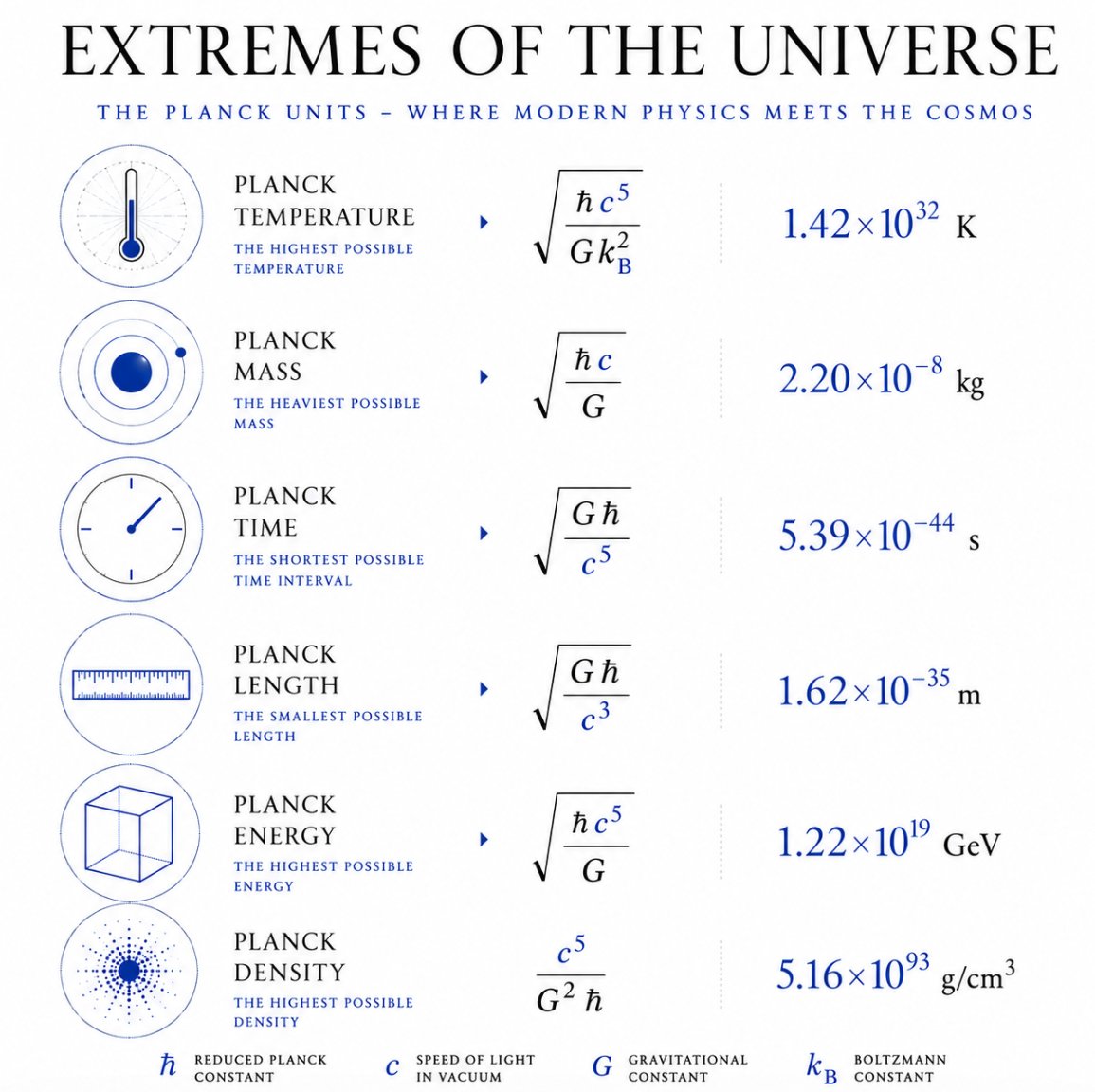
What this is showing
The Planck units are what you get when you build a system of units out of nothing but fundamental constants — the reduced Planck constant $\hbar$, the speed of light $c$, the gravitational constant $G$, and the Boltzmann constant $k_B$ — and demand that each combination come out with the dimensions of a length, a time, a mass, and so on. Given that set of constants, there is exactly one combination for each quantity (up to a dimensionless factor of order one): no human choice of ruler or clock enters the formulas themselves, only the choice of which constants to build from.
| Quantity | Formula | Value |
|---|---|---|
| Planck length | $\sqrt{G\hbar/c^3}$ | $1.616 \times 10^{-35}$ m |
| Planck time | $\sqrt{G\hbar/c^5}$ | $5.39 \times 10^{-44}$ s |
| Planck mass | $\sqrt{\hbar c/G}$ | $2.176 \times 10^{-8}$ kg |
| Planck energy | $\sqrt{\hbar c^5/G}$ | $1.22 \times 10^{19}$ GeV |
| Planck temperature | $\sqrt{\hbar c^5/(G k_B^2)}$ | $1.417 \times 10^{32}$ K |
| Planck density | $c^5/(G^2\hbar)$ | $5.155 \times 10^{93}$ g/cm³ |
Every formula in the chart is correct, and five of the six values match the accepted numbers to the digits shown. (The chart gives the Planck mass as $2.20 \times 10^{-8}$ kg; the accepted value is $2.176 \times 10^{-8}$ kg, so the third digit is off — a rounding slip, not a conceptual one.)
The part worth getting right
The chart labels these as “the highest possible temperature,” “the heaviest possible mass,” “the smallest possible length,” and so on. That framing is extremely common in popular science writing, and it is not what the Planck units actually are.
The clearest way to see this is the Planck mass. At $2.176 \times 10^{-8}$ kg it works out to about 22 micrograms — very roughly the mass of a flea’s egg, or on the order of a fifth of a grain of sand (both vary enough in real life that this is a scale comparison, not a precise one). It is obviously not the heaviest possible mass in nature; anything you can see is heavier. Its actual significance is narrower and more specific: it is the mass at which a pointlike elementary particle’s Compton wavelength and Schwarzschild radius become comparable (equal up to a factor of order one), which is why it functions as an upper bound for elementary particles specifically, not for mass in general. The same distinction holds for the Planck temperature — a semiclassical black hole’s Hawking temperature climbs toward $T_P$ as its mass falls toward $m_P$, a real ceiling for that specific physical picture, not for temperature everywhere.
The same correction applies to the Planck length. It is not a known minimum length; it is the scale at which general relativity and quantum field theory stop being jointly reliable, because the gravitational effect of a quantum fluctuation becomes comparable to the fluctuation itself. That much is solid theoretical ground. Whether nature also enforces an actual hard minimum length there is a separate, stronger claim. Neither GR nor QFT alone contains a minimum-length postulate — they become jointly unreliable at $\ell_P$, which is a different statement from forbidding shorter distances. Separate operational arguments that combine GR with the quantum uncertainty principle (measuring a short enough distance deposits enough energy in a small enough region to form a black hole) do suggest sub-Planckian distances may be unmeasurable in principle, and several quantum-gravity programs (string theory, loop quantum gravity, holographic bounds) build in something like a floor near this scale. None of it is experimentally confirmed.
The post’s own caption gets this right, incidentally, and is more careful than the chart it accompanies: it describes the Planck units as “revealing the scales where space, time, energy, and gravity are expected to behave in ways our current theories cannot fully describe.” That is the accurate reading. The chart’s own subtitles overreach past it.
Catalog status: Proven Systems
The Planck units themselves are simple dimensional analysis — the formulas are definitions, not a physical hypothesis, and not something that could turn out to be wrong. The numerical values are only as good as the constants they’re built from — since the 2019 SI redefinition, $\hbar$, $c$, and $k_B$ are exact by definition, and $G$ is the only one of the four that’s actually measured, with a relative uncertainty around $2\times10^{-5}$. What is unconfirmed is the physical interpretation layered on top, covered above. The Planck length is roughly fifteen orders of magnitude below what the Large Hadron Collider can probe ($1.22\times10^{19}$ GeV vs. a ~13.6 TeV collision energy).
Where this touches PBT
Directly, and in a way worth being plain about. Paper 14 works out an equilibrium radius for a solar-mass body under Pressure-Based Theory’s own collapse mechanism, against a stated target of about $10^{-35}$ m — the Planck length itself, taken as the scale a collapsed body should reach. The computed result came out between $9.2 \times 10^{31}$ m and $8.5 \times 10^{88}$ m depending on the exponent chosen, missing the target by 67 to 124 orders of magnitude. That failure is already documented on this site and is not softened here.
Worth being precise about what that target actually is. A solar mass compressed to Planck density (the row above) would have a radius on the order of $10^{-22}$ to $10^{-23}$ m, verified directly from the table’s own density value — many orders of magnitude larger than the Planck length. “Collapse to the Planck length as a radius” is a stronger, different claim than “collapse to Planck density,” and Paper 14’s stated target is the former.
The chart above is a useful reminder of why that target was chosen in the first place, and also of why choosing it needs an argument rather than an assumption. If the Planck length is not a floor that nature enforces, then “collapse proceeds to the Planck length” is not a default any theory gets for free — it is a claim that has to be derived from the theory’s own mechanism. Paper 14’s arithmetic says PBT’s mechanism does not produce it.