Four Ways Atomic Spins Can Order Themselves
July 2026
Original post: @mathemetica on X, 2026-07-19. If the embed above doesn’t load, the same image and description are below.
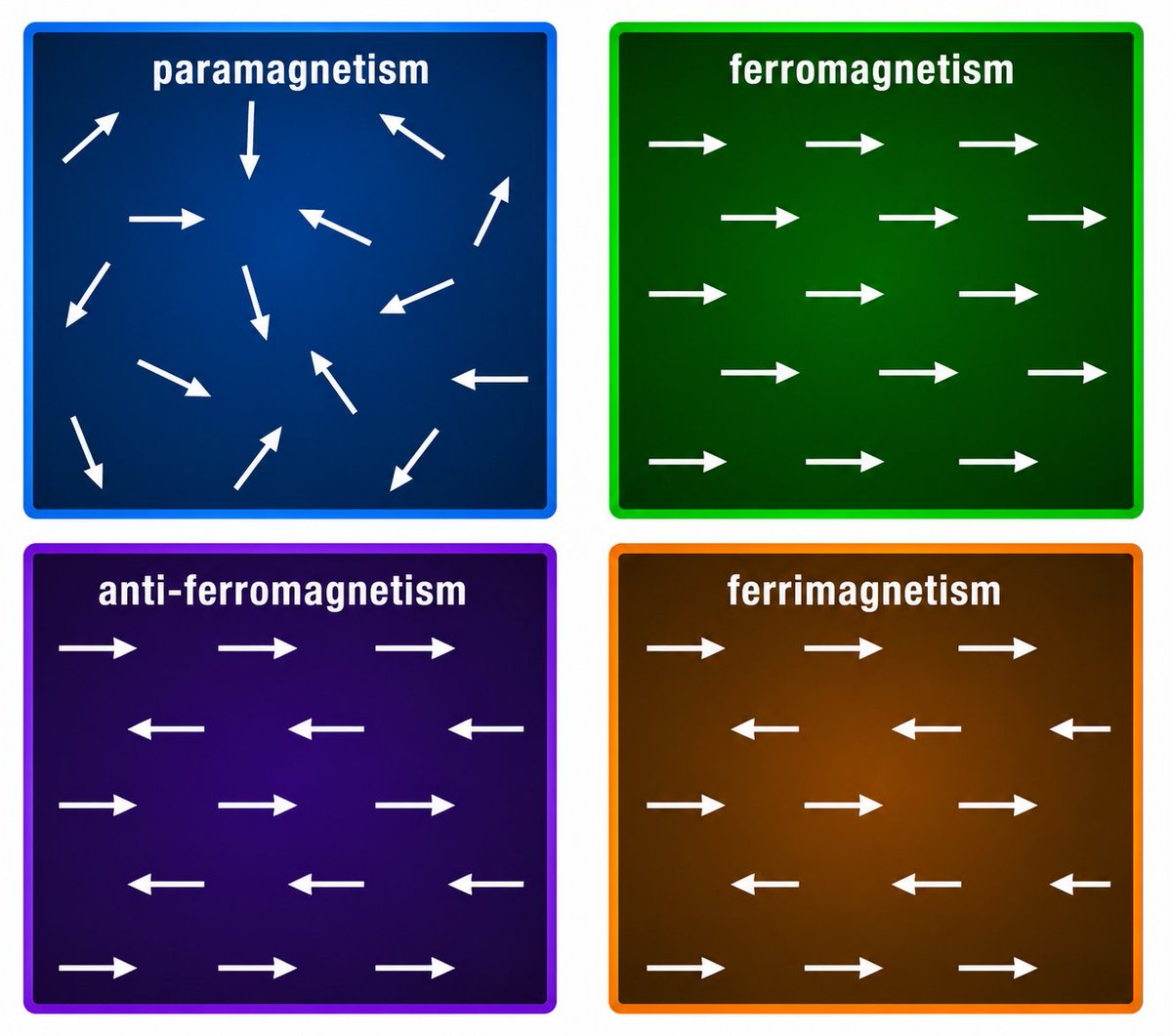
What this is showing
Every atom with unpaired electrons carries a tiny magnetic moment (a “spin”), and how those countless individual moments arrange themselves relative to each other determines a material’s bulk magnetic behavior:
- Paramagnetism: individual spins point in random directions with no coordination — the material has no net magnetization on its own, though an external field can weakly, temporarily align them.
- Ferromagnetism: neighboring spins align parallel to each other spontaneously, even with no external field — this is the strong, permanent magnetism of iron, nickel, and cobalt.
- Anti-ferromagnetism: neighboring spins align in alternating opposite directions, canceling out almost perfectly — the material has essentially zero net magnetization despite very strong local ordering.
- Ferrimagnetism: neighboring spins alternate like anti-ferromagnetism, but the opposing moments are unequal in strength, so they don’t fully cancel — the material ends up net-magnetized, like a ferromagnet, but through a different underlying mechanism (this is how naturally magnetic lodestone, magnetite, actually works).
The real physics behind it
This ordering arises from exchange interaction — a genuinely quantum-mechanical effect (rooted in the Pauli exclusion principle acting on overlapping electron wavefunctions) that energetically favors either parallel or antiparallel neighboring spins, depending on the material’s specific electron structure. Above a material-specific critical temperature (the Curie temperature for ferromagnets, the Néel temperature for antiferromagnets), thermal agitation overwhelms the exchange interaction and the ordering breaks down into paramagnetism — which is why a magnet loses its magnetism if heated enough.
Catalog status: Proven Systems
These four magnetic ordering types are standard, extensively confirmed solid-state physics — directly measurable via neutron diffraction (which is sensitive to spin orientation, unlike X-ray diffraction) and bulk magnetic susceptibility measurements.
Where this touches PBT
This site already covers magnetism and ferromagnetic decay mechanically in Why Some Magnets Last and Others Don’t and PBT’s general magnetism claims in the Magnetism topic page (flux distortion in the aether medium, per Paper 3). Those pieces focus on ferromagnetic domain behavior and decay specifically; this diagram’s broader four-way classification (including anti-ferro and ferrimagnetism) is included here as standard reference context, not yet mapped onto PBT’s own mechanism in that level of detail.