The Lorentz Force: Why the Force Arrow Comes Out of the Page
August 2026
Original post: @oprydai on X, 2026-08-02. If the embed above doesn’t load, the same chart is below.
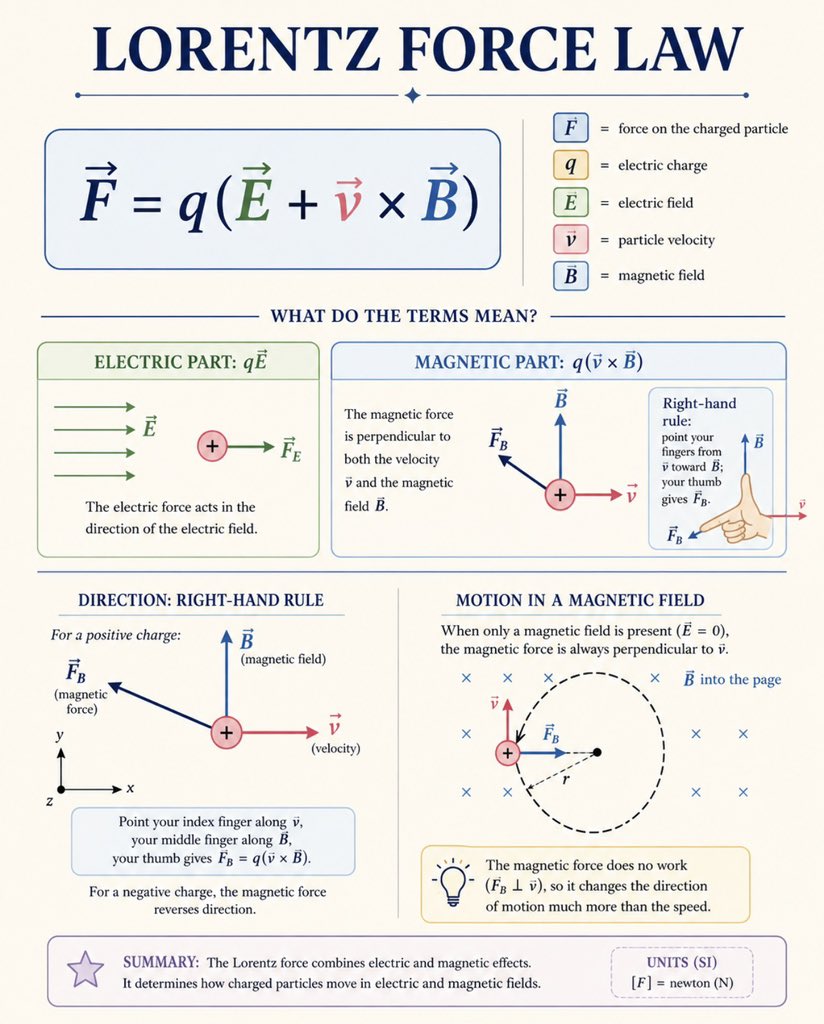
What this is showing
The Lorentz force law is the standard statement of how an electromagnetic field pushes on a charge:
$$\mathbf{F} = q(\mathbf{E} + \mathbf{v} \times \mathbf{B})$$
It has two terms doing genuinely different jobs. The electric term $q\mathbf{E}$ is the intuitive one — the force points along the field, and a positive charge is pushed the way the field arrows point. The magnetic term $q(\mathbf{v} \times \mathbf{B})$ behaves nothing like that. It depends on the charge’s velocity, and it points perpendicular to both the velocity and the field at once.
That perpendicularity has a consequence the chart states correctly: the magnetic force does no work. Because $\mathbf{F}_B$ is always at right angles to $\mathbf{v}$, the dot product $\mathbf{F}_B \cdot \mathbf{v}$ is zero, so a magnetic field cannot change a particle’s speed at all — only its direction. This is why a charged particle moving perpendicular to a uniform magnetic field travels in a circle at constant speed rather than changing speed as it curves — the motion is still accelerating (a circle always is), just never in a way that speeds up or slows down the particle. (The chart phrases this as changing direction “much more than the speed,” which understates it: the change in speed is exactly zero, not merely small.) A velocity component parallel to $\mathbf{B}$ is unaffected by the magnetic force at all, which turns the circle into a helix — the chart’s picture assumes the perpendicular case.
The site’s Lorentz Force Law entry covers the equation’s status and its experimental footing. This entry is about the part that is hardest to draw, and that the chart above gets wrong.
The part the diagrams get backwards
A cross product does not point anywhere in the plane of the two vectors you started with. It points perpendicular to that plane — out of the page or into it. The chart’s own right-hand-rule panel draws it as an in-plane arrow instead, which is a common way this rule gets mis-drawn.
Both panels below label the charge positive explicitly — “For a positive charge” on the right-hand-rule panel, a “+” on the particle in both — so the sign isn’t a reading of intent, it’s printed on the chart.
Take the chart’s own right-hand-rule panel. It sets up axes with $x$ to the right, $y$ up, and $z$ out of the page — drawn, by the panel’s own convention, as a diagonal pointing down and to the left of the origin, visible in its small axis key. It then draws the velocity $\mathbf{v}$ along $+x$ and the magnetic field $\mathbf{B}$ along $+y$. Working the cross product:
$$\hat{x} \times \hat{y} = \hat{z}$$
So the force on a positive charge points straight out of the page, toward the reader — which, by the chart’s own drawing convention, should appear as a diagonal down-and-left, matching its $z$-axis key. The printed $\mathbf{F}_B$ arrow instead points up and to the left: a different diagonal from the chart’s own out-of-page direction, not a stylized version of it. That rules out reading the arrow as an awkward-but-correct 3D sketch — it’s a distinct, in-plane direction. It also fails a second way: it has a component along $+y$, and the force is required to be perpendicular to $\mathbf{B}$, which is along $+y$.
The circular-motion panel has a different kind of error, not the same one. There, $\mathbf{B}$ is genuinely into the page (drawn as $\times$ symbols) and $\mathbf{v}$ points up, so the force is correctly drawn in the plane — the panel gets the plane right and the side wrong. With $\mathbf{v} = +\hat{y}$ and $\mathbf{B} = -\hat{z}$:
$$\hat{y} \times (-\hat{z}) = -\hat{x}$$
The force on a positive charge points to the left, so the centre of the orbit is to the left and the particle circles counter-clockwise. The chart draws the force and the orbit’s centre to the right, turning the particle clockwise — the mirror image of the correct sense.
What is worth noticing is that the chart’s equation, its summary sentence, and its right-hand-rule finger instructions — index along $\mathbf{v}$, middle along $\mathbf{B}$, thumb gives $\mathbf{F}_B$ — are all stated exactly right. Follow those instructions literally with your own hand and your thumb comes out of the page, disagreeing with the arrow printed beside them. The two drawn errors are different in kind: the right-hand-rule panel puts the force in the wrong plane entirely; the circular-motion panel gets the plane right and flips the side within it.
The quick self-check: if a diagram shows you $\mathbf{v}$ and $\mathbf{B}$ both lying in the page and not parallel to each other, the magnetic force must be drawn as a dot (out of the page) or a cross (into it). Any in-plane force arrow is a mistake in that case. (Two edge cases aside: if $\mathbf{v}$ and $\mathbf{B}$ point the same or opposite ways there’s no force at all, and if either vector itself has a component out of the page the force can legitimately have an in-plane part.)
Catalog status: Proven Systems
The Lorentz force law is about as well-confirmed as physics gets — it is the operating principle behind mass spectrometers, particle accelerators, cyclotrons, cathode-ray tubes, and electric motors, each of which is built and tuned around this specific direction rule. Nothing here questions the physics; the correction is to one popular illustration of it.
Where this touches PBT
Pressure-Based Theory proposes a mechanical account of what a magnetic field is, but it does not propose a change to this force law — Paper 3 reuses the standard equation unmodified. That matters for how PBT should be judged: any mechanical picture of magnetism has to reproduce a force that is perpendicular to both the velocity and the field, and that does no work. Those are necessary constraints a mechanism should be expected to reproduce, at minimum, in whatever limit recovers ordinary electromagnetism — not a claim that satisfying them alone proves a mechanism correct.