Hydrogen Orbital Probability Density
July 2026
Original post: @cosmosarcive on X, 2026-07-22. If the embed above doesn’t load, the same image and description are below.
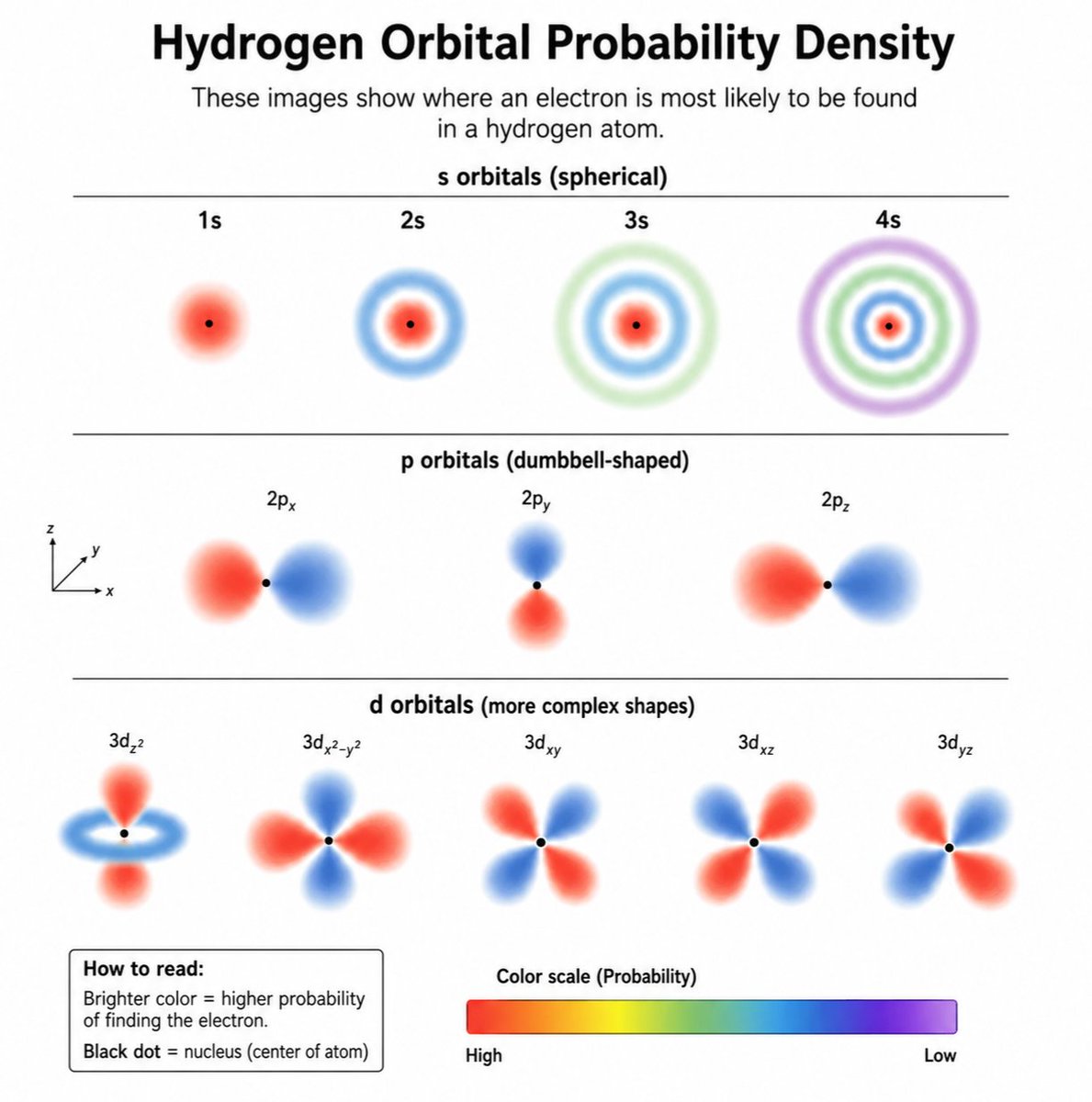
What this is showing
This diagram shows the actual computed shapes of a hydrogen atom’s electron orbitals — the regions of space where an electron is likely to be found, grouped by type:
- s orbitals (1s, 2s, 3s, 4s): spherically symmetric, with successive shells adding concentric layers of high/low probability.
- p orbitals (2p$_x$, 2p$_y$, 2p$_z$): dumbbell-shaped, oriented along each axis, each with a node (zero probability) at the nucleus.
- d orbitals (3d${z^2}$, 3d${x^2-y^2}$, 3d${xy}$, 3d${xz}$, 3d$_{yz}$): more complex, multi-lobed shapes.
The color scale (red = high probability, purple = low) represents $|\psi|^2$, the squared magnitude of the electron’s wavefunction — the direct physical meaning the Schrödinger equation assigns to $\psi$ under the Born rule.
The real physics behind it
These shapes aren’t artistic renderings or approximations — they’re exact analytic solutions to the Schrödinger equation for a hydrogen atom (one proton, one electron), first worked out in the 1920s. Each orbital is labeled by three quantum numbers: principal ($n$: 1, 2, 3…), azimuthal ($l$: s, p, d, f…), and magnetic ($m$), which together determine the orbital’s size, shape, and orientation. This is one of the few problems in quantum mechanics solvable exactly in closed form, which is part of why the hydrogen atom is the starting point for every introductory quantum mechanics course — everything about multi-electron atoms, chemical bonding, and the periodic table itself builds outward from these same solutions.
Catalog status: Proven Systems
Hydrogen’s orbital solutions aren’t a hypothesis under test — they’re an exactly solvable result of standard quantum mechanics, confirmed to extraordinary precision by spectroscopy (the orbital energies directly predict the hydrogen emission spectrum, verified to many decimal places) for a full century.
Where this touches PBT
Pressure-Based Theory doesn’t currently offer its own derivation of atomic orbital shapes — this diagram is standard quantum mechanics, used here exactly as mainstream physics defines it. PBT’s own account of quantum effects (vorticity in the aether medium, per Paper 6) hasn’t been shown to reproduce this specific, exactly-solved result, so no connection is claimed here.