Hamiltonian Flows: Why Some Streamlines Preserve Area and Others Don't
September 2026
Original post: @matharium on X, 2026-09-27. If the embed above doesn’t load (it’s a video), one of the four worked fields, F(x,y) = (y², −x²), is captured in the still frame below and described in full below that.
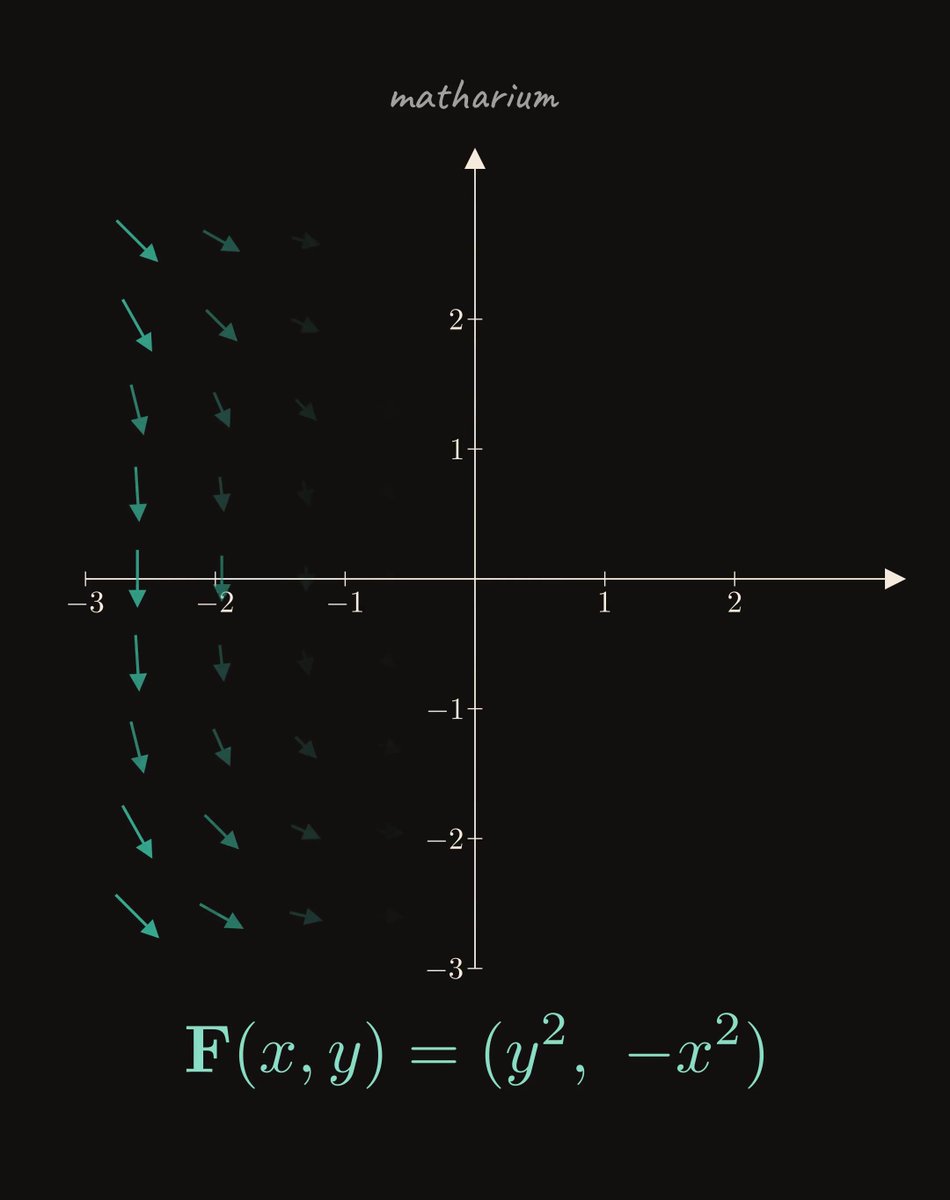
What this is showing
A streamline of a vector field F is the path a particle follows if its velocity always equals the field arrow beneath it: dx/dt = F(x, y). The post asks what happens when F is built from a single scalar function H (a Hamiltonian) in a specific way: F = (∂H/∂y, −∂H/∂x).
That construction forces every streamline to sit exactly on a level curve of H, a curve where H stays constant. This is checkable directly from the four fields given:
- F = (y², −x²): solving ∂H/∂y = y² and −∂H/∂x = −x² gives H = x³ + y³ (up to a constant), matching the field shown in the still frame above.
- F = (−y, x): a pure rotation field, gives H = x² + y² (circles).
- F = (sin y, sin x): gives H = cos x − cos y.
- F = (x − y, x + y): this one is not built from a Hamiltonian this way. Its divergence is 2, not 0. Rewritten with z = x + iy, this field is exactly z ↦ (1 + i)z, whose flow is z(t) = z₀e^{(1+i)t}, a spiral that rotates and grows outward.
The real physics behind it
The three Hamiltonian fields have zero divergence everywhere, a direct consequence of equality of mixed partial derivatives: ∂²H/∂x∂y = ∂²H/∂y∂x, so div F = ∂/∂x(∂H/∂y) + ∂/∂y(−∂H/∂x) = 0 identically. A flow with zero divergence carries every region of area through unchanged. This is Liouville’s theorem: a flow on a surface is area-preserving if and only if it’s divergence-free, and in two dimensions, volume preservation and this Hamiltonian (“symplectic”) structure are the same thing.
The spiral field breaks that. Its constant divergence of 2 means area grows at rate d(Area)/dt = (divergence) × Area, so a patch of area A₀ becomes A₀e^{2t} after time t, exactly the stretching the post states.
This isn’t specific to abstract math exercises. Divergence measuring “how much a vector field is a source or sink at a point” is the same operator behind conservation of mass in fluid dynamics (an incompressible flow is divergence-free by definition) and behind Maxwell’s equations for electric and magnetic fields.
Catalog status: Proven Systems
Liouville’s theorem and the equality of mixed partial derivatives it rests on are proven mathematical theorems, not physical hypotheses to be tested, the same category Gradient, Divergence, and Curl already sits in on this site.
Where this touches PBT
This connects to two things already here, but neither is a claim that PBT is confirmed or refuted by this post. It’s a precise vocabulary this site’s own papers currently use loosely.
First, this is the direct companion piece to Gradient, Divergence, and Curl: that page introduces divergence as a concept, this one shows exactly what divergence being zero or nonzero does to a flow over time.
Second, Paper 5 and Paper 7 describe PBT’s quantum-spin model as literal aether vorticity, a rotational flow formalized in the Vorticity Spin Quantization formula, while also describing the underlying flow as a radial inflow (v_r = −1/r, a sink, which has nonzero divergence). Paper 6 separately mentions “instabilities (e.g., divergence in high B)” without stating whether that means this same vector-calculus divergence.
This post supplies a precise, checkable question the papers don’t currently answer. By the result above, a divergence-free flow is exactly what would let a rotating patch of “spin” carry around without shrinking or leaking. So is the aether flow behind PBT’s spin model meant to be divergence-free? Or does it genuinely have a nonzero-divergence sink term, putting Paper 6’s own “divergence” language in tension with the area-preservation property demonstrated here? The papers don’t currently say. Answering it is open work they haven’t done, not a result this post settles either way.
Sources: