Gradient, Divergence, and Curl: The Three Questions Vector Calculus Asks
July 2026
Original post: @oprydai on X, 2026-07-20. If the embed above doesn’t load, the same image and description are below.
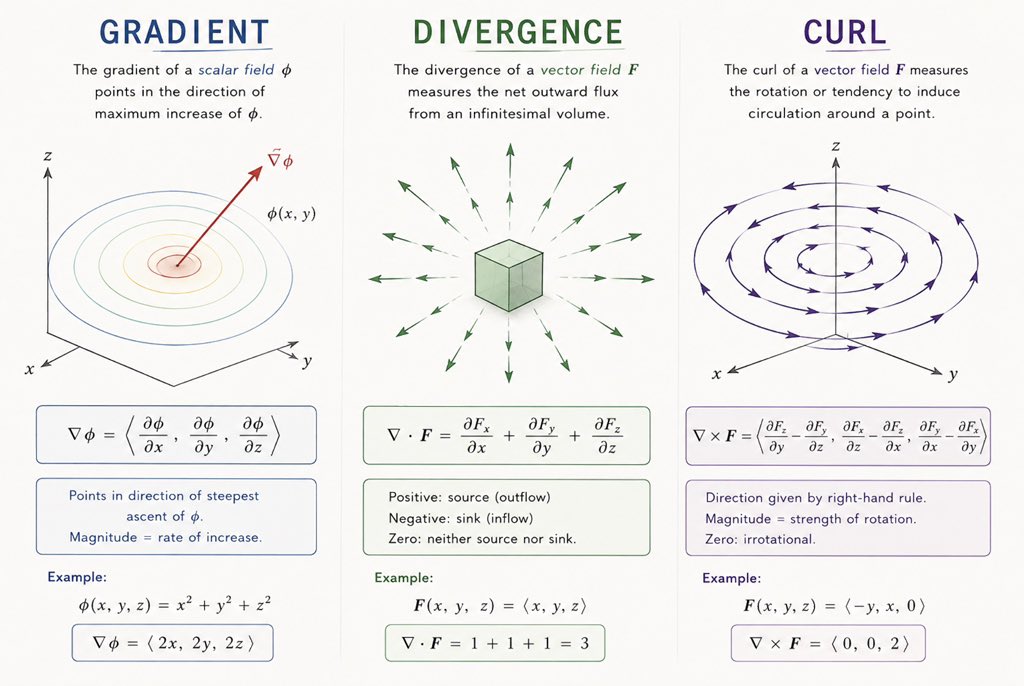
What this is showing
These are the three fundamental operations vector calculus uses to describe how fields change in space, each answering a different question:
- Gradient ($\nabla\phi$) — takes a scalar field (a single number at every point, like temperature or pressure) and returns a vector pointing in the direction of steepest increase, with magnitude equal to the rate of that increase.
- Divergence ($\nabla\cdot\mathbf{F}$) — takes a vector field and returns a scalar: how much the field is “spreading out” from a point (positive = a source, like the arrows radiating outward from the cube shown; negative = a sink; zero = neither).
- Curl ($\nabla\times\mathbf{F}$) — takes a vector field and returns another vector describing local rotation: which axis the field circulates around, and how strongly.
The real physics behind it
These three operators are the actual mathematical language every field theory in physics is written in. Maxwell’s equations — the complete, exact theory of classical electromagnetism — are four equations built entirely from divergence and curl applied to the electric and magnetic fields. Fluid dynamics uses divergence to express conservation of mass (an incompressible flow has zero divergence everywhere) and curl to describe vorticity. Gravity’s classical field equations use divergence in exactly the same way electric fields do. This isn’t a notational convenience — it’s the actual structure of how physical fields propagate and interact in three-dimensional space.
Catalog status: Proven Systems
Vector calculus itself isn’t a physical theory to be confirmed or falsified — it’s the exact mathematical framework underneath physical theories that are. The operators and their identities are theorems, not hypotheses.
Where this touches PBT
This connects directly to two things already on this site. First, the duct-branch CFD visualization elsewhere in this section is a direct, visual example of divergence in action — the turbulent zone at the T-branch junction is exactly where the flow field’s divergence is large and nonzero. Second, Pressure-Based Theory’s own force-unification claims (flux imbalances and shadowing, throughout Paper 1 and Paper 2) are themselves gradient/divergence-type arguments in plain language, though the papers don’t currently formalize them with these operators explicitly — a real, if informal, structural resemblance to how standard field theories are actually written.