Eddy Currents: Braking Without Touching Anything
September 2026
Original post: @LensScientific on X, 2026-09-08. If the embed above doesn’t load, the same diagram is below.
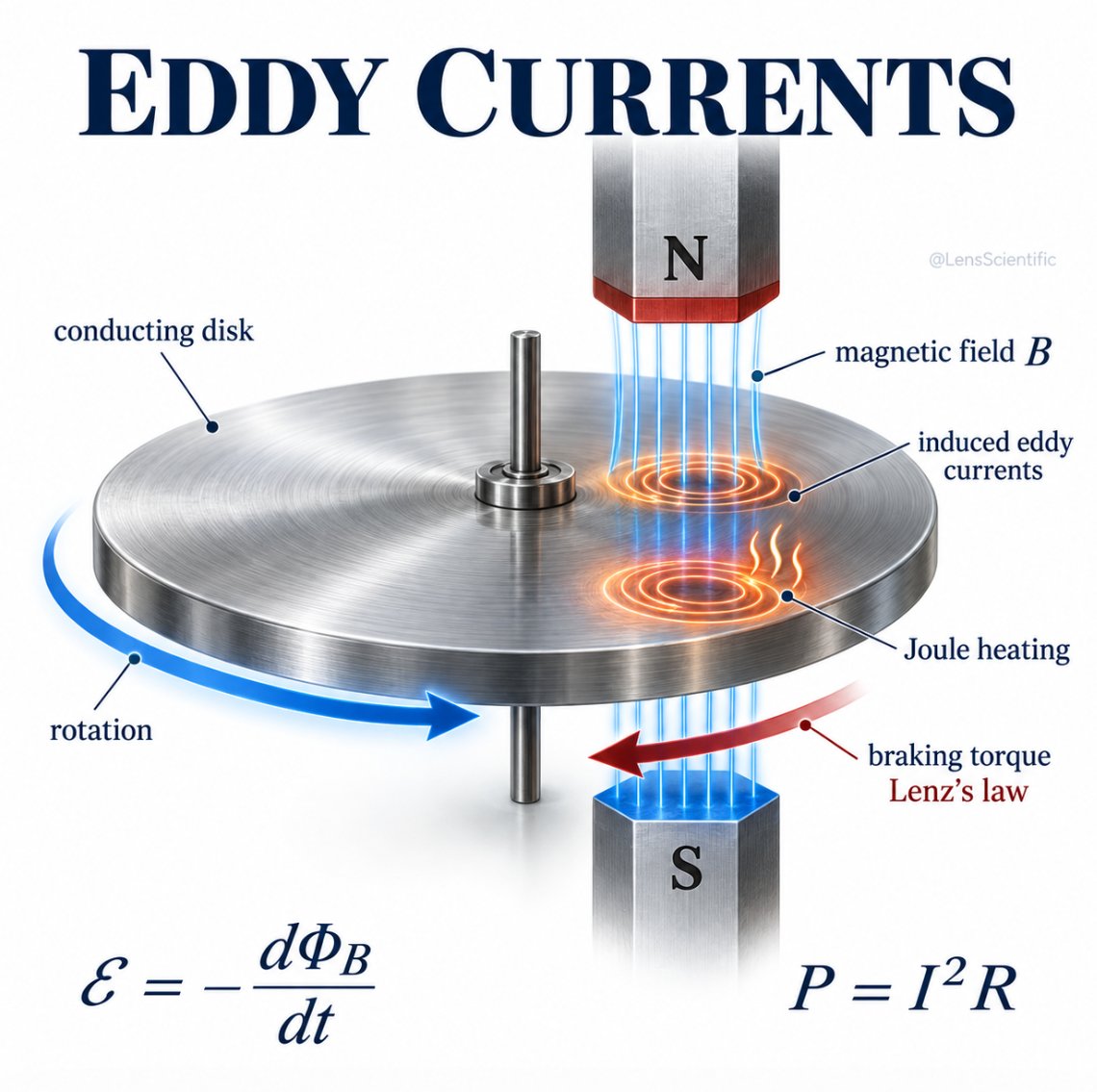
What this is showing
An eddy current is a loop of electric current induced inside a conductor whenever the magnetic flux through it changes. The diagram’s setup is the classic case: a metal disk spins between the poles of a magnet, so any given patch of the disk sweeps into and out of the field as it rotates. That changing flux through the patch, by Faraday’s law ($\mathcal{E} = -d\Phi_B/dt$), induces a circulating current in the metal itself — no wires, no contacts, just a solid conductor moving through a field.
Those induced currents then do two things at once, both correctly labeled in the diagram:
- They oppose the motion that created them. This is Lenz’s law, and it’s really just a restatement of energy conservation: the induced current generates its own magnetic field, and that field is oriented to fight the change in flux that caused it — which means it drags against the disk’s rotation. The result is a genuine braking torque with no physical contact between brake and disk at all.
- They heat the conductor. A current flowing through a resistive material dissipates energy as heat ($P = I^2R$), so the kinetic energy removed from the spinning disk doesn’t vanish — it becomes heat in the metal.
Both effects come from the same currents; the diagram’s two callouts (braking torque, Joule heating) aren’t two separate phenomena; they’re the same physical process seen from two accounting angles: momentum removed from the disk, energy converted to heat.
Why this is genuinely useful, not just a curiosity
The diagram’s closing line lists real applications, and each one leans on a different half of the same effect:
- Magnetic braking (eddy-current brakes on trains, roller coasters, and some exercise equipment) uses the braking torque directly — no friction pads, no wear, and the braking force scales with speed, which is a useful property on its own.
- Damping (in galvanometers and some scales) uses the same drag to kill oscillations quickly without a mechanical damper.
- Induction heating flips the framing: the Joule heating is the whole point, and it’s used deliberately to heat metal without contact (induction cooktops, industrial metal hardening).
- Metal detection and non-destructive testing use the fact that a conductor’s own induced currents perturb an external field in a way a detector coil can pick up — cracks and flaws in the metal change how the eddy currents form, which shows up as a measurable signal.
Catalog status: Proven Systems
This is textbook 19th-century electromagnetism (Faraday’s law and Lenz’s law, both over 150 years old and confirmed continuously since), applied to solid conductors instead of wire loops. Nothing here is in dispute; eddy-current brakes and induction heaters are commercial, off-the-shelf technology built directly on this mechanism.
Where this touches PBT
Nowhere, checked directly rather than assumed — no paper or formula entry on this site currently addresses electromagnetic induction, Faraday’s law, or eddy currents. This is standard physics shown for its own sake, the same category the Visuals section explicitly makes room for.