The Casimir Effect
July 2026
Original post: @mathhub_vn on X, 2026-07-20. If the embed above doesn’t load, the same image and description are below.
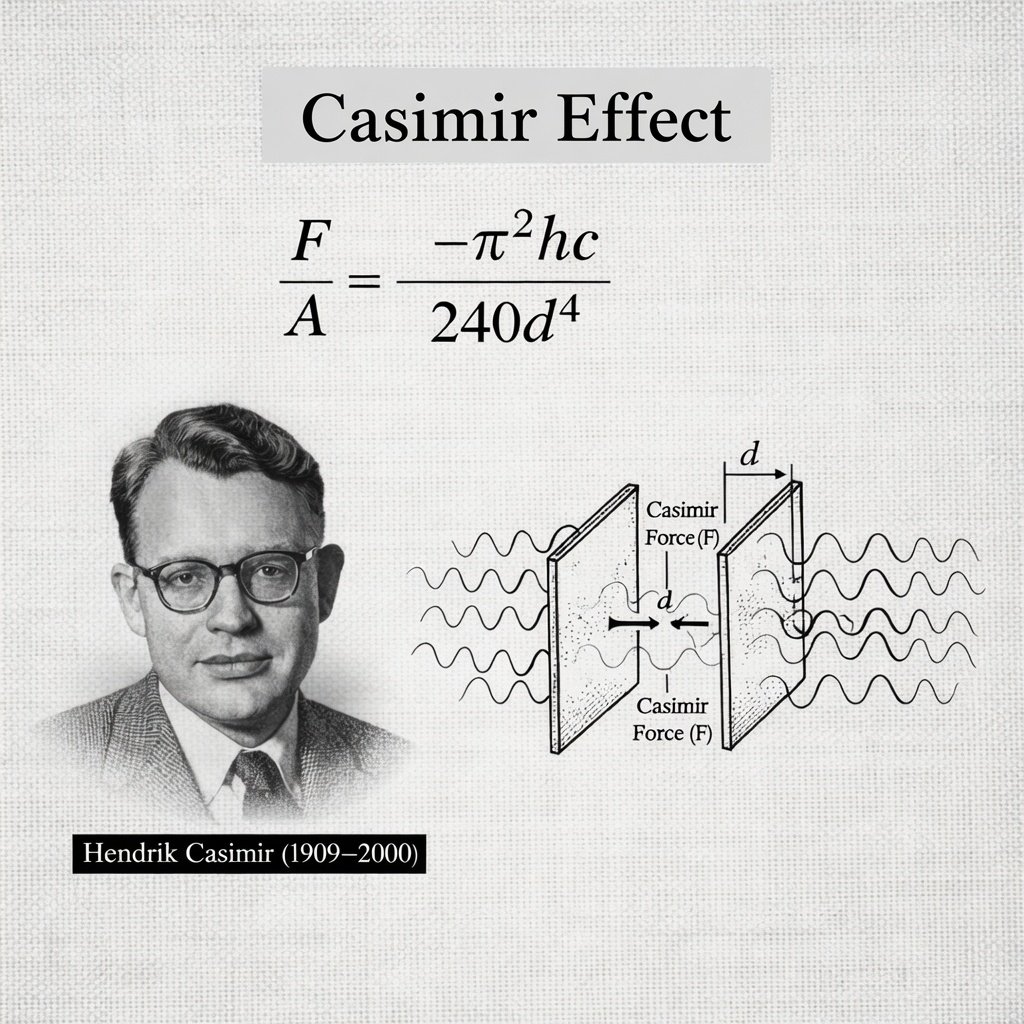
What this is showing
Two uncharged, conducting plates placed extremely close together (separation $d$) experience a real, measurable attractive force — the Casimir effect, predicted by Hendrik Casimir in 1948. The plates restrict which quantum vacuum field modes can exist in the gap between them (only wavelengths that fit an integer number of times fit between the plates), while the unrestricted space outside allows every mode. That imbalance creates a small net inward pressure:
$$\frac{F}{A} = -\frac{\pi^2\hbar c}{240 d^4}$$
The force grows extremely quickly as the plates get closer ($1/d^4$), which is why it’s only measurable at very small separations (typically sub-micron).
The real physics and its full write-up
This effect is genuinely real and precisely confirmed — first observed qualitatively in the 1950s, then measured to high precision starting in 1997 (Lamoreaux) and 1998 (Mohideen & Roy). This site already has a full, dedicated treatment of the Casimir effect and a related 2026 claim (Casimir Inc.’s “MicroSPARC” device) in Casimir Vacuum Energy and PBT: What MicroSPARC Does and Doesn’t Show — including exactly where this connects to Pressure-Based Theory’s own vacuum/aether claims, and where it doesn’t. This entry exists to give the diagram itself a durable visual home; see that article for the fuller discussion.
Catalog status: Proven Systems
The static Casimir force itself (shown here) is standard, independently confirmed quantum field theory — not in dispute.