The Baryon Decuplet: The Diagram That Predicted a Particle
July 2026
Original post: @scievision369 on X, 2026-07-22. If the embed above doesn’t load, the same image and description are below.
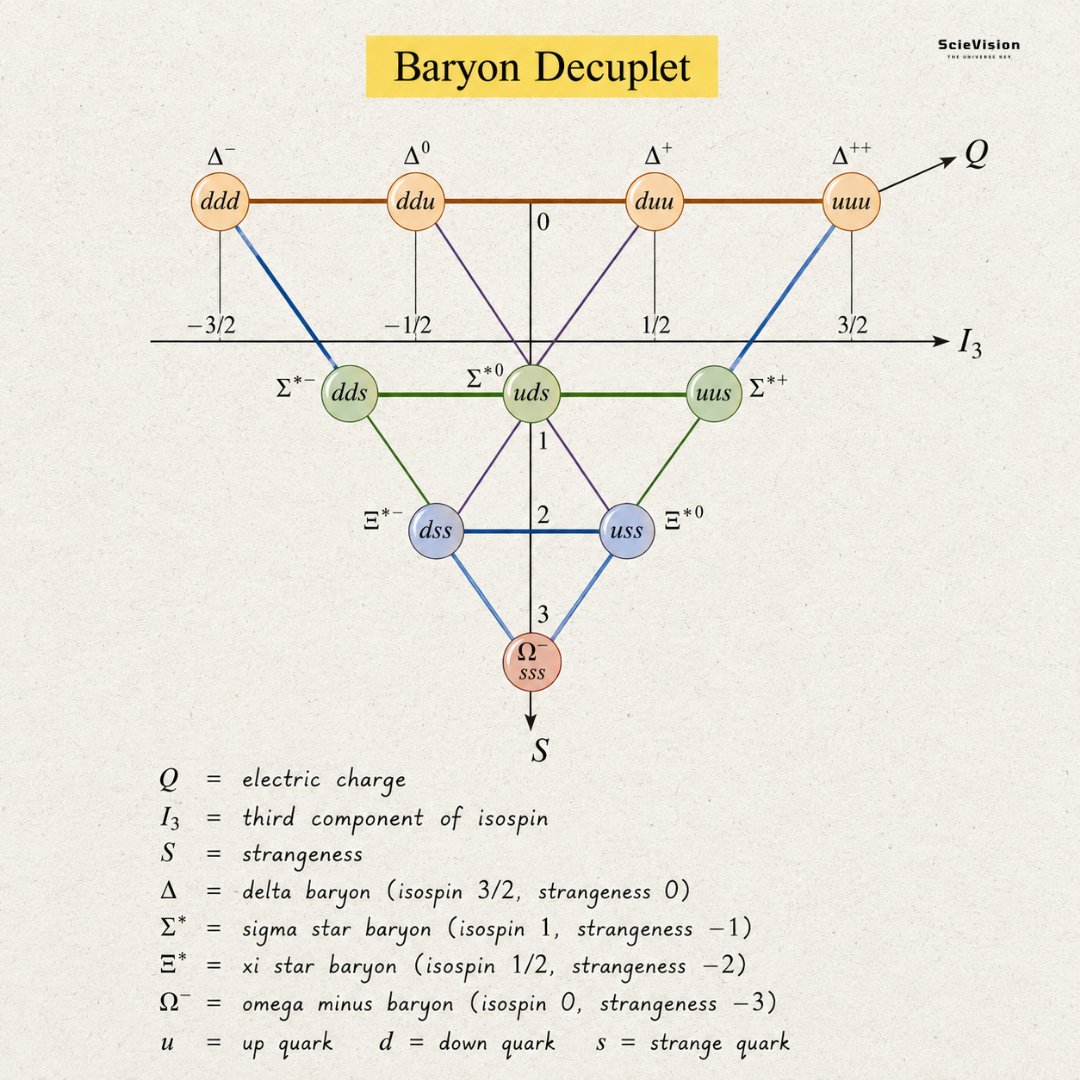
What this is showing
The Baryon Decuplet arranges ten baryons (three-quark particles) with spin 3/2 into a triangle, plotted by two quantum numbers: the third component of isospin ($I_3$, horizontal axis) and strangeness ($S$, vertical axis, increasing downward). Each row groups particles by their strange-quark ($s$) content — zero strange quarks along the top ($\Delta$ baryons), down to three strange quarks at the bottom point ($\Omega^-$). The quark composition of each particle (e.g. $ddd$, $uds$, $sss$) is labeled directly on the diagram, and the pattern is completely regular: every step across or down the triangle corresponds to swapping one up or down quark for a strange quark.
The real physics behind it
This is one of the genuine landmark diagrams in 20th-century physics. In 1962, Murray Gell-Mann (and independently Yuval Ne’eman) used the emerging “Eightfold Way” classification scheme — grouping particles by symmetry patterns that would later be understood as manifestations of the quark model — to arrange the known spin-3/2 baryons into exactly this triangular pattern. The pattern had an empty slot at the bottom: a particle with strangeness $-3$, all three quarks strange ($sss$), that hadn’t yet been observed. Gell-Mann predicted its mass, charge, and lifetime directly from the pattern’s own regularity. In 1964, the $\Omega^-$ was discovered at Brookhaven National Laboratory with almost exactly the predicted properties — one of the cleanest confirmed predictions in particle physics, and a major piece of evidence that quarks are physically real constituents of matter, not just a bookkeeping device.
Catalog status: Proven Systems
The baryon decuplet and the underlying quark model are core, extensively confirmed parts of the Standard Model — this isn’t a hypothesis under test, it’s an experimentally validated prediction with a specific, famous discovery (the $\Omega^-$) behind it.
Where this touches PBT
Pressure-Based Theory’s own account of the strong force (confinement as vorticity, per Paper 1 and Paper 7) is a mechanical alternative to QCD’s gluon-mediated confinement, but it doesn’t currently offer its own derivation of the quark classification pattern shown here. This diagram is standard Standard Model physics, included on its own merits as a genuinely striking piece of the real particle physics landscape PBT is proposing to unify differently.