The Invisible Wall: A Famous Factory Anomaly, and the Force Budget That Doesn't Close
July 2026
In August 1980, at a 3M plant in South Carolina, a man walked into the middle of a factory floor and could not keep walking. Nothing was in front of him. He leaned his full weight forward and still could not advance, and when he tried to leave he found he could not turn around either, so he backed out the way he came.
That was David Swenson, a 3M electrostatics specialist, and he put the episode in front of his own professional society twice — at the 17th Annual EOS/ESD Symposium in September 1995, and in the ANTEC ‘97 proceedings under a title that shows he knew how it sounded: “Wide Polypropylene Web Static Charge — A Phenomenon Worthy of ‘Star Trek’.”
The story circulates every year or two, and it’s usually told one of two ways: as a marvel, or as a debunking. This entry does neither. It runs the arithmetic — and the arithmetic is the interesting part, because no straightforward electrostatic route gets within one to two orders of magnitude of the force needed to stop a leaning adult at the field strengths these accounts estimate.
That gap is the whole point of what follows.
The disclosure this needs up front: this site develops Pressure-Based Theory, and one of the hypotheses floated for this incident involves a confined cloud of charged air — which is the kind of explanation I’d like to be true. It fails the same arithmetic as everything else, by about the same margin, and I’ve said so in the place where it comes up rather than leaving it as the last candidate standing.
What was running
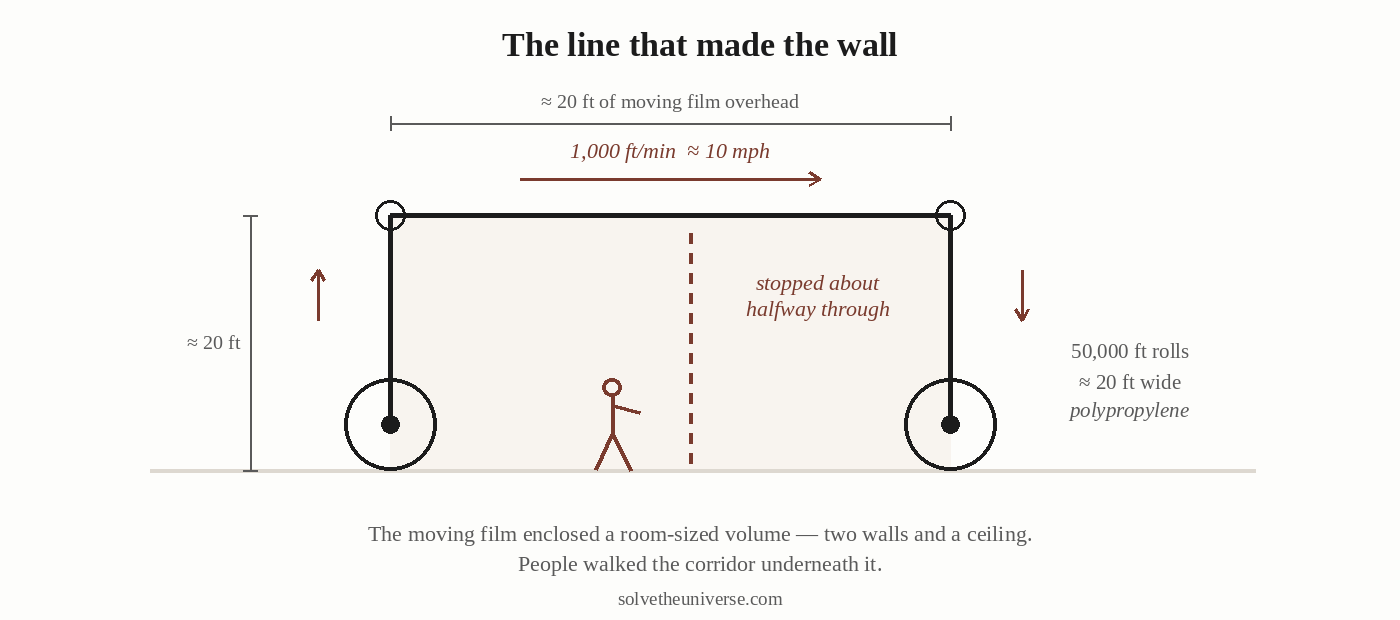
The line was slitting polypropylene film for pressure-sensitive tape backing — rolls 50,000 feet long and about 20 feet wide (roughly 6 m), unspooling at 1,000 feet per minute, roughly 10 mph. The film came off the main roll, climbed about 20 feet to overhead rollers, crossed about 20 feet horizontally, then dropped to the slitter.
That path is why this happened at all: the moving film enclosed a room-sized volume — two walls and a ceiling of fast-moving charged plastic — with a corridor underneath that people walked through.
The charging itself is ordinary. The film was manufactured with deliberately dissimilar surface structure on its two faces, and contact electrification occurs between dissimilar surfaces even in the same material. Web handlers deal with this daily. What was unusual was scale and geometry: an enormous, continuously regenerated charge wrapped around a room.
What’s actually on the record, and how firmly
Being straight about sourcing, because it bears on everything after it.
The account reproduced most widely — and the one used here — is the EOS/ESD session abstract together with Swenson’s narrative as hosted by Bill Beaty on amasci.com since 1996. I have not read the ANTEC ‘97 paper itself. The 300–500 kV/ft estimate attributed to it here comes from secondary summaries, not from the pages — as does a web width of 21 feet, where the EOS/ESD account says 20. Nothing turns on the foot, but anyone leaning hard on the field estimate should go to the proceedings first.
What that record does establish: a named engineer, a plant, a date, a line configuration, two presentations to a professional audience, and a production manager who disbelieved the report, went back with Swenson, found the effect gone, returned early the next morning when the workers said it usually appeared, watched his own short curly hair stand on end, and said he “didn’t know whether to fix it or sell tickets.”
It also establishes a condition. The setting was extremely humid — late summer in South Carolina — but the effect showed up in the relatively drier early-morning window, which the line workers had already worked out before any specialist arrived. And it establishes an ending: grounding the machinery stopped it permanently.
What the record does not contain: any instrument trace, any photograph or video, any independent replication, any charge-density map, and any published quantitative model. There is no peer-reviewed journal paper. For an effect that appeared in a narrow window on a line that no longer runs that way, that absence is expected — but it is still an absence, and “well documented” overstates it. What exists is a credible first-hand account from a qualified person, presented twice to peers. That is worth something, and it is not the same thing as data.
The numbers, carefully
Two figures get quoted interchangeably, and they are not the same kind of thing.
The instrument read 200 kV/ft — but that was its ceiling. It “slammed to full scale,” which sets a lower bound and nothing more. In SI, that floor is about 0.66 MV/m.
The 300–500 kV/ft figure is an estimate, not a measurement:
$$300\ \text{kV/ft} \approx 0.98\ \text{MV/m} \qquad 500\ \text{kV/ft} \approx 1.64\ \text{MV/m}$$
For scale, uniform-gap dry air breaks down near 3 MV/m — so the estimate sits below bulk breakdown, though that comparison is looser than it looks, since hair standing on end and a pegged field meter both imply local enhancement at extremities well above the free-field value.
The part nobody runs
Here is the arithmetic the retellings skip, and it is not close.
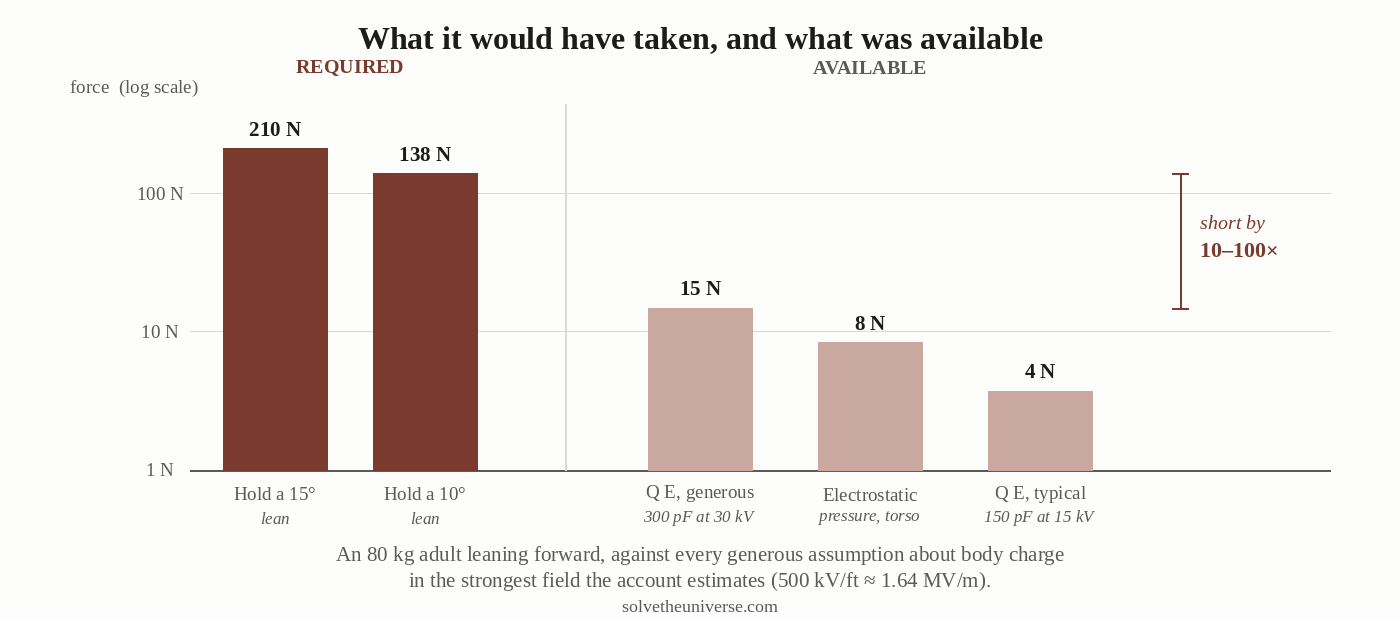
Start with what’s required. Swenson leaned his weight forward and did not move. A person of 80 kg leaning at angle $\theta$ from vertical needs a horizontal restraining force of $mg\tan\theta$. Even a shallow 10° lean needs about 138 N; 15° needs about 210 N. Call the target 100–200 N.
Now what’s available. The direct route is $F = QE$ on a body carrying net charge. Human body capacitance runs roughly 100–300 pF, and in air a person holds a potential of order 10–30 kV before corona bleeds it away. Taking the generous end of every one of those — 300 pF at 30 kV, giving 9 µC, in the highest estimated field:
$$F = QE = (9\times10^{-6}\ \text{C})(1.64\times10^{6}\ \text{V/m}) \approx 15\ \text{N}$$
A second, rougher route is electrostatic pressure, $\varepsilon_0 E^2/2$. At 1.64 MV/m that’s 11.9 Pa — about 8 N over a torso-sized frontal area. Treat that as a ceiling rather than an estimate: the full Maxwell stress only acts one-sided when a body strongly distorts the field, and in a smoother field the front and back stresses largely cancel.
Invert it and the problem gets sharper. To reach 150 N by $QE$ in that field you need about 92 µC on the body. At 100–300 pF, that corresponds to a body potential of roughly 305 to 915 kV. Air will not let a human body hold that. It coronas off long before, which is the same physics that caps the 10–30 kV figure above.
So the shortfall isn’t a detail to be tightened with better assumptions. Every standard electrostatic route lands one to two orders of magnitude below the reported effect, and the assumptions above were already generous in every direction.
And there’s a catch that makes it worse. That $QE$ figure uses the standard model for a tribocharged, isolated body — someone who has picked up charge walking across a floor and is insulated from ground. A person standing on a concrete plant floor is closer to the opposite case: approximately grounded, with net charge set by induction rather than retained. For a grounded conductor sitting in a uniform external field, the net force is essentially zero — the charges redistribute and the forces on them cancel. A net force appears only where the field is non-uniform, and that is exactly the induced-dipole force discussed below, which points at the nearest charged film rather than along the corridor.
Which sharpens the whole problem into a single statement: the route that could produce a forward-blocking force is the one that doesn’t apply to a grounded person, and the route that does apply doesn’t point along the corridor. The magnitude gap and the direction gap turn out to be the same gap seen from two sides.
The popular explanation is also wrong about direction
Separately from the magnitude problem, the explanation most often attached to this story — including in the AI-written draft that sent me looking into it — is that the field induced charges on the body of anyone entering, and induction produced repulsion.
That gets the sign backwards. A neutral conductor in a non-uniform field polarizes, and the induced near-side charge sits where the field is stronger, so the net force is toward the field maximum. That’s attraction — the same effect that pulls tap water toward a charged comb.
But the geometry matters more than the sign, and this is where the textbook demo stops helping. In this arrangement the field maxima are at the film surfaces themselves — the two walls and the ceiling. An induced-dipole force therefore points sideways or upward, toward the nearest plastic. It does not produce a barrier standing across the corridor halfway down its length. Induction doesn’t just get the sign wrong here; it doesn’t produce the reported shape of the thing at all.
Bill Beaty raised the sign objection on his own page in 1996, and added a second one: a smooth field force should build gradually, like “an invisible pillow,” not present an edge. That’s a fair puzzle rather than a theorem — a smoothly rising force can feel like a wall once it exceeds what your footing can push against, and space-charge or corona-onset boundaries genuinely can be fairly sharp. But it’s one more thing any real explanation has to deliver.
And there’s a third constraint the retellings drop entirely, including the version I started from. Swenson couldn’t turn around. A static force field pushing along one axis has no business preventing rotation in place. That detail is stranger than the barrier itself, and no electrostatic story on offer addresses it.
What’s left
Four possibilities, and I don’t think the evidence picks between them.
The field was far higher than estimated. The meter only ever established a floor, so this is a live possibility — but it is narrower than it looks. With body potential capped by corona at 10–30 kV, $Q$ is fixed and $F = QE$ scales linearly with $E$. And $E$ can’t rise far: the estimate is already 1.64 MV/m against a bulk dry-air breakdown near 3 MV/m, leaving under a factor of two before the corridor is a glow discharge rather than a standing field. Spend all of that headroom and $QE$ reaches roughly 27 N — still five times short of holding a 10° lean. Even allowing an $E^2$ scaling by abandoning the corona cap, it reaches about 50 N and remains short. Breakdown closes most of this escape route by itself.
The coupling isn’t $QE$ on a quasi-neutral body. Continuous corona exchange, charge injection at hair and extremities, a conducting concrete floor, and an enormous moving air mass make “neutral conductor in an electrostatic field” the wrong model. A real answer needs the actual charge distribution on those webs and a field solution for that geometry. Nobody has published one.
A confined space-charge cloud. Beaty’s own guess is that the spool sprays out ionized air of opposite polarity, trapped under the tent by the field and by the violent air motion of a 20-foot web moving at 10 mph. This is the candidate closest to my own interests, so: it fails the same arithmetic. Ion-wind and space-charge pressures at these fields are in the pascal range, the same order as the electrostatic pressure computed above, and Beaty himself notes it still predicts a pillow rather than a wall. Calling it a “pressure gradient” would make it sound like it belongs to this site’s subject matter. The accurate label is confined space charge, and it does not close the gap either.
The barrier was substantially perceptual. Hair being pulled upright across the whole body, microshocks at the extremities, ozone, the sound of the line, and the plain strangeness of the sensation are all real physical inputs that don’t require newtons. A person meeting that wall of sensation may genuinely be unable to make themselves continue, and may report leaning without advancing in complete good faith. This is the only candidate that doesn’t demand impossible numbers, and the only one that also accounts for why he couldn’t turn around. That isn’t the same as evidence for it — it has never been tested either, and “the option left when the others fail” is a weak kind of support. It is also not a debunking. Swenson’s field meter still pegged; the manager’s hair still stood up; the grounding fix still worked. The electrostatics were real, and enormous. It’s specifically the mechanical force on a human body that the arithmetic won’t support.
What the fix does and doesn’t tell us
One correction to how this story usually gets framed here and elsewhere, including in my first pass at it: the grounding fix is an explanation, at the granularity engineering actually needed. Charge accumulated on the web with no dissipation path; they gave it one; the effect stopped and never came back. That’s a correct causal account of the cause class, and industrial electrostatics — web handling, static bars, pinned charge — is a real, mature field, not an empty one.
What’s unresolved is finer than that: the sign, the shape, the no-turn condition, and above all the magnitude. “Electrostatics” is the right label and a sufficient basis for a fix. It is not yet a quantitative account of what a person’s body actually encountered in that corridor.
That’s why this sits in Unknowns rather than anywhere firmer — with the caveat that the underlying account itself rests on one person’s testimony relayed through a popularizer’s page, and the primary paper deserves to be read before anyone builds much on it.
Why it’s here
I’ll mark this as interest-driven rather than neutral, because it is: this site’s recurring complaint is that a name for a phenomenon often gets accepted in place of a mechanism, which is the argument in Why Pressure and on the Electricity topic page. The invisible wall is a convenient parable for that view, and I chose it partly because it is.
What survives that admission is the arithmetic, which doesn’t care about the parable. Anyone can check it: body capacitance, a plausible body potential, the documented field, $F = QE$. It takes about a minute, and it comes out one to two orders of magnitude short, and in forty-five years of this story being retold as a marvel or dismissed as a legend, the number that would settle which it is has apparently never been the part anyone reaches for.
One thing you can do with this. Next time this story crosses your feed, don’t argue about whether it happened. Ask what force would have been required, and what force was available. That’s a one-minute calculation with numbers already in the story, and it’s a better test than any amount of arguing about plausibility — here and nearly everywhere else.
Sources
- D. Swenson, “Case Study — Large Plastic Web Electrostatic Problems, Results, and Cure,” Session 7.7, 17th Annual EOS/ESD Symposium, 14 September 1995.
- D. Swenson, “Wide Polypropylene Web Static Charge — A Phenomenon Worthy of ‘Star Trek’,” ANTEC ‘97 Conference Proceedings, pp. 1310–1313. Not consulted directly for this entry — cited as the source of the 300–500 kV/ft estimate via secondary summaries.
- W. Beaty, “Invisible Electrostatic Wall at 3M adhesive tape plant”, amasci.com, August 1996 — the hosted narrative account, including Beaty’s own objections and his ion-cloud hypothesis.
The force-budget calculations, the unit conversions, and the required-body-potential inversion were computed here, not quoted from any source. A claim that NASA and government agencies contacted Swenson after publication circulates widely; it traces to a recollection of a conversation at an ESD meeting, not to either paper, and is set aside here as hearsay.