The Discovery of Kevlar
August 2026
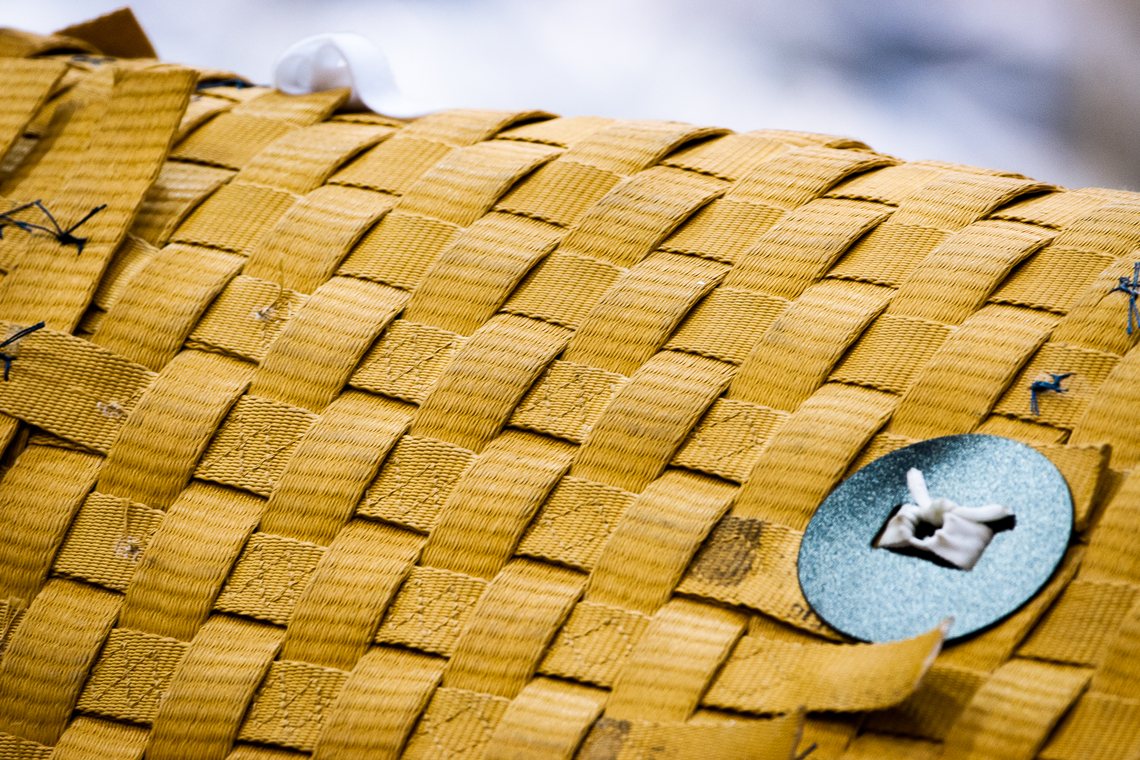 Woven Kevlar. Photo by Paul Hudson, CC BY 2.0.
In 1965, in DuPont’s Pioneering Research Laboratory in Wilmington, Delaware, Stephanie Kwolek finished a batch of polymer solution and got something that looked like it had gone wrong.
It should have been clear and syrupy. Polymer solutions are. This one was cloudy — turbid, she said later, opalescent when you stirred it, buttermilk in appearance — and it poured almost like water. In a lab where the useful product was thick and transparent, she had a jar of thin milk.
The standard move was to pour it out. Cloudy means something undissolved. Thin means the polymerization underperformed. Either one is a failed batch, and here were both.
She didn’t pour it out.
What follows is why that was the right call on the chemistry rather than a lucky hunch. Everything wrong with that jar traced back to a single fact about what was in it — and that one fact is what made the fiber possible.
The chemist and the assignment
 Stephanie Kwolek, 1986. Science History Institute, CC BY-SA 3.0.
Kwolek joined DuPont in 1946 with a bachelor’s degree in chemistry and a plan to leave. She wanted medical school and couldn’t afford it, so the lab job in Buffalo was meant to be temporary — she took it partly because DuPont, unusually for the time, paid women and men the same starting salary. She retired forty years later, in 1986.
Around 1964 her group was put onto a search for a lightweight fiber strong enough to replace the steel cord inside car tires. The reason usually given is an anticipated gasoline shortage — a tidy motive for a programme that started nearly a decade before the 1973 oil shock, so hold it loosely. What matters is the target, because the target is what “stronger than steel” would later be measured against.
The route was aromatic polyamides — aramids. Nylon is a long flexible chain you can melt and push through a spinneret. Aromatic polyamides refuse: benzene rings in the backbone stiffen the chain and push its decomposition temperature above its melting point, so heating one to spin it destroys it before it flows.
That single fact shapes the whole story. If you can’t melt them, you dissolve them and spin from solution — which makes the solution the product, and its appearance the only data anyone has before the spinneret. Kwolek built hers by low-temperature polycondensation, reacting a diamine with a diacid chloride in a cold polar solvent to reach high molecular weight without cooking the result. The batch that started all this was poly(p-benzamide).
Three things wrong, one fact underneath
Take the objections in the order they’d have hit her.
Too thin. Dissolve a normal polymer and viscosity climbs steeply — long floppy chains tangle with each other. A high-molecular-weight solution that pours like water reads instantly as a polymerization that didn’t go far enough.
Too cloudy. Clear means dissolved. Cloudy means something is scattering light, and in a polymer lab the usual something is undissolved particulate.
It would wreck the spinneret. The holes are tiny — about a thousandth of an inch, in the figure that comes down with the story. Push a suspension of solid particles through them and they plug. The technician who ran the spinning equipment, Charles Smullen, declined to run the batch for exactly that reason, and Kwolek had to talk him into it. He wasn’t being difficult. Given a cloudy solution, he was right.
Notice that the third objection isn’t like the other two. Thin and cloudy are things the batch was. “It will clog the spinneret” is a prediction derived from the cloudiness, resting on an assumption nobody had reason to question: that the only thing making a polymer solution cloudy is suspended solid.
Kwolek tested that assumption rather than arguing with it. She filtered the solution and ran it again, and the cloudiness stayed.
That is a smaller result than it’s often made to sound, and worth being exact about. Filtering ruled out particulate. It said nothing about molecular weight, or order, or whether anything useful would come out the other end. What it did was remove the one objection that could have ended the matter before anything got measured — which is usually all a first test can do, and it was enough. Smullen spun it. The fiber didn’t clog anything, and it didn’t break the way nylon would.
Why “too thin” was the signal
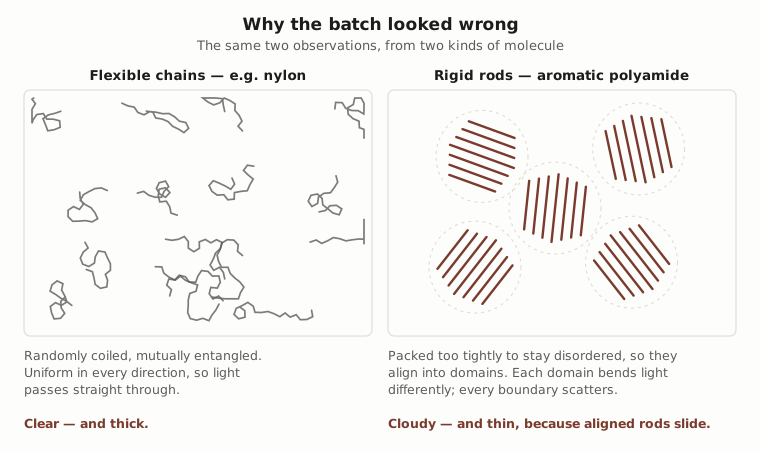
Poly(p-benzamide) chains aren’t floppy. They’re stiff rods, and rods in a crowd behave nothing like tangled string.
Above a certain concentration a solution of rigid rods can’t stay randomly oriented, because there isn’t room. Every rod excludes a volume to every other rod, and past a threshold the system has more freedom lining them up in parallel domains than keeping them randomly pointed. The solution orders itself, unprompted. It becomes a liquid crystal — still liquid, still pourable, but with local regions of aligned molecules.
For idealized hard rods, Onsager’s 1949 treatment puts the onset near
$$\phi_c \approx 3.3 \cdot \frac{D}{L}$$
where $L/D$ is the rod’s aspect ratio. Long thin rods order at low concentration — a few percent by volume will do it. Real aramid dopes are messier than hard spheres and cylinders, but the scaling is the point: the stiffer and longer the molecule, the sooner it happens.
Now the objections, in reverse.
Thin because aligned rods slide past one another and entangled coils don’t. Viscosity in these systems climbs with concentration in the normal way, then drops off a cliff at the transition into the ordered phase, then climbs again. Kwolek’s solution wasn’t thin because the polymer was short. It was thin because the polymer was long and stiff enough to have ordered itself.
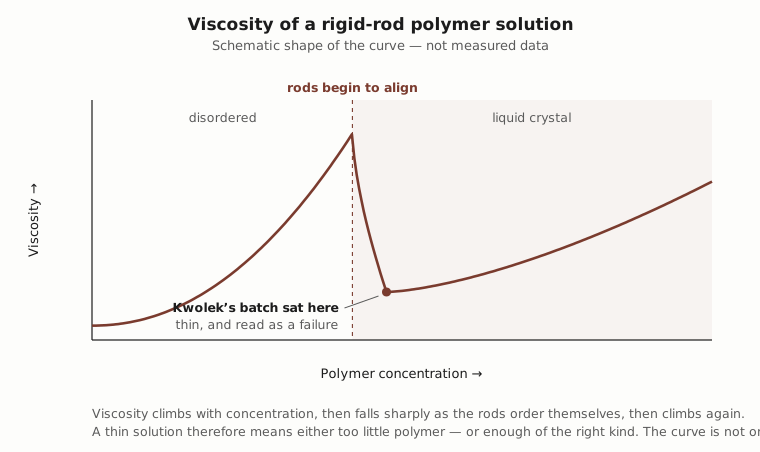
That shape is the crux of the whole episode. Viscosity is not a one-to-one function of concentration for these polymers — a given low reading is consistent with two completely different situations, one a failed batch and the other exactly what you were looking for. The lab’s discard rule assumed the curve only ever went up.
Cloudy because the aligned domains are birefringent: their refractive index depends on direction, so light crossing between two domains pointing different ways scatters. Many domains, many boundaries, milky liquid. The turbidity was the domains themselves. Stirring changed the shimmer because shearing partly aligns them — which a suspension of grit would not do.
Worth resisting the temptation to call that proof. Cloudiness and stir-opalescence are consistent with a polydomain liquid crystal; emulsions can look similar. What actually settles it is optical: a liquid-crystalline dope is birefringent and depolarizes plane-polarized light. That property, not the buttermilk look, is what Kwolek’s patent was eventually written around.
And it never would have clogged, because there was nothing solid in there to clog with.
What that buys you
Ordinary fiber spinning has to manufacture molecular alignment from nothing. You extrude, then draw the filament hard to drag tangled chains into rough parallel with the fiber axis, and you never get very far, because the chains pull back toward their coiled equilibrium the whole time.
Kwolek’s dope showed up at the spinneret already ordered. Not globally ordered — the domains still pointed every which way, and lining them up along the fiber axis still took the extensional flow through the hole. But the difference between starting from aligned rods and starting from a bowl of knots is most of the battle, and because these chains are rigid, the alignment they get doesn’t relax back once the fiber coagulates.
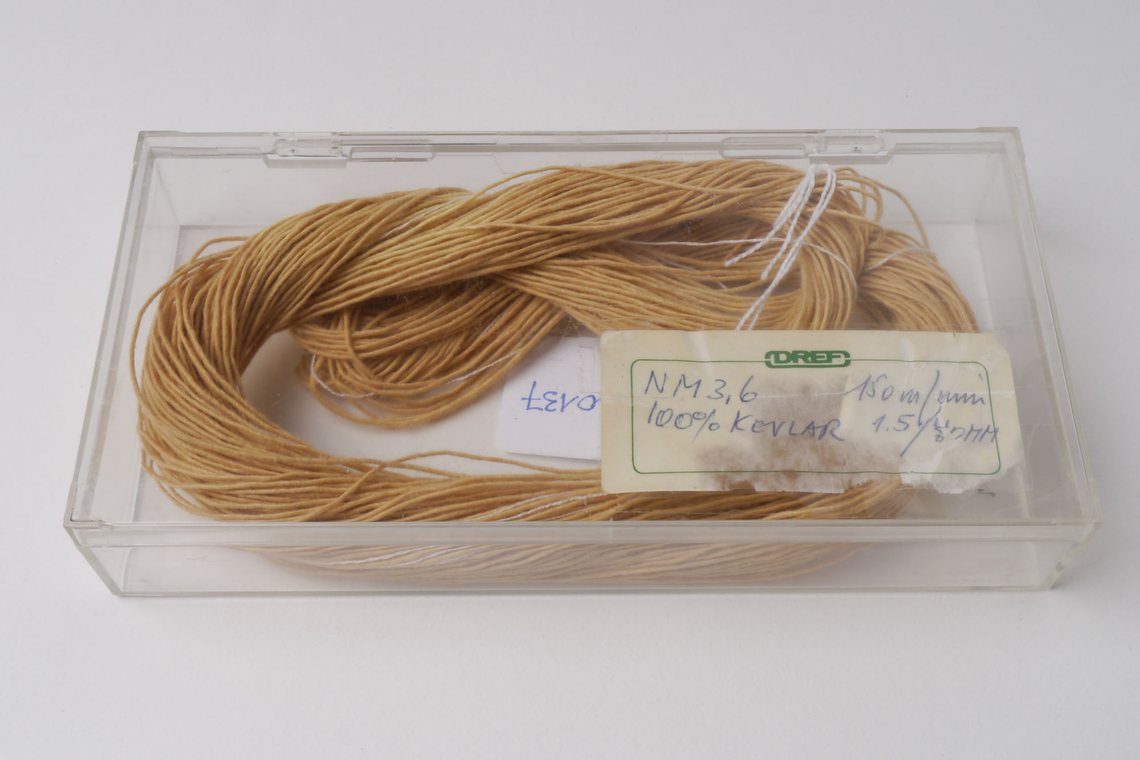 A museum specimen of Kevlar yarn, showing the characteristic gold. Collectie Industriemuseum Gent, CC0.
Two different bonds then do two different jobs, and it’s worth not blurring them. Once the chains lie along the fiber axis, an axial pull is resisted by the covalent bonds of the backbone itself — that’s the load path, and it’s why the number comes out so high. The hydrogen bonds between amide groups on neighbouring chains aren’t carrying that pull; they lock the chains sideways so the fiber can’t simply shear apart with chains sliding past each other. Necessary, but across the load rather than along it.
So the strength has two parents. The molecule supplies something worth aligning — a stiff all-aromatic backbone at high molecular weight, hydrogen-bonded to its neighbours. The liquid crystal supplies the alignment, at a cost of almost nothing. Neither one alone gives you Kevlar.
And even the second parent wasn’t news to physics. Onsager had published the rod-ordering result in 1949; that stiff rods at concentration form ordered phases was available knowledge, not something discovered in this jar. What was new was meeting it in a working polymer solution, in a lab where nobody was looking for it, wearing the costume of a failed batch.
The patents show this is what was understood to be the invention. Kwolek’s key filing is titled “Optically anisotropic aromatic polyamide dopes” — the anomaly itself, claimed as the thing. Dopes where “microscopic regions of a given dope are birefringent,” and which are “uniquely suited for the preparation of high strength shaped articles (e.g., fibers) often without post-shaping treatment.” That last phrase means the extreme post-draw that flexible-chain fibers need becomes largely unnecessary. It does not mean the fiber makes itself, and the commercial process is where that gets settled.
The numbers, carefully
“Five times stronger than steel” is attached to this story everywhere. It’s a real claim, it’s defensible, and it’s defensible against exactly one kind of steel.
DuPont’s own technical guide gives both Kevlar grades a density of 1.44 g/cm³, with breaking tenacity of 2,920 MPa for Kevlar 29 and 3,000 MPa for Kevlar 49. Steel is 7.85 g/cm³. Specific strength is just strength over density:
$$\frac{3{,}000\ \text{MPa}}{1.44\ \text{g/cm}^3} = 2{,}083\ \text{kN}\cdot\text{m/kg}$$
| Material | Tensile strength | Density | Specific strength |
|---|---|---|---|
| Kevlar 49 | 3,000 MPa | 1.44 g/cm³ | 2,083 kN·m/kg |
| Kevlar 29 | 2,920 MPa | 1.44 g/cm³ | 2,028 kN·m/kg |
| Steel tire cord, 1970s (0.20 mm) | 2,800 MPa | 7.85 g/cm³ | 357 kN·m/kg |
| Structural steel (A36) | 400 MPa | 7.85 g/cm³ | 51 kN·m/kg |
Against 1970s steel tire cord, Kevlar 49 comes out at 5.8× by weight. That’s where the “five times” lives, and it isn’t a marketing round-off — it’s the comparison the programme was actually running, against the exact material it set out to displace, in the era it set out to displace it.
Two things fall out of the same table that the slogan hides.
On absolute strength it isn’t five times anything. 3,000 MPa against 2,800 MPa is a 7% edge. Cut a steel tire cord and a Kevlar yarn of equal cross-section and they break at nearly the same load. All of the advantage is in the density column, which is why dropping “by weight” turns a true sentence into a false one.
Against ordinary structural steel, five times is a wild understatement — the ratio is about 41×. Which is a decent reminder that “stronger than steel” isn’t a well-formed claim until you say which steel.
Stiffness behaves differently again and usually gets quoted just as loosely. Kevlar 49’s modulus is 112,400 MPa against roughly 200,000 MPa for steel, so in absolute terms steel is nearly twice as stiff. Per unit weight Kevlar wins by about 3.1×. Same trap as before, smaller margin.
And because a fair account of a material includes what it’s bad at: Kevlar’s compressive strength is far below its tensile strength — the same rigid, hydrogen-bonded structure that resists being pulled apart kinks and buckles when pushed — and it degrades under prolonged UV. Superb in tension, unremarkable in compression.
(How firm are those numbers? The arithmetic is exact and the fiber data is DuPont’s own, but the steel baseline is a secondary source and the two figures come from different test traditions. Details in the notes — it’s the weakest link in the chain above, and moving it moves the headline.)
Two things the story usually gets wrong
The 1965 batch was not Kevlar. What Kwolek spun in 1965 was poly(p-benzamide). Kevlar is poly(p-phenylene terephthalamide) — a different polymer from different monomers. What 1965 established was the principle: an anisotropic, liquid-crystalline dope spins into a fiber of extraordinary strength. PPTA came later as the better embodiment of it, introduced around 1971.
 The polymer Kevlar is actually made of — PPTA, from p-phenylenediamine and terephthaloyl chloride, losing HCl. Not the poly(p-benzamide) of the 1965 batch. Diagram by Hbf878, CC0.
Kevlar took more than one person. Turning a liquid-crystalline dope into a manufacturable product needed a spinning process to match, and that was Herbert Blades’s dry-jet wet spinning — extruding the dope, in sulfuric acid of at least 98% concentration, through an air gap before it meets the coagulation bath. The gap is where the extensional flow does its final alignment work unimpeded. Kwolek’s discovery is genuinely hers and nothing else happened without it. It wasn’t sufficient on its own, and the one-woman-one-afternoon telling quietly deletes six years and a second invention.
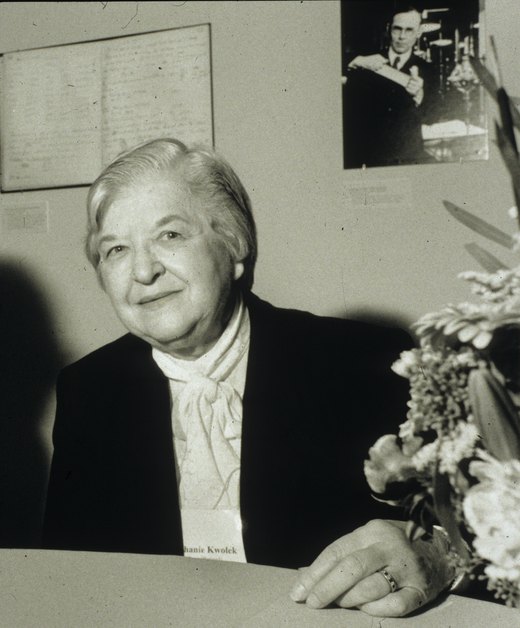 Kwolek at a Science History Institute event. Photo by Harry Kalish, CC BY-SA 3.0.
One more fact that belongs in any complete telling. Kwolek assigned the patent to DuPont, as her employment terms required, and never received royalties from a material now counted in roughly two hundred applications. She was inducted into the National Inventors Hall of Fame in 1995, received the National Medal of Technology in 1996 and the Perkin Medal in 1997, and died on 18 June 2014 at ninety.
What this one actually teaches
Most retellings file this under serendipity, which is the least useful reading available.
The physics wasn’t accidental anywhere. The polymer was deliberately designed to be stiff and rod-like. Stiff rods at concentration order themselves — thermodynamics, not luck. Ordered rods flow easily and scatter light. Every link from the design intent to the strange jar is causal, and none of it needed a lucky break.
What was contingent was the interpretation, and that was a real judgement call by a person who could have gone the other way. The lab had a rule — cloudy and thin means bad batch, discard — and it was a good rule, right nearly every time. It had simply never met a case where all its warning signs were being produced by success instead of failure. A rule that fires on appearances can’t tell you which underlying cause produced them.
So the transferable part isn’t “keep your failures.” It’s narrower and more useful: when several things look wrong at once, find out whether they share a root cause before concluding you have several problems. Three faults with three causes is a bad batch. Three warning signs with one root is something else entirely, because a single cause producing several effects is a mechanism, and a mechanism is a thing you can exploit.
That’s the same instinct this site keeps coming back to in Why Pressure and The Invisible Wall: a name for a phenomenon is not a mechanism, and the interesting question is almost never what do we call this but what single thing would produce all of these observations at once.
One thing you can do with this. Next time something you built comes out wrong in more than one way at the same time, resist the urge to list the faults and fix them one at a time. Write them in a column and ask whether one cause could produce every line. Usually it can’t, and you have a bad batch. Occasionally it can — and that’s the only situation in which the thing in front of you is more interesting than the thing you set out to make.
Notes on sources, and how firm each claim is
Kept out of the body deliberately, so the story can run. Nothing here is optional reading if you intend to rely on a number.
The narrative details are secondary. The appearance of the solution, Smullen’s refusal, the filtering — all of it traces to Kwolek’s own oral-history interviews with the Science History Institute and its Beckman Center, recorded in 1986 and 1998. I have not read the transcripts; they reach this page through secondary reproductions, and quoted phrases are theirs rather than mine. Go to the transcripts before leaning on any specific wording. The spinneret’s “thousandth of an inch” comes down the same chain.
The patents were read directly. US 3,671,542, Optically anisotropic aromatic polyamide dopes, Kwolek, filed 23 May 1969, granted 20 June 1972 — source of the birefringence and post-shaping quotations. US 3,600,350, Poly(p-benzamide) composition, process and product, Kwolek, filed 20 April 1970, granted 17 August 1971. US 3,767,756, Dry jet wet spinning process, Blades, filed 30 June 1972, granted 23 October 1973.
The fiber data is DuPont’s own, from the Kevlar Aramid Fiber Technical Guide, course code KEV 0319 — every density, tenacity and modulus in the table. In that edition the Tensile Modulus rows read, as printed:
| Tensile Modulus | Kevlar 29 | Kevlar 49 |
|---|---|---|
| psi | 10.2 x 10⁶ | 6.3 x 10⁶ |
| (MPa) | (70,500) | (112,400) |
Those can’t all be right. 70,500 MPa really is 10.2 × 10⁶ psi, so the Kevlar 29 column is self-consistent and the conversion convention is ordinary. But 112,400 MPa is 16.3 × 10⁶ psi, not 6.3 × 10⁶ — and 6.3 × 10⁶ psi would be about 43 GPa, which is no Kevlar grade at all. The error is in that one printed cell; the SI value is the consistent one and is what’s used above. Scoped to the printing quoted.
The steel baseline is the weakest link. 2,800 MPa is 0.20 mm tire cord in the 1970s, from a published review of high-carbon tire wire tracking the figure by decade — 3,300 MPa by the 1980s, 3,600 by the early 1990s. That’s a secondary source, not a mill certificate. Modern super-tensile cord at 3,200–3,500 MPa would put the ratio at 4.7–5.1× instead of 5.8×. And A36 is specified by yield (~250 MPa) with an ultimate strength band of roughly 400–550 MPa; 400 is the low, round end, so the 41× is an upper figure and would be about 30× at the other end. The point that row is making survives either number.
The two figures aren’t from the same test. Kevlar’s is a yarn breaking tenacity measured by textile methods on conditioned yarn; steel’s is a filament ultimate tensile strength. Published nominal values from two traditions, not two coupons on one machine. The comparison is the standard one and it’s fair — it just isn’t a matched-protocol result and shouldn’t be quoted as one.
Everything arithmetic was computed here, not quoted: the specific strengths, 5.8×, 41×, ~30×, the 7% absolute edge, 3.1× specific modulus, 4.7–5.1×, and the psi/MPa inconsistency above.
Also secondary, and flagged as such: the ~200 applications figure is the Science History Institute’s count. The Hall of Fame year is given as 1994 by some sources and 1995 by the Hall’s own listing and most others. PPTA’s commercial rollout is usually put at 1971–72 rather than a single date. Onsager’s original is “The Effects of Shape on the Interaction of Colloidal Particles,” Annals of the New York Academy of Sciences 51 (1949), 627–659.
Review. This entry went through two deliberately adversarial passes before publication, each told to attack the history, chemistry, arithmetic and any overclaiming rather than comment on style. Neither found an arithmetic error. Both found overclaiming, which gets corrected rather than argued with. Among the things they killed: an earlier draft called liquid crystallinity “the entire reason the fiber is strong,” credited the hydrogen bonds with carrying axial load, treated cloudiness as proof of liquid crystallinity, and described the alignment as arriving “free” when only the local part of it does.
Image credits. Woven Kevlar by Paul Hudson, CC BY 2.0. Kwolek portrait (1986), Science History Institute, and the later portrait by Harry Kalish, both CC BY-SA 3.0. Kevlar yarn specimen, Collectie Industriemuseum Gent, CC0. PPTA synthesis diagram by Hbf878, CC0. All via Wikimedia Commons. The two explanatory diagrams — coils versus rod domains, and the viscosity curve — were drawn here in the site’s palette.