20 Sound Wave Formulas
July 2026
Original post: @cosmosarcive on X, 2026-07-22. If the embed above doesn’t load, the same content is captured in the image and full description below.
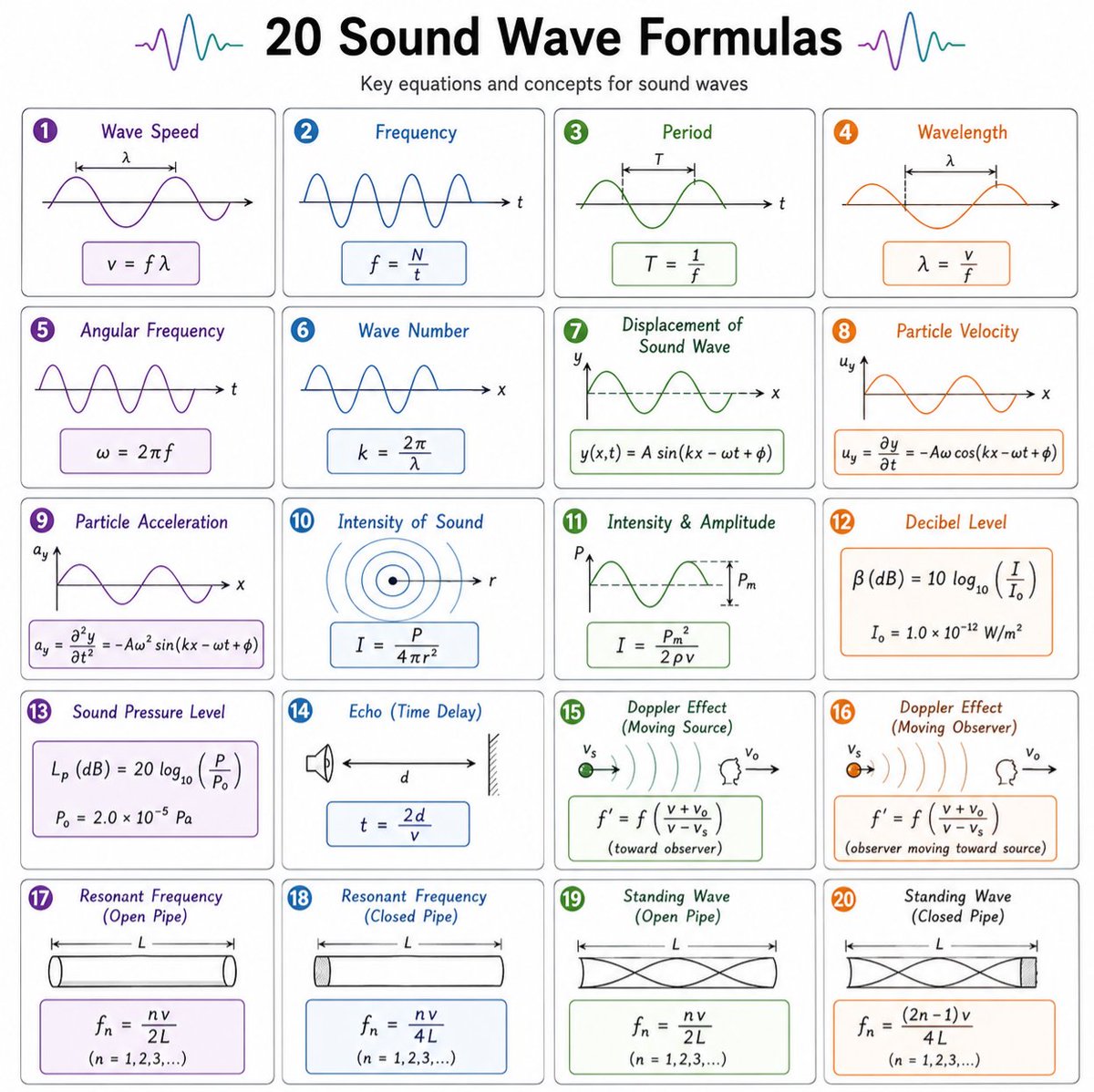
Wave motion basics (1–6)
Sound is a mechanical pressure wave, and these six formulas describe any traveling wave regardless of what medium it’s in:
- Wave speed: $v = f\lambda$ — speed equals frequency times wavelength.
- Frequency: $f = N/t$ — number of cycles per unit time.
- Period: $T = 1/f$ — time for one full cycle, the reciprocal of frequency.
- Wavelength: $\lambda = v/f$ — distance a wave travels in one full cycle.
- Angular frequency: $\omega = 2\pi f$ — frequency expressed in radians per second rather than cycles per second. See the Symbols & Units catalog for $\omega$’s broader use across this site.
- Wave number: $k = 2\pi/\lambda$ — the spatial analog of angular frequency, radians per unit distance.
Describing the wave itself (7–9)
- Displacement: $y(x,t) = A\sin(kx - \omega t + \phi)$ — the actual position of a particle in the medium at position $x$ and time $t$, for a wave of amplitude $A$ and phase $\phi$.
- Particle velocity: $u_y = \partial y/\partial t = -A\omega\cos(kx-\omega t+\phi)$ — how fast a single particle in the medium is moving, found by differentiating displacement with respect to time. This is the particle’s own oscillation speed, not the wave’s propagation speed $v$ — a common point of confusion worth being direct about.
- Particle acceleration: $a_y = \partial^2y/\partial t^2 = -A\omega^2\sin(kx-\omega t+\phi)$ — the second derivative, describing the restoring force driving the oscillation.
Intensity and loudness (10–13)
- Intensity: $I = P/(4\pi r^2)$ — sound power spreading out over an expanding spherical surface as it travels from a point source; this is why sound (and light, and gravity) all follow the same inverse-square falloff with distance.
- Intensity and amplitude: $I = P_m^2/(2\rho v)$ — intensity in terms of pressure amplitude $P_m$, medium density $\rho$, and wave speed $v$.
- Decibel level: $\beta(\text{dB}) = 10\log_{10}(I/I_0)$, with reference intensity $I_0 = 1.0\times10^{-12}$ W/m² — the quietest sound a healthy human ear can detect, by definition.
- Sound pressure level: $L_p(\text{dB}) = 20\log_{10}(P/P_0)$, with reference pressure $P_0 = 2.0\times10^{-5}$ Pa — the same idea measured directly in pressure rather than intensity (the factor-of-20 instead of 10 comes from intensity scaling as pressure squared).
Echo and the Doppler effect (14–16)
Echo (time delay): $t = 2d/v$ — round-trip time for a reflection off a surface at distance $d$.
Doppler effect (moving source): $f’ = f\left(\dfrac{v+v_o}{v-v_s}\right)$ — the familiar pitch shift as an ambulance passes: the frequency you hear is higher the whole time it approaches, and lower once it has gone by.
Worth being precise here, because the usual description is wrong. People — and a lot of textbook captions — say the pitch “rises as it approaches, then falls.” It does not rise. Put the observer a little off to the side of the road and let $\theta$ be the angle between the ambulance’s velocity and the line to your ear. Only the component of its motion along that line shifts the pitch, so the formula becomes $f’ = f\,\dfrac{v}{v - v_s\cos\theta}$. Far off and approaching, $\cos\theta \approx +1$ and the pitch sits at its maximum, $f\,v/(v-v_s)$. At the moment of closest approach $\cos\theta = 0$ and you hear the true pitch $f$. Receding, $\cos\theta \to -1$ and it bottoms out at $f\,v/(v+v_s)$. Since $\cos\theta$ decreases the whole way through, the pitch falls monotonically from first hearing to last and never rises at any point. What people are remembering is loudness, which really does grow on approach — the only way the pitch itself can rise is if the ambulance is speeding up toward you.
Doppler effect (moving observer): the same relationship, $f’ = f\left(\dfrac{v+v_o}{v-v_s}\right)$, applied when the listener is moving toward a stationary source instead.
Resonance and standing waves (17–20)
- Resonant frequency, open pipe: $f_n = nv/2L$, $n=1,2,3,\ldots$ — a pipe open at both ends supports every harmonic.
- Standing wave, open pipe: the same formula, $f_n = nv/2L$ — resonance and standing-wave frequency are the same thing for an open pipe, which is why these two rows of the source chart match exactly.
- Standing wave, closed pipe: $f_n = (2n-1)v/4L$, $n=1,2,3,\ldots$ — a pipe closed at one end supports only odd harmonics (the fundamental, 3rd, 5th, and so on), which is what the $(2n-1)$ term enforces.
A real inconsistency worth flagging rather than silently reproducing: the source chart’s own row 18 (“Resonant Frequency, Closed Pipe”) states $f_n = nv/4L$ for $n=1,2,3,\ldots$ — but checked directly against row 20 (the standing-wave version for the same closed-pipe case), that’s only correct at $n=1$. At $n=2$, row 18’s formula predicts a resonance at $v/2L$ that a real closed pipe doesn’t have — closed pipes skip even harmonics entirely, which row 20’s $(2n-1)v/4L$ correctly captures and row 18’s plain $nv/4L$ does not. Row 18 appears to be a common informal shorthand (often stated loosely as “closed pipe: $v/4L$” for the fundamental only) rather than the fully general formula; row 20 is the one to actually use for $n>1$.
Catalog status: Proven Systems
All twenty of these are standard, exhaustively confirmed acoustics and wave mechanics — used every day in audio engineering, architectural acoustics, ultrasound imaging, and musical instrument design. The one caught inconsistency (row 18 vs. row 20) is an error in this specific infographic’s shorthand, not a disputed point in the underlying physics.
Where this touches PBT
Sound is the clearest case on this entire site where “pressure” isn’t a metaphor for anything — a sound wave is, literally and by definition, a traveling pattern of pressure compression and rarefaction in a medium. See Why Pressure for the fuller argument this connects to: PBT’s own claim is that gravity, electromagnetism, and other forces might relate to pressure in this same literal way, not just the analogical way they’re normally taught. Nothing on this page is itself a PBT claim — it’s the real, established acoustics that argument is built on.