Carl Friedrich von Weizsäcker & Hans Bethe
July 2026
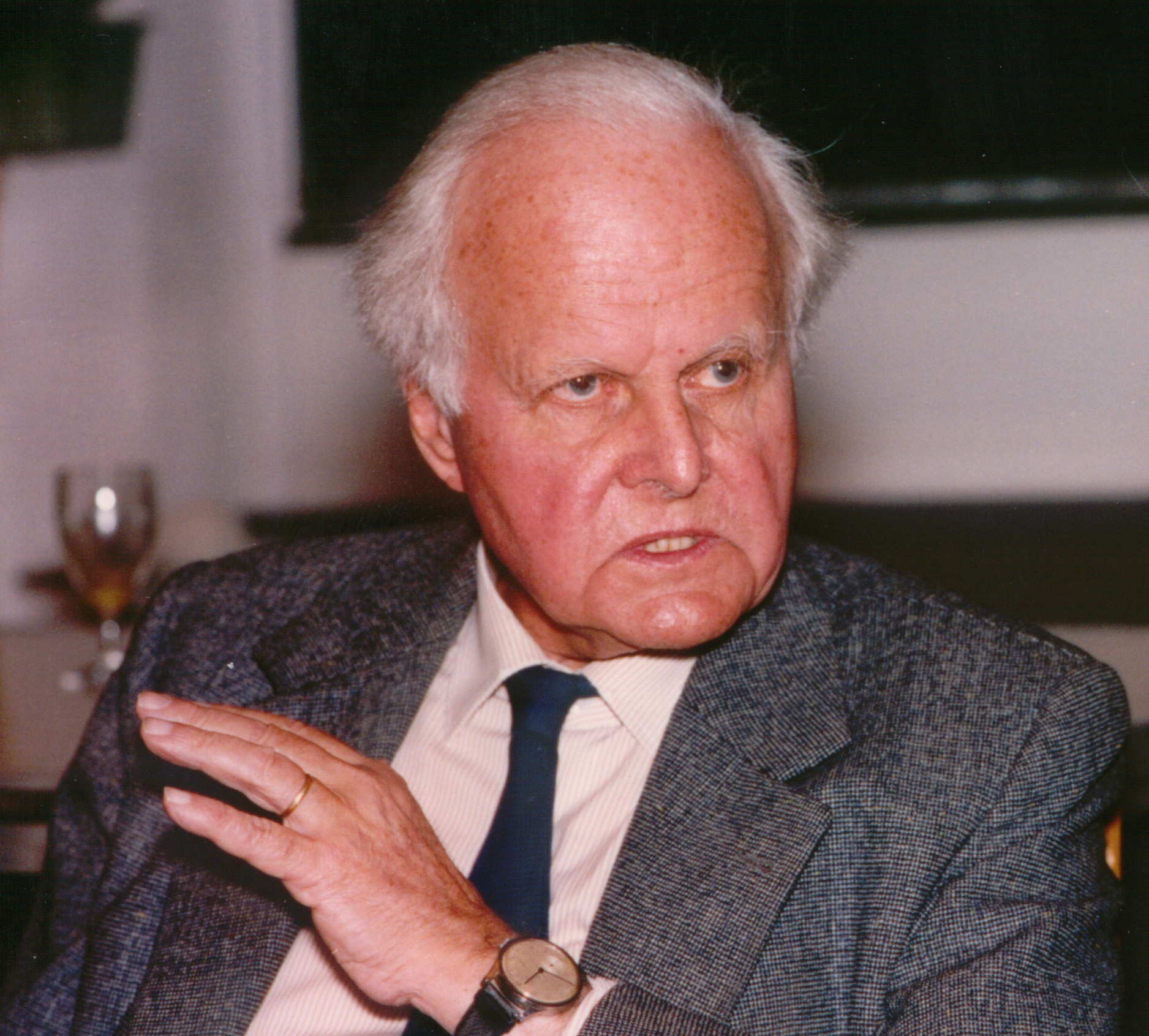 Photo: Ian Howard, via Wikimedia Commons, CC BY-SA 3.0.
Who they were
Carl Friedrich von Weizsäcker (1912–2007) was a German physicist and philosopher who, in 1935, proposed modeling the atomic nucleus as a liquid drop to predict its binding energy. Hans Bethe (1906–2005), a German-American physicist who later won the 1967 Nobel Prize in Physics for explaining the nuclear reactions that power stars, refined the formula with Robert Bacher in 1936.
What they’re known for on this site
The Semi-Empirical Mass Formula (also called the Weizsäcker or Bethe-Weizsäcker formula) predicts a nucleus’s binding energy per nucleon from real physical terms: volume, surface, Coulomb (electrostatic repulsion), asymmetry (a Pauli-exclusion penalty for unequal proton/neutron counts), and pairing. It’s genuinely proven physics, still used today, and forms the basis for the Bohr-Wheeler fissionability parameter used elsewhere on this site.
Catalog status: Proven Systems
The liquid-drop model is standard, well-confirmed nuclear physics — not a hypothesis under test.
Mentioned on this site
- Semi-Empirical Mass Formula (established)
- Nuclear Binding Energy Formula
- Paper 13 (unpublished draft)
Where this touches PBT
Paper 13 (unpublished draft) uses the real semi-empirical mass formula as its verified starting point, then adds PBT’s own asymmetry-term ladder toy model on top — this site’s own Formula Catalog is explicit that PBT’s addition is a partial, unproven derivation, not a modification of Weizsäcker and Bethe’s original, proven result.