Max Planck
July 2026
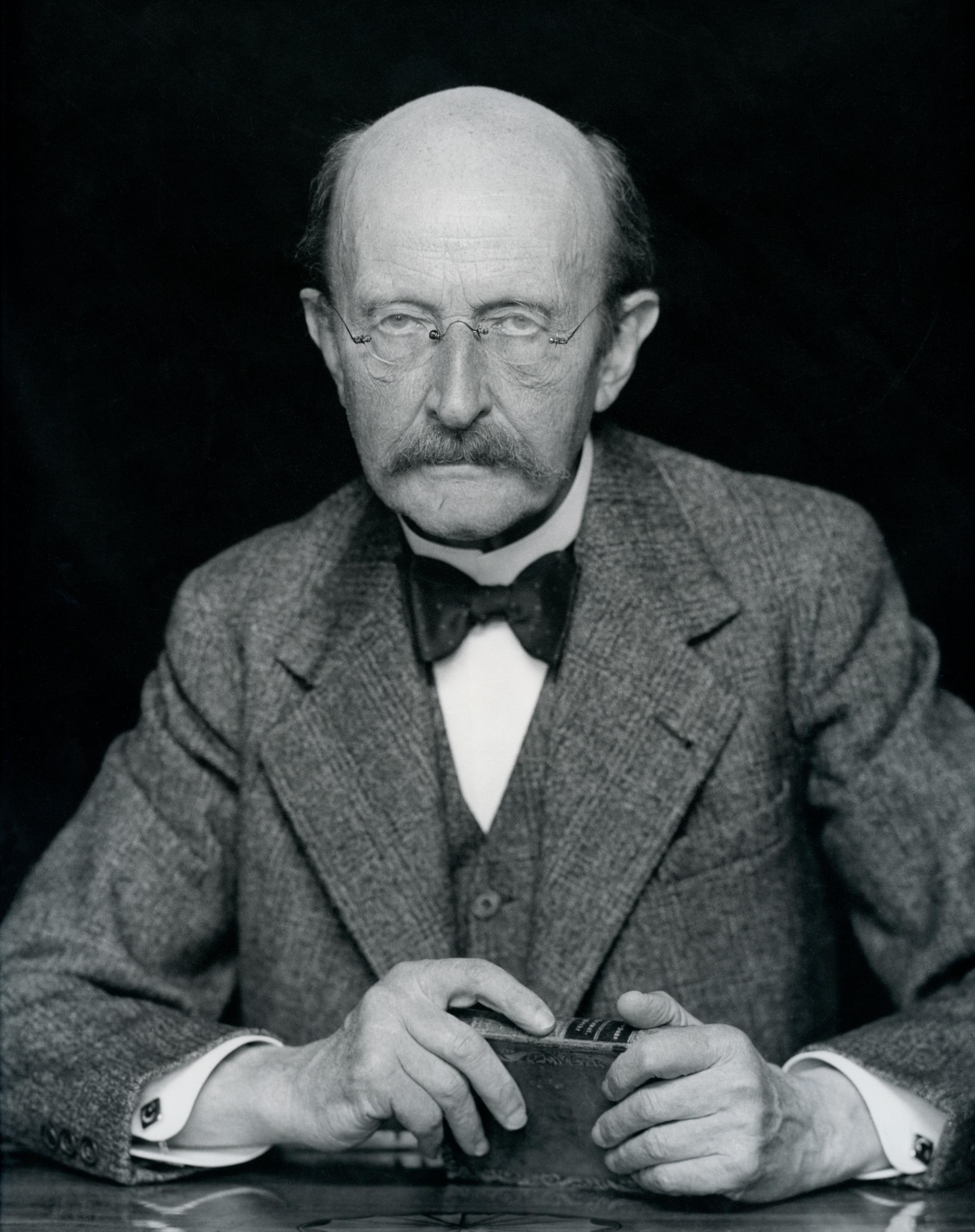
Who he was
Max Planck (1858–1947) was a German theoretical physicist. His 1900 resolution of the blackbody radiation problem — proposing that energy is emitted in discrete quanta rather than continuously — is the founding moment of quantum mechanics. He received the 1918 Nobel Prize in Physics.
What he’s known for on this site
This site already has a full dedicated treatment in Field Notes: Blackbody Radiation, Planck’s Quantization, and the Birth of Quantum Mechanics, covering the ultraviolet catastrophe, the quantization formula $E=nh\nu$, and the real, precisely-measured connection to the Cosmic Microwave Background. Planck’s constant ($h$, and its reduced form $\hbar = h/2\pi$) is one of the most-used symbols across this entire site — see its full entry in the Symbols & Units catalog.
Catalog status: Proven Systems
Planck’s quantization and the constant that carries his name are among the most precisely confirmed results in physics — not a hypothesis, the literal starting point of an entire field.
Mentioned on this site
- Field Notes: Blackbody Radiation — the full treatment
- Symbols & Units: ħ, h
- Hydrogen Orbital Probability Density — quantum numbers built on the same quantization Planck introduced
Where this touches PBT
Planck’s constant appears throughout PBT’s own formulas exactly as standard physics defines it — PBT doesn’t currently offer its own derivation of quantization itself, using $h$/$\hbar$ as an imported, unmodified constant rather than a value the theory’s own mechanism produces.