Emmy Noether — the Theorem That Explains Why Conservation Laws Exist at All
July 2026
Original post: @PhilosophyOfPhy on X, 2026-07-22. If the embed above doesn’t load, the same image and description are below.
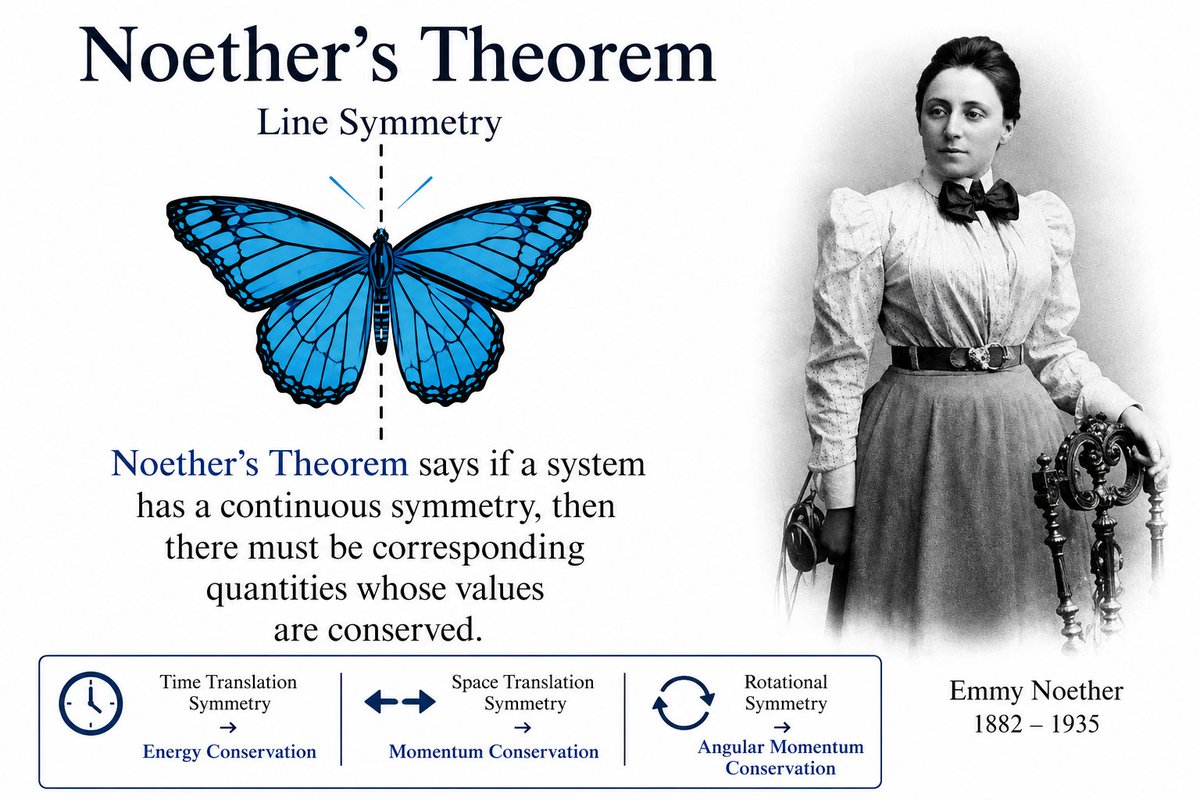
Who she was
Amalie Emmy Noether (1882–1935) was a German mathematician working at the University of Göttingen, then one of the world’s leading centers for mathematics and physics, under the encouragement of David Hilbert and Felix Klein — two of the most prominent mathematicians of the era. Despite that, Göttingen’s faculty initially refused to grant her a paid position solely because she was a woman; Hilbert is reported to have responded to the objection by pointing out that the university was not a bathhouse. She eventually lectured for years under Hilbert’s own name before formally receiving a position. Beyond the theorem below, she’s independently regarded as a founder of modern abstract algebra — “Noetherian rings” and “Noetherian induction” are named for her foundational work there, a separate body of work from the physics result this entry covers.
What she actually proved
In 1918, while working through mathematical problems raised by Einstein’s newly-published general relativity, Noether proved a result now called Noether’s theorem: for every continuous symmetry a physical system has, there exists a corresponding conserved quantity. “Continuous symmetry” means the system’s laws look the same after a smooth, continuous transformation — shifting forward in time, sliding sideways in space, or rotating by some angle. The theorem shows these aren’t independent coincidences; each one is the same underlying fact wearing a different face:
- Time-translation symmetry (the laws of physics work the same today as tomorrow) $\rightarrow$ conservation of energy.
- Space-translation symmetry (the laws work the same here as they do a mile away) $\rightarrow$ conservation of momentum.
- Rotational symmetry (the laws work the same no matter which direction you’re facing) $\rightarrow$ conservation of angular momentum.
Before Noether, conservation of energy and momentum were treated as separate empirical facts — true because every experiment ever run confirmed them, not because anything required them to be true. Noether’s theorem showed why they must be true, as a direct mathematical consequence of the universe simply not caring what time it is or which way you’re facing.
Why this matters beyond the three examples
The theorem is completely general — it applies to any symmetry a system has, not just the three classic spacetime ones above. Modern particle physics leans on this constantly: the Standard Model’s own conserved quantities (electric charge, color charge, and others) are Noether-theorem consequences of internal symmetries in the theory’s mathematical structure (the “gauge symmetries” that define quantum electrodynamics and quantum chromodynamics), not separate assumptions bolted on. Every conservation law used anywhere in physics — including every paper on this site — is either a direct instance of Noether’s theorem or assumed true on the strength of experiments that the theorem explains from first principles.
Catalog status: Proven Systems
Noether’s theorem is a rigorously proven mathematical result, not a physical hypothesis under test — once a system’s symmetries are specified, the corresponding conserved quantity is a matter of mathematical derivation, not experimental confirmation. What experiment confirms is that the symmetries themselves hold in the real world (e.g., that the laws of physics really don’t change over time) — which every precision test to date supports.
Where this touches PBT
Pressure-Based Theory’s own papers assume standard conservation laws throughout (energy, momentum, angular momentum all appear across Paper 1 through Paper 13 (unpublished draft)) without deriving them from the theory’s own symmetries the way Noether’s theorem would require — they’re imported from standard physics, not shown to follow from PBT’s own aether-medium assumptions. This isn’t a criticism unique to PBT (most working physics papers assume conservation laws rather than re-deriving them from scratch), but it means PBT hasn’t yet been checked for whether its own claimed symmetries actually produce the conservation laws it relies on.