Blaise Pascal
July 2026
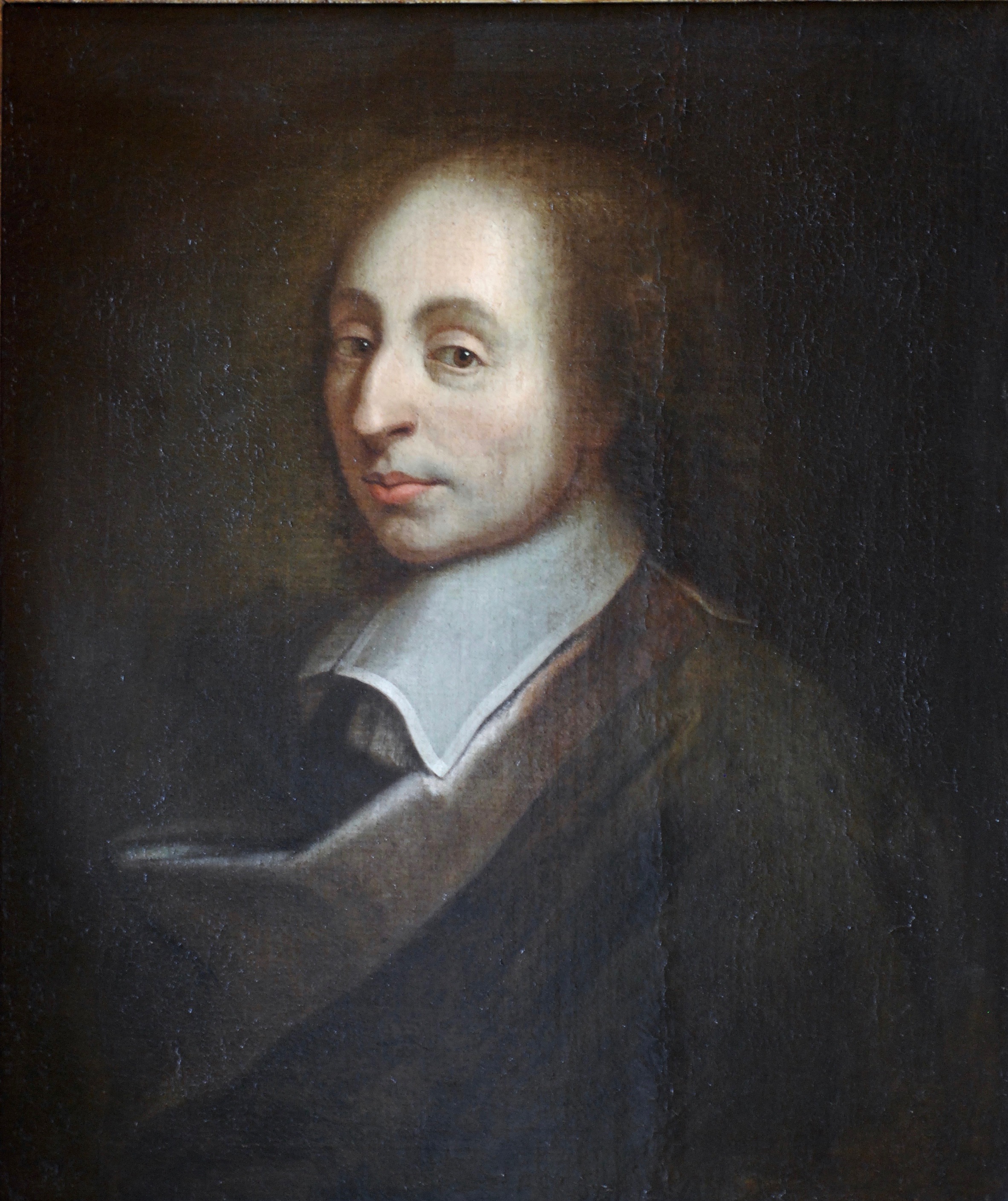
Who he was
Blaise Pascal (1623–1662) was a French mathematician, physicist, inventor, and philosopher. In an unusually short life, he made foundational contributions to probability theory, built one of the first mechanical calculators, and did the pressure and vacuum experiments this site’s own subject matter is named after.
What he’s known for on this site
Pascal’s 1653 work established Pascal’s Law (also called Pascal’s Principle): pressure applied anywhere to a confined, incompressible fluid is transmitted equally and undiminished in all directions — the physical basis of every hydraulic system built since. He also settled a major open scientific question of his era: whether “nature abhors a vacuum,” as Aristotelian physics held, or whether air itself has weight and exerts pressure that decreases with altitude. Building on Torricelli’s 1643 invention of the mercury barometer, Pascal arranged for his brother-in-law Florin Périer to carry a barometer up the Puy de Dôme mountain in 1648 — the mercury column dropped measurably with altitude, direct proof that atmospheric pressure is real, physical, and caused by the weight of the air above, not some abstract “horror of the void.” The SI unit of pressure, the pascal (Pa), used throughout this site’s Symbols & Units catalog and its Atmospheric & Vacuum Pressure Measurement guide, was named for him in 1971.
Catalog status: Proven Systems
Pascal’s Law and the physical reality of atmospheric pressure are foundational, exhaustively confirmed classical physics — not in question by anyone, PBT included.
Mentioned on this site
- Symbols & Units catalog — the pascal (Pa) unit definition
- Atmospheric & Vacuum Pressure Measurement — the pascal/kilopascal row in the conversion table
Where this touches PBT
Pascal’s own work is the historical root of “pressure” as a serious, measurable physical quantity — the same word this site’s entire subject, Pressure-Based Theory, takes its name from. That’s a genuine thematic resonance, not a mechanical connection: Pascal’s pressure is force transmitted through a confined fluid or gas — a fixed, bounded volume of matter that’s already understood to be there. PBT’s own picture is different: it holds that what we call the vacuum of space isn’t empty at all, but filled with a medium of particles — similar in kind to air or water molecules, though not identical to either — and that pressure simply exists in that medium the same direct way air pressure or water pressure exists, not as something generated or derived from a separate cause. That same medium is what PBT claims light and radio waves actually propagate through, rather than propagating through nothing. The particles are held to be moving fast enough, and be small enough, that their drag on large bodies (planets, spacecraft) is negligible — PBT’s own proposed answer to the drag objection that helped sink Le Sage’s original 18th-century version of this idea. Nothing about Pascal’s proven 17th-century results is evidence for or against PBT’s own claims — they’re independent, and this site is direct about that rather than implying the name similarity means more than it does. See Pressure for the fuller, dedicated statement of this point of understanding.