Albert Einstein
July 2026
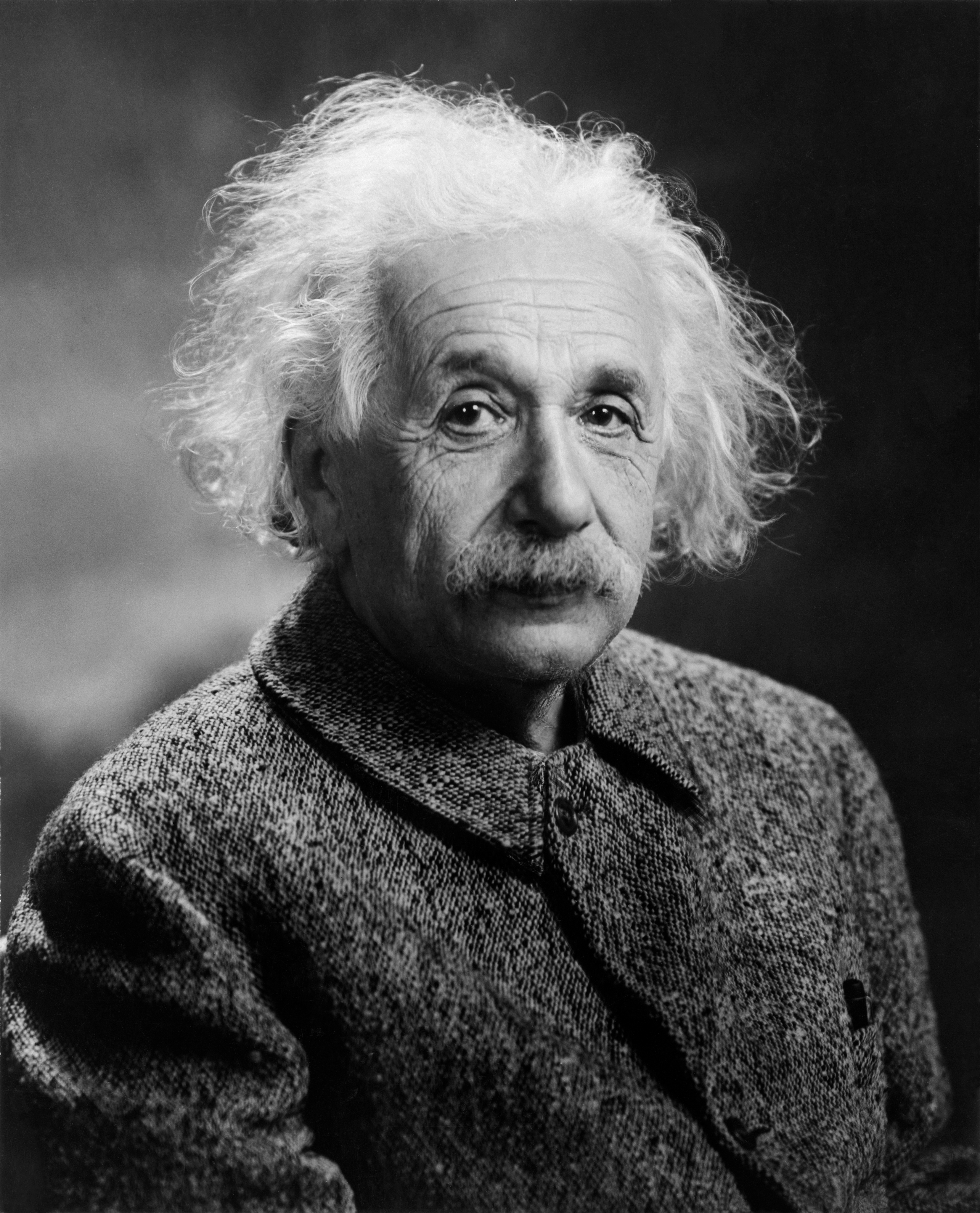
Who he was
Albert Einstein (1879–1955) was a German-born theoretical physicist whose 1905 “miracle year” papers (special relativity, the photoelectric effect, and Brownian motion) and 1915 general theory of relativity reshaped physics from the ground up. He received the 1921 Nobel Prize in Physics — for the photoelectric effect specifically, general relativity still being considered too new to fully confirm at the time.
What he’s known for on this site
General relativity (GR) replaced Newton’s gravity-as-force with gravity as the curvature of spacetime itself, caused by mass and energy. It’s one of the most precisely tested theories in physics — confirmed by Mercury’s perihelion precession, light bending during the 1919 eclipse expedition, gravitational time dilation (verified continuously by GPS satellites), and the direct detection of gravitational waves (LIGO, 2015). See General Relativity for the fuller status. Pressure-Based Theory’s own aether framework (Einstein-Aether Theory) is a real, published extension built directly on top of GR’s own mathematical structure, not a replacement for it — PBT’s papers explicitly aim to recover GR’s confirmed predictions (like light bending, see Weak-Field Light Bending) as a special case of a broader mechanical picture.
Catalog status: Proven Systems
General relativity is not a hypothesis under test on this site — it’s the extensively confirmed backdrop every paper here explicitly measures itself against.
Mentioned on this site
- General Relativity — the theory itself
- Einstein-Aether Theory — the real framework PBT’s own aether field builds on
- Weak-Field Light Bending — a GR prediction PBT’s papers check themselves against
- Standard Cosmology — GR’s role in the expanding-universe model
Where this touches PBT
Every paper on this site treats general relativity as the standard it needs to reproduce or improve on, not a claim it disputes. PBT’s own aether field is explicitly built as an extension of GR’s mathematical framework, not a rival to it.