Where Newton Stopped Short: An Exact Geometric Result at Classical Scale, and Where It Doesn't Yet Reach
July 2026
Authors
Matthew Foutch, with Claude (Anthropic) and Grok (xAI) as AI collaborators
Abstract
Paper 14 found that Pressure-Based Theory’s shadowing mechanism reproduces Newton’s inverse-square law to within 0.01% in the classical two-body limit. This paper asks what that result actually establishes, and corrects a real error made in an earlier draft of this same paper along the way. The relevant geometric quantity for a shadowing force is not the raw solid angle a body blocks — that quantity does grow faster than $1/d^2$ at close range, as an earlier draft of this paper incorrectly used to claim a real near-field breakdown. The quantity that actually determines net force is the cosine-weighted momentum-deficit integral over the same blocked cone, and that integral is exactly $\pi(R/d)^2$ — exact inverse-square — at every separation $d>R$ outside an idealized opaque sphere, with no near-field correction at all, for the same underlying reason Newton’s own Shell Theorem is exact rather than approximate. This is a cleaner, stronger, and more surprising result than the (incorrect) bounded-approximation claim it replaces. It is also narrowly scoped: it holds for a point test particle outside a single, perfectly opaque sphere. It says nothing about the two real, still-open problems that actually threaten this mechanism: whether a realistically imperfect absorber (not perfectly opaque, not a mathematical point) preserves exact proportionality to mass — the historical self-shielding objection (Poincaré, Maxwell) that is the actual reason Le Sage-type gravity has never been rescued, not a side caveat — and mutual shadowing between two extended bodies, neither of which this paper attempts. Drag and heating, per Paper 14, remain separately unresolved.
Keywords: push gravity, shadowing mechanism, solid-angle occlusion, Newtonian limit, self-shielding, Le Sage gravity, Shell Theorem
Introduction
Newton’s law works to extraordinary precision, and Newton himself declined to propose a mechanism for it in the Principia — “hypotheses non fingo,” I feign no hypotheses, in the context of declining to publish an untested mechanical cause for gravity (he explored other speculative mechanisms privately, a point worth stating plainly rather than turning the phrase into more than the specific thing it was). General Relativity gives a mathematically complete, exhaustively tested account of gravity — a geometric one, mass curving spacetime — which is not a deficiency needing correction; it’s a different category of explanation than a kinetic account of a physical process with moving parts. The one serious historical attempt at that kinetic genre is Georges-Louis Le Sage’s particle-flux shadowing (1748), cited directly as Paper 1’s own reference 1. It is settled, disproven physics today — for reasons this paper takes more seriously than an earlier draft did (see Discussion).
Paper 14 reported that PBT’s version of shadowing reproduces Newton’s law to 0.01% in the classical limit. This paper set out to ask how far that extends. An earlier draft made a real error doing so — treating blocked solid angle as if it were the force — caught before publication by a dedicated adversarial review. This version corrects that error, replacing an incorrect “the approximation breaks down near contact” claim with the actual, exact result, and states plainly what the exact result does and doesn’t cover.
Theory Description
The shadowing mechanism’s classical claim: a body of radius $R$ immersed in an isotropic ambient flux blocks part of that flux from reaching a point at distance $d$. The resulting directional deficit in incoming flux reads as a net force toward the body. The quantity that determines this net force is not simply “how much of the sky is blocked” (the solid angle) — it’s the vector sum of the missing flux, and off-axis blocked directions contribute less to the net axial force than on-axis ones, by a factor of $\cos\theta$. Conflating these two quantities was the error in an earlier draft of this paper.
Mathematical Formalism
The blocked solid angle (how much of the sky the sphere covers, as seen from distance $d>R$) has the exact form:
$$\Omega_{exact}(R,d) = 2\pi\left(1-\sqrt{1-(R/d)^2}\right)$$
This is not the quantity that determines net force. For that, integrate the missing flux over the blocked cone (half-angle $\alpha$, where $\sin\alpha=R/d$ exactly, from the standard tangent-line construction — an exact relation, not an approximation, valid at any $d>R$), weighted by $\cos\theta$ to project onto the axial direction:
$$F_{geo}(R,d) \propto \int_0^{2\pi}\int_0^\alpha \cos\theta\sin\theta\,d\theta\,d\phi = 2\pi\cdot\frac{\sin^2\alpha}{2} = \pi\sin^2\alpha$$
Since $\sin\alpha=R/d$ exactly, this gives:
$$F_{geo}(R,d) \propto \pi\left(\frac{R}{d}\right)^2$$
exactly, for every $d>R$ — not a far-field limit, not a leading-order approximation with corrections at close range. Verified independently, both algebraically (the identity $\sin^2(\arcsin x)=x^2$ makes this exact by construction, not numerical coincidence) and numerically to floating-point precision at $R/d$ from 0.05 to 0.9999.
This is the same phenomenon behind Newton’s own Shell Theorem: a spherically symmetric source produces an exact inverse-square field outside itself at any distance, not just far away. The cosine weighting that turns “blocked solid angle” into “net force” is exactly what reproduces that exactness here — the raw solid angle overcounts near-field blocking, and the cosine projection exactly compensates for it.
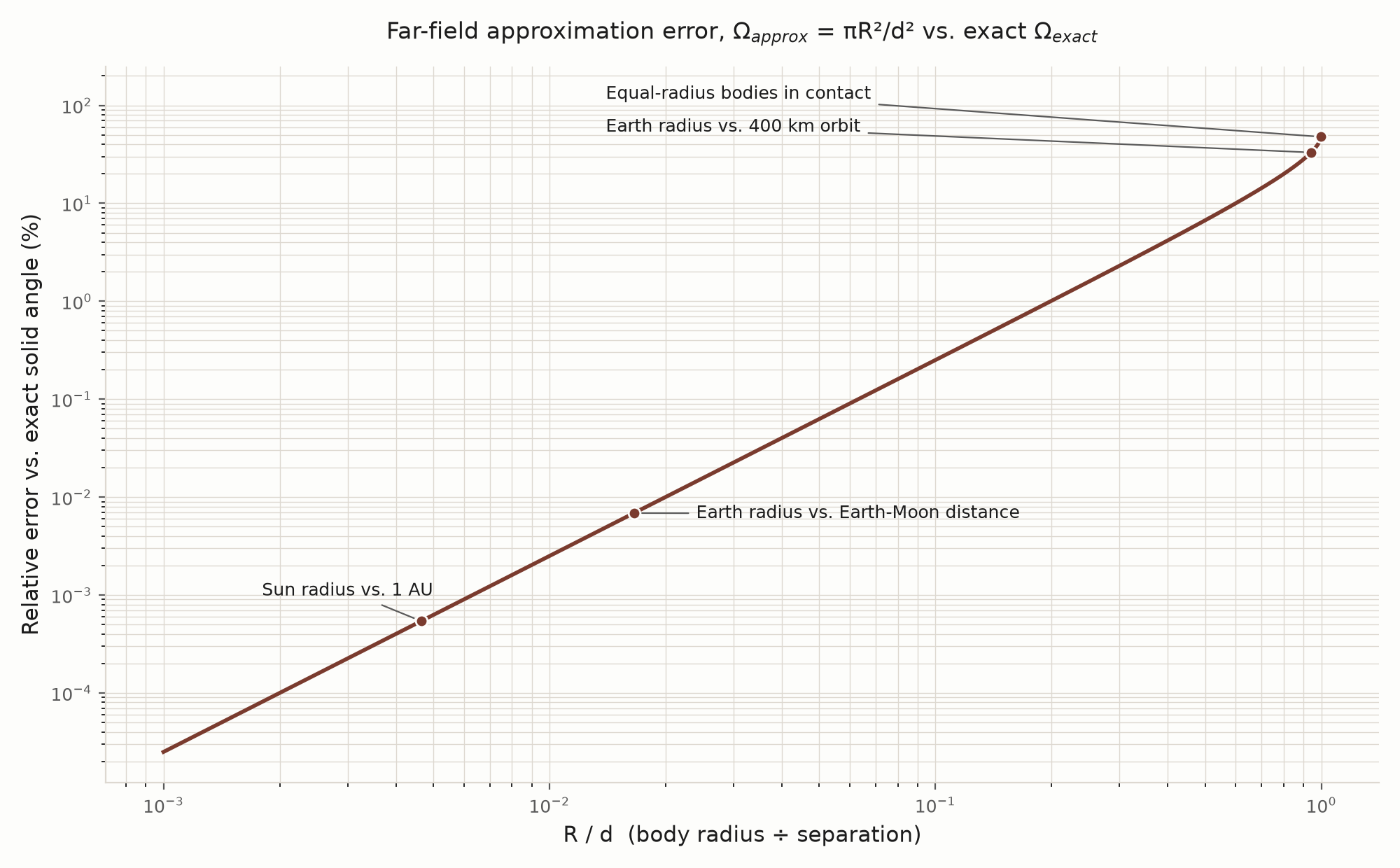
Figure 1. Generated via Python/matplotlib, computed directly from the formulas above (script preserved in this project’s own research log for reproducibility). The dashed curve is the real, growing discrepancy in blocked solid angle — the quantity an earlier draft of this paper mistakenly used. The flat line at zero is the actual force-relevant quantity: exactly $\pi(R/d)^2$, with no deviation, at every separation from $R/d=0.001$ to the point of contact.
Results
The force-relevant geometric factor is exactly inverse-square at every separation outside an idealized opaque sphere. There is no near-field breakdown of the kind an earlier draft of this paper claimed (a 33% deviation at low-Earth-orbit separations, 50% at contact) — that claim used blocked solid angle, the wrong quantity, and has been retracted. The corrected result is stronger: for a point test particle and a single, perfectly opaque sphere, $F_{geo}\propto1/d^2$ holds exactly, with zero deviation, at any separation greater than the sphere’s radius.
This does not mean the mechanism is validated at close range, or anywhere else beyond this idealized case — two real limitations remain, and the first is the actual historical crux, not a footnote.
- Self-shielding (Poincaré, Maxwell): the calculation above assumes a perfectly opaque sphere — every ray in the blocked cone is fully stopped. Real matter isn’t like that; a real body has some finite absorption/scattering cross-section per unit path length, not infinite opacity. If a body is opaque enough to produce meaningful shadowing at all, the outward layers partially shield the inward layers from the same ambient flux — meaning the effective shadow a body casts need not scale linearly with its mass. This is not a side caution: real gravity is measured to be exactly proportional to mass to extraordinary precision (Galileo’s equal-acceleration result, and modern torsion-balance/equivalence-principle experiments constraining composition-dependent deviations to roughly one part in $10^{13}$) (Superseded 2026-07-31: MICROSCOPE (2022) gives $\sim10^{-15}$, 100x tighter — see revision note.). A shadowing mechanism that doesn’t preserve exact mass-proportionality for realistically dense, differently-composed bodies is not a viable account of Newtonian gravity, regardless of how exact its point-sphere geometry is. This is the actual reason Le Sage-type gravity has never been successfully rescued — not an open detail alongside a secured foundation.
- This calculation is a point test particle and one sphere, not real two-body gravity. Real gravitation is mutual between two extended masses. Mutual shadowing — each body partially blocking the other’s own view of the ambient flux, with both bodies’ finite size and (per point 1) finite opacity — is a genuinely different and harder calculation this paper does not attempt.
Discussion
The corrected result is narrower and more accurate than the earlier draft’s claim, and also more elegant: exact inverse-square, not an approximation with a computable failure point, for the idealized case actually solved here. That’s a real, if modest, mathematical fact about the geometry — table stakes for the mechanism, not a demonstration of it.
The self-shielding problem is the correct center of gravity for this whole line of inquiry, more than the geometric exactness above. It is the historical reason Le Sage’s mechanism was never fully rescued even before drag and heating entered the picture, and — combined with Paper 14’s finding that drag and heating remain unresolved too — leaves this paper’s overall picture as: the pure single-sphere geometry is exactly right, and every other piece needed for a complete mechanism (mass-linearity under realistic opacity, mutual two-body shadowing, drag, heating) remains open. Newton stopped short of proposing a mechanism at all. This paper narrows exactly one piece of what a mechanism would require, correctly this time, and is explicit that it is one piece among several still missing.
Testable Predictions
- Self-shielding is checkable against data that already exists. If a realistic, finite-opacity version of this mechanism predicts any composition- or density-dependent deviation from exact mass-proportionality, that prediction is directly constrained by existing high-precision equivalence-principle experiments (torsion-balance tests already bounding composition-dependent effects to about 1 part in $10^{13}$) (Superseded 2026-07-31: MICROSCOPE (2022) gives $\sim10^{-15}$, 100x tighter — see revision note.). Any future finite-opacity model must be checked against this real, existing bound before being presented as viable — a concrete, immediately-available falsification test, not a proposed future observation.
- Mutual two-body shadowing is a defined, tractable next calculation, not yet attempted here: extend the single-sphere-and-point-particle result above to two finite spheres, each partially shadowing the other, and check whether the exact inverse-square result survives.
Conclusion
An earlier draft of this paper claimed a real, calculable near-field breakdown in the shadowing mechanism’s Newtonian reduction. That claim was wrong — it used blocked solid angle where the actual force depends on a cosine-weighted integral, and that integral is exactly inverse-square at every separation, not approximately so. The corrected result is narrower in scope than originally advertised and mathematically stronger where it applies. It does not touch the actual central problem this mechanism has never solved: whether shadowing preserves exact proportionality to mass once bodies are treated as realistically imperfect absorbers rather than idealized opaque points and spheres. That problem, not the geometry corrected here, is where the real work remains.
References
- Le Sage, G.-L. (1748). Essai de Chymie Méchanique.
- Edwards, M. R. (Ed.). (2002). Pushing Gravity: New Perspectives on Le Sage’s Theory.
- Newton, I. (1713). Philosophiæ Naturalis Principia Mathematica, 2nd ed., General Scholium (“hypotheses non fingo”).
- Newton, I. (1687). Philosophiæ Naturalis Principia Mathematica, Book I, Proposition 71 (the Shell Theorem).
- Maxwell, J. C. (1875). “Atom,” Encyclopædia Britannica, 9th ed. — added 2026-07-31; see revision note below.
- Poincaré, H. (1908). Science et Méthode. — added 2026-07-31; see revision note below.
- Touboul, P., et al. (2022). “MICROSCOPE Mission: Final Results of the Test of the Equivalence Principle,” Physical Review Letters 129, 121102. — added 2026-07-31.
Revision Note — 2026-07-31
Four corrections, found during the consolidation audit that produced Paper 17. Original text above is preserved unchanged; corrections are stated here.
1. Missing references (citation error). This paper’s Results section attributes the self-shielding objection to “Poincaré, Maxwell” and its Discussion calls it “the historical reason Le Sage’s mechanism was never fully rescued,” but neither Maxwell nor Poincaré appeared anywhere in the original reference list. Both are now added as references 5 and 6. Maxwell’s critique is in his article “Atom” (Encyclopædia Britannica, 9th ed., 1875), verified by direct quotation from the article text — the passage in which he states that if any appreciable fraction of the flux energy were communicated as heat, it “would in a few seconds raise it, and in like manner the whole material universe, to a white heat.” For Poincaré, the year (1908) and the substance (a quantitative heating critique) are verified; a more precise chapter localization was attempted from primary text and could not be confirmed, so the citation is given at book level rather than asserting an unverified chapter.
2. The equivalence-principle bound cited here is 100x weaker than the best available. This paper twice cites “roughly one part in $10^{13}$” from torsion-balance experiments. That figure is accurate for torsion balances, but it is not the strongest existing constraint: the MICROSCOPE satellite mission’s final result (2022) gives an Eötvös parameter of $\eta(\text{Ti},\text{Pt}) = [-1.5 \pm 2.3(\text{stat}) \pm 1.5(\text{syst})]\times10^{-15}$ — a bound roughly 100 times tighter. Since this paper uses the number specifically as a falsification threshold for any future finite-opacity model, understating it understates the constraint the mechanism must survive. The correct threshold is $\sim10^{-15}$, not $\sim10^{-13}$. This makes Testable Prediction 1 substantially stronger, not weaker.
3. The exact result’s coefficient scales with area, not mass — now stated explicitly. This paper’s headline result, $F_{geo}\propto\pi(R/d)^2$, is correct, but its coefficient is $\pi R^2$: the sphere’s cross-sectional area. For a perfectly opaque body the shadow is a property of the silhouette and carries no information about what lies behind the surface, so it cannot scale with a volume quantity. Concretely, three bodies of identical mass ($M=4.1888$ in units where $\rho R^3$ sets the scale) cast shadows of $3.1416$, $12.5664$, and $50.2655$ — a 16x spread in force at fixed mass, against a measured mass-proportionality now bounded to $\sim10^{-15}$. The original text flags self-shielding as limitation 1 and is not wrong, but it understates the severity: for the perfectly-opaque case actually solved here, mass-proportionality does not merely degrade, it fails outright. Paper 17 names this the Area-Mass Obstruction and shows that the optically-thin linearization of Paper 16 is what repairs it, by rendering the shadow integral formally identical to the Newtonian volume integral.
5. Rendering fix (display only, no change of meaning). This paper’s central display equation was rendering incorrectly on the live site. CommonMark strips the backslash from LaTeX spacing macros before KaTeX ever sees them, so \!\! and \, were reaching the renderer as a literal !! and literal commas — the headline integral displayed as ∫∫!!... sinθ,dθ,dφ. Corrected by escaping the macros (\\,) and dropping the purely cosmetic negative thin spaces. A site-wide sweep found the same defect in Paper 14, Paper 16, and the Reference Guide; all are fixed. The mathematics was always correct — only its display was wrong.
4. Stated verification range is inconsistent between text and figure. The Mathematical Formalism section states the result was verified numerically “at $R/d$ from 0.05 to 0.9999”; Figure 1’s caption states “from $R/d=0.001$ to the point of contact.” Independent re-verification for Paper 17 covered $R/d$ from 0.001 to 0.9999, agreeing with the closed form to a maximum relative error of $2.4\times10^{-14}$ (floating-point precision). The figure’s stated range is the correct one.
Revision History
This is a standing work, revised as the underlying understanding improves rather than fixed at publication. Every substantive change is logged here, most recent first.
| Rev | Date | Change | By |
|---|---|---|---|
| 4 | 2026-09-09 | Wording only: removed self-labeling “honest” language per CLAUDE.md Communication Style (site-wide sweep). No claim, number, figure or conclusion changed. | Matthew Foutch / Claude |
| 3 | 2026-08-15 | Revision history block added to this paper, under the standing-work rule adopted this day. No claim, number, figure or conclusion was changed — the rows above record corrections made earlier, on the dates shown. This row records the addition of the block itself. | Matthew Foutch / Claude |
| 2 | 2026-07-31 | Five corrections from the consolidation audit that produced Paper 17: Maxwell and Poincaré added as references (both were cited in the text but absent from the list); the equivalence-principle bound corrected from $\sim10^{-13}$ to MICROSCOPE’s $\sim10^{-15}$, which strengthens Testable Prediction 1; the Area-Mass Obstruction stated explicitly (an opaque body’s shadow scales with silhouette area, not mass); the verification range reconciled between text and figure caption; and a KaTeX rendering fix. Original text preserved unchanged — see the full Revision Note below. | Matthew Foutch / Claude |
| 1 | 2026-07-28 | Original publication. | Matthew Foutch / Claude |