Deriving the General Electric Field Equation
August 2026
Original post: @mathemetica on X, 2026-08-31. If the embed above doesn’t load, the same derivation and image are below.
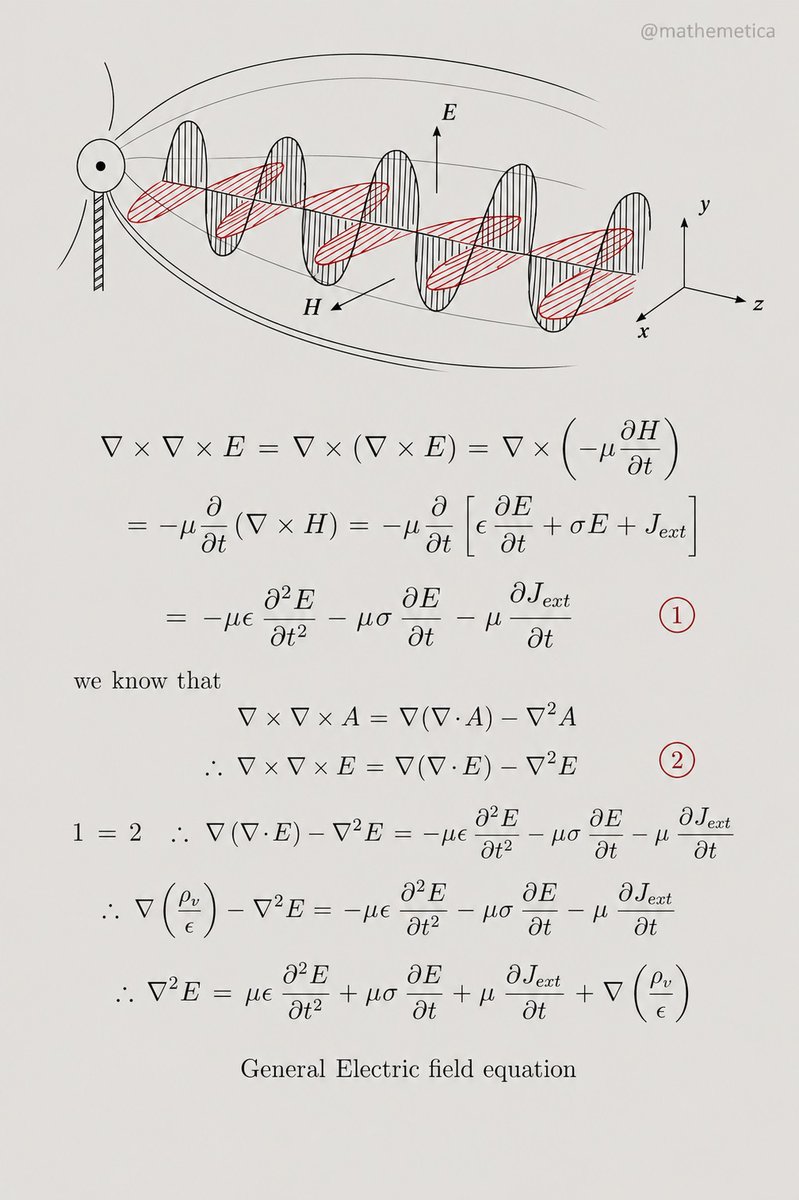
The question it’s answering
How can empty space carry a signal from an antenna to a satellite, with nothing physically there to carry it? The derivation below is the standard answer: starting from two of Maxwell’s four equations, a vector identity, and a third of Maxwell’s equations, the electric field turns out to obey a single partial differential equation — and every signal in the question, plus MRI, is a solution of it.
The derivation, step by step
Start from Faraday’s law, $\nabla \times E = -\mu \frac{\partial H}{\partial t}$, and take the curl of both sides:
$$\nabla \times \nabla \times E = \nabla \times \left(-\mu\frac{\partial H}{\partial t}\right) = -\mu\frac{\partial}{\partial t}(\nabla \times H)$$
Substitute the Ampère–Maxwell law, $\nabla \times H = \epsilon\frac{\partial E}{\partial t} + \sigma E + J_{ext}$ — displacement current, Ohmic conduction current, and an external source current, added together:
$$\nabla \times \nabla \times E = -\mu\epsilon\frac{\partial^2 E}{\partial t^2} - \mu\sigma\frac{\partial E}{\partial t} - \mu\frac{\partial J_{ext}}{\partial t} \qquad (1)$$
Apply the vector identity $\nabla \times \nabla \times A = \nabla(\nabla \cdot A) - \nabla^2 A$:
$$\nabla \times \nabla \times E = \nabla(\nabla \cdot E) - \nabla^2 E \qquad (2)$$
Set (1) equal to (2), then substitute Gauss’s law, $\nabla \cdot E = \rho_v / \epsilon$:
$$\nabla\left(\frac{\rho_v}{\epsilon}\right) - \nabla^2 E = -\mu\epsilon\frac{\partial^2 E}{\partial t^2} - \mu\sigma\frac{\partial E}{\partial t} - \mu\frac{\partial J_{ext}}{\partial t}$$
Rearrange for $\nabla^2 E$:
$$\nabla^2 E = \mu\epsilon\frac{\partial^2 E}{\partial t^2} + \mu\sigma\frac{\partial E}{\partial t} + \mu\frac{\partial J_{ext}}{\partial t} + \nabla\left(\frac{\rho_v}{\epsilon}\right)$$
the general electric field equation — independently re-derived here term by term rather than taken on the post’s word, and it checks out exactly as shown.
What the four terms on the right actually are
- $\mu\epsilon\,\partial^2 E/\partial t^2$ — the wave term. This is what lets the equation support a propagating wave at all; radio, Wi-Fi, radar, and MRI’s RF pulses are all specific solutions of it.
- $\mu\sigma\,\partial E/\partial t$ — the damping term, from conductivity $\sigma$. It’s why a radio signal attenuates faster through seawater or a conductive wall than through air or vacuum.
- $\mu\,\partial J_{ext}/\partial t$ — the driving term: a changing external current, an antenna, is what generates the field in the first place.
- $\nabla(\rho_v/\epsilon)$ — the source term, from any local charge-density gradient.
Drop the wave term and the equation stops describing a wave — it becomes a diffusion equation, the same mathematical form as heat spreading through a solid. Every radiative, far-field technology on the post’s own “which one disappears” list depends on that single term surviving.
Catalog status: Proven Systems
This is a standard derivation from Maxwell’s equations, confirmed to extraordinary precision across a century of radio, radar, and telecommunications engineering. Nothing about it is a claim under test.
Where this touches PBT
The post’s closing line, “the vacuum is not empty; it is the medium,” reads standard electromagnetism in PBT’s own preferred language rather than making a claim of PBT’s own — $\mu$, $\epsilon$, and $\sigma$ here are ordinary vacuum/material constants, not PBT’s own aether field. Nothing in this derivation has been imported into PBT’s own math, and no published PBT paper currently derives its own version of this specific equation. The connection is thematic, not derivational: both this derivation and PBT’s own starting point treat “a medium with real properties, not empty space” as the thing worth explaining.