States of Matter: What Makes a State a State
August 2026
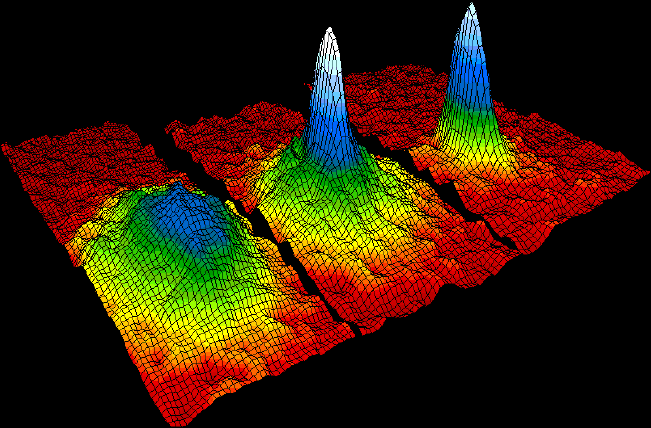
The 1995 JILA measurement that confirmed the Bose–Einstein condensate: velocity-distribution snapshots of a rubidium-87 gas, left to right, as it is cooled below 170 nanokelvin. The narrow spike is the condensate — atoms occupying one quantum state together. Credit: NIST/JILA/CU-Boulder, public domain.
Water is a solid, a liquid, and a gas without ever changing what it is made of. The molecules are identical in all three. What changes is how they collectively behave.
That much is easy. The hard part — and the actual subject of this page — is the next question: what qualifies a behaviour as a separate state, rather than the same state under different conditions?
The short answer, stated up front because most treatments never state it: thermodynamics has a precise definition of a phase, and by that definition the count is not in dispute at all. What is in dispute is which things that are not phases still get called states of matter. The physics is settled; the vocabulary is not. Everything below is an unpacking of that sentence.
Two ways to draw the line
The thermodynamic definition. A phase is a region separated from its neighbours by a non-analyticity in the free energy — a point where a thermodynamic quantity jumps or kinks rather than varying smoothly — or equivalently by a coexistence boundary where two forms sit side by side. Ice and water coexist at 0 °C; water and steam coexist along the boiling line. This is Gibbs, and it is the working definition.
The symmetry definition. Take a gas: it looks the same from every point and in every direction, carrying the full continuous translational and rotational symmetry of empty space. Freeze it and that symmetry is gone — a crystal only looks the same if you slide it by exactly one lattice spacing, having picked particular directions and positions out of a set that were all equivalent a moment before. Nothing chose them; the material settled on some. That is spontaneous symmetry breaking, and the quantity that goes from zero to finite as it happens — sometimes abruptly, sometimes continuously — is the order parameter.
These two are not rivals. Symmetry breaking is a refinement that tells you what kind of order appeared; it is not the definition of a phase. Missing that is the most common error in popular treatments, and the reason for the next paragraph.
Boil a pot of water and you have watched a phase transition with latent heat, a sharp boundary, and no symmetry change whatsoever. Liquid and gas have identical symmetry — both fully symmetric under continuous translation and rotation. The crystal’s order parameter is zero in both. They are unambiguously different phases by the thermodynamic definition, and indistinguishable by the symmetry one.
There is a second twist. The first-order line separating them ends. Above the critical point — 373.946 °C and 22.064 MPa for water — there is no meniscus, no boiling, and no boundary, so you can carry a substance from unambiguous liquid to unambiguous gas by steering around the endpoint without crossing anything. The supercritical region is not a third state sitting alongside the other two; it is the region where the liquid/gas distinction stops being defined.
So the working picture has three kinds of entry:
- Phases with a broken symmetry — solid, superfluid, condensate, supersolid, liquid crystal. Thermodynamic phases that also have an order parameter.
- Phases without a symmetry change — liquid and gas. Real phases with a real first-order line, and no order parameter distinguishing them.
- Regimes that are not phases at all — plasma, quark–gluon plasma, degenerate matter. The behaviour changes so completely that lumping them in with their neighbours would obscure more than it explained, but the change is a smooth crossover or a shift in the equation of state, with no non-analyticity to point at.
Only the first two are phases in the strict sense. All three get called states of matter.
The classical four
Solid. Atoms hold fixed positions in a repeating lattice, breaking the continuous translational and rotational symmetry of space down to a discrete subset. It resists both compression and shear — the shear part is what separates a solid from every fluid below. Category 1.
Liquid. Fixed volume, no fixed shape. Molecules stay in contact but exchange neighbours freely, so the material flows under shear while resisting compression.
Gas. Neither fixed volume nor fixed shape. Molecules are far enough apart to interact mainly through brief collisions, and the material expands to fill its container.
Liquid and gas are the pair above: category 2, separated by a genuine first-order line that terminates at the critical point.
Plasma. Heat a gas until collisions strip electrons from nuclei and it becomes a soup of free ions and free electrons — which conducts electricity and responds to magnetic fields, neither of which a neutral gas does. Under ordinary laboratory and stellar conditions there is no phase transition here: ionisation climbs smoothly with temperature, a continuous dial. Category 3. (The qualifier is real. A first-order “plasma phase transition” is predicted and increasingly supported in warm dense hydrogen at megabar pressures, so the crossover statement is a claim about ordinary conditions, not a universal one.)
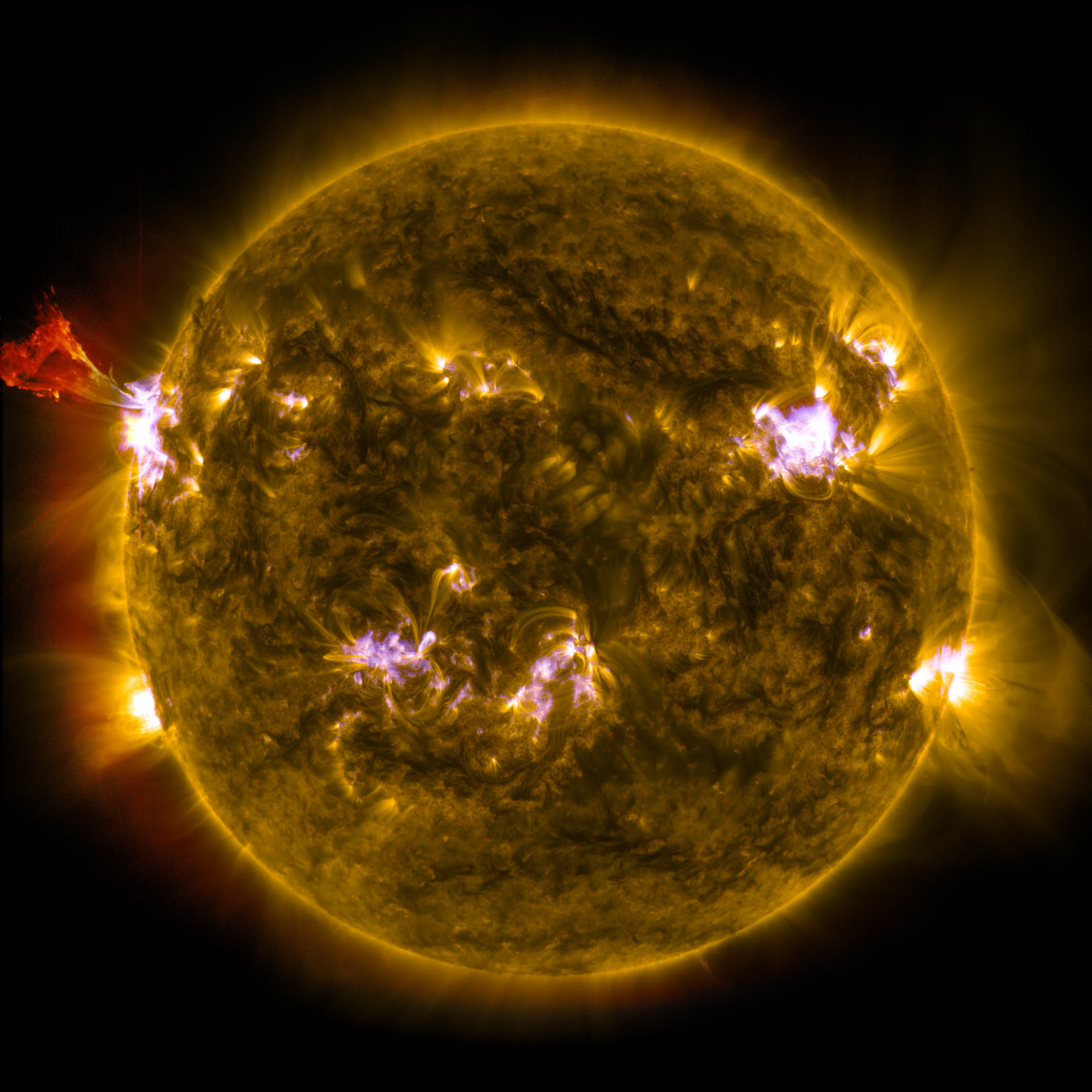
A prominence eruption on the Sun, imaged in extreme ultraviolet by NASA’s Solar Dynamics Observatory. The material tracing those arcs is plasma following magnetic field lines — the behaviour that separates a plasma from the gas it was a moment before. Credit: NASA/SDO/AIA, public domain.
Plasma is very likely the most abundant state of ordinary matter in the universe, though not for the reason usually given. Stars are not where most of the ordinary matter is: stars and cold galactic gas together account for only around 10% of the baryon budget. The bulk sits in diffuse ionised gas between and around galaxies — the circumgalactic medium, the intracluster medium, and the warm–hot intergalactic medium. Those are plasmas too, and they are what carries the claim. The census is genuinely incomplete, which is why “very likely” is the accurate hedge.
Three of the four schoolroom states therefore sit outside the symmetry test. Only the solid is a broken-symmetry phase. Liquid and gas are phases without a symmetry change; plasma is not a separate phase at all.
The cold end: condensates
Cool a gas far enough and its particles stop behaving as individuals. What happens next depends on which family of particle you started with — and that split is the real content of the two panels that usually close out a states-of-matter chart.
Bosons may share a quantum state with no limit on how many. Cool them enough and a macroscopic fraction drop into the single lowest state together, becoming one coherent quantum object large enough to photograph. This is the Bose–Einstein condensate, predicted by Satyendra Nath Bose and Albert Einstein in 1924–25 and first made in June 1995 at JILA by Eric Cornell and Carl Wieman, who cooled rubidium-87 below 170 nanokelvin. Wolfgang Ketterle achieved it independently in sodium at MIT months later. The three shared the 2001 Nobel Prize in Physics. The header image is that measurement.
Fermions are forbidden from sharing a quantum state — the Pauli exclusion principle — so they cannot condense directly, however cold they get. They must pair up first: two fermions bound together behave as a composite boson, and that can condense. This is the mechanism behind superconductivity, and it is what the fermionic condensate is — about 500,000 potassium-40 atoms cooled to roughly $5\times10^{-8}$ K and paired using a tuned magnetic field, first achieved by Deborah Jin, Markus Greiner and Cindy Regal at JILA on 16 December 2003.
Superfluid. A fluid that flows with zero viscosity, creeping up and over the walls of its container. Discovered in helium-4 in 1937 by Pyotr Kapitsa and, independently, John Allen and Don Misener; Kapitsa’s half-share of the 1978 Nobel Prize in Physics cited his basic inventions and discoveries in low-temperature physics. The order parameter is a complex macroscopic wavefunction and the broken symmetry is a global U(1) phase symmetry rather than a spatial one. Rigidity of that phase is what produces frictionless flow.
Supersolid. Both at once: a rigid crystalline lattice that simultaneously flows without friction — spatial translation and U(1) phase broken in the same material, which is why it was doubted for decades. Groups at ETH Zurich and MIT observed supersolid behaviour in light-coupled condensates in 2017; in 2019 three groups working independently in Innsbruck, Stuttgart and Pisa produced it in dipolar condensates, where the crystalline modulation arises from the atoms’ own interactions rather than being imposed by lasers.
These are one mechanism wearing different clothes. Every entry here breaks the same global U(1) phase symmetry. They differ in what condenses and under what conditions — bosonic atoms, paired fermionic atoms, paired electrons in a superconductor, helium in two isotopes — not in which symmetry is at stake.
Which puts the “sixth state” question in its place. Superfluid helium-3, discovered in 1972 by Douglas Osheroff, David Lee and Robert Richardson at Cornell and awarded the 1996 Nobel Prize, is paired-fermion superfluidity — 31 years before the ultracold-gas result. BCS superconductivity is paired-fermion condensation too, observed as a phenomenon in 1911 and explained theoretically in 1957.
“The same physics” would still be too strong, and the reason is worth stating. Superfluid helium-3 is a strongly interacting, p-wave, spin-triplet system with a multi-component order parameter and its own distinct phases; the 2003 potassium-40 work is a dilute, s-wave, Feshbach-tuned gas in the BEC–BCS crossover. Same broad class, genuinely different pairing symmetry and interaction regime. The 2003 novelty was tunability — dialling pairing strength continuously across the crossover in a clean, dilute system — not the first existence of paired-fermion condensation.
The consistent move is to apply one standard to both statistics. The 1995 BEC and the 2003 fermionic condensate are each new experimental realisations of condensate physics with earlier precedents: superfluid helium-4 in 1937 for bosons (itself a strongly interacting liquid rather than a weakly interacting BEC) and helium-3 in 1972 for fermions. Demoting only the fermion case, as popular framings tend to, is the inconsistency.
The hot and dense end
Quark–gluon plasma. Push nuclear matter hot enough and nucleons stop being the right description; quarks and gluons rather than protons and neutrons carry the thermodynamics. This is thought to be the state of the universe for the first few microseconds after the Big Bang.
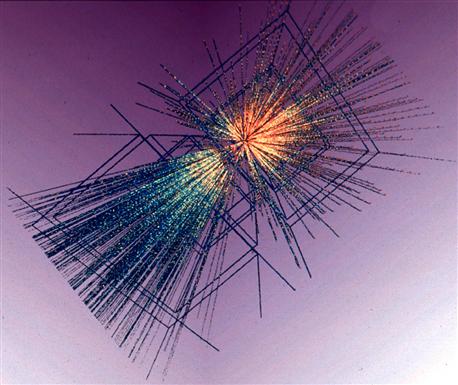
An actual lead-ion collision recorded by the NA49 experiment at CERN. Each track is a particle produced in the fireball; the density of them is the signature that something other than ordinary nuclear matter formed. Credit: CERN PhotoLab, CC BY 4.0.
Two corrections to the usual description, both load-bearing here.
The symmetry runs the other way. In ordinary hadronic matter chiral symmetry is spontaneously broken; in the quark–gluon plasma it is restored. The hot phase is the more symmetric one, so any shorthand along the lines of “a new state is a symmetry that breaks” points backwards in this case.
And at collider conditions it is not a sharp transition. With physical quark masses and near-zero baryon chemical potential, lattice QCD gives a smooth crossover with a pseudocritical temperature around 156.5 ± 1.5 MeV, roughly $1.8\times10^{12}$ K. There is no clean point where hadronic matter stops and plasma starts, and the number depends on which observable you track. Deconfinement and chiral restoration are related, and neither is exact in real QCD. So quark–gluon plasma has genuine symmetry content and is still category 3 — a regime rather than a phase — because the non-analyticity is absent.
The experimental history deserves precision. CERN announced compelling evidence for a new state of matter from its heavy-ion programme in 2000. In April 2005 the four RHIC collaborations at Brookhaven reported that what they had made behaved as a nearly frictionless liquid rather than the gas of free quarks most had expected — the “perfect liquid” result, published together in Nuclear Physics A. By Brookhaven’s own account they kept gathering evidence and “in February 2010, they felt confident announcing it,” having measured the fireball’s temperature precisely enough to declare it quark–gluon plasma at around four trillion degrees. Five years of deliberate caution between a strong result and a firm claim is a good model for how this kind of announcement should go.
Degenerate matter. Compress matter far enough and the Pauli exclusion principle itself holds it up: electrons or neutrons cannot occupy the same state, so at extreme density they resist further compression through quantum statistics rather than any force between them. Electron-degenerate matter supports white dwarfs, neutron-degenerate matter supports neutron stars at densities comparable to an atomic nucleus.
This is a regime of the equation of state, not a phase — no order parameter switches on to define it, and it is a family rather than one state. Cooling white dwarf interiors are separately expected to crystallise, and that would be a genuine symmetry-breaking transition happening inside degenerate matter.
Two that sit outside the scheme
Liquid crystal. Flows like a liquid while its molecules stay collectively aligned. A nematic phase — pictured below — breaks rotational symmetry while leaving translational symmetry intact, a partial ordering that is neither liquid nor solid. Smectics go further, additionally breaking translational symmetry along one direction into layers that still flow within themselves. So this is a family ordered by how much symmetry each member gives up, all of it category 1. Every LCD screen relies on the effect.
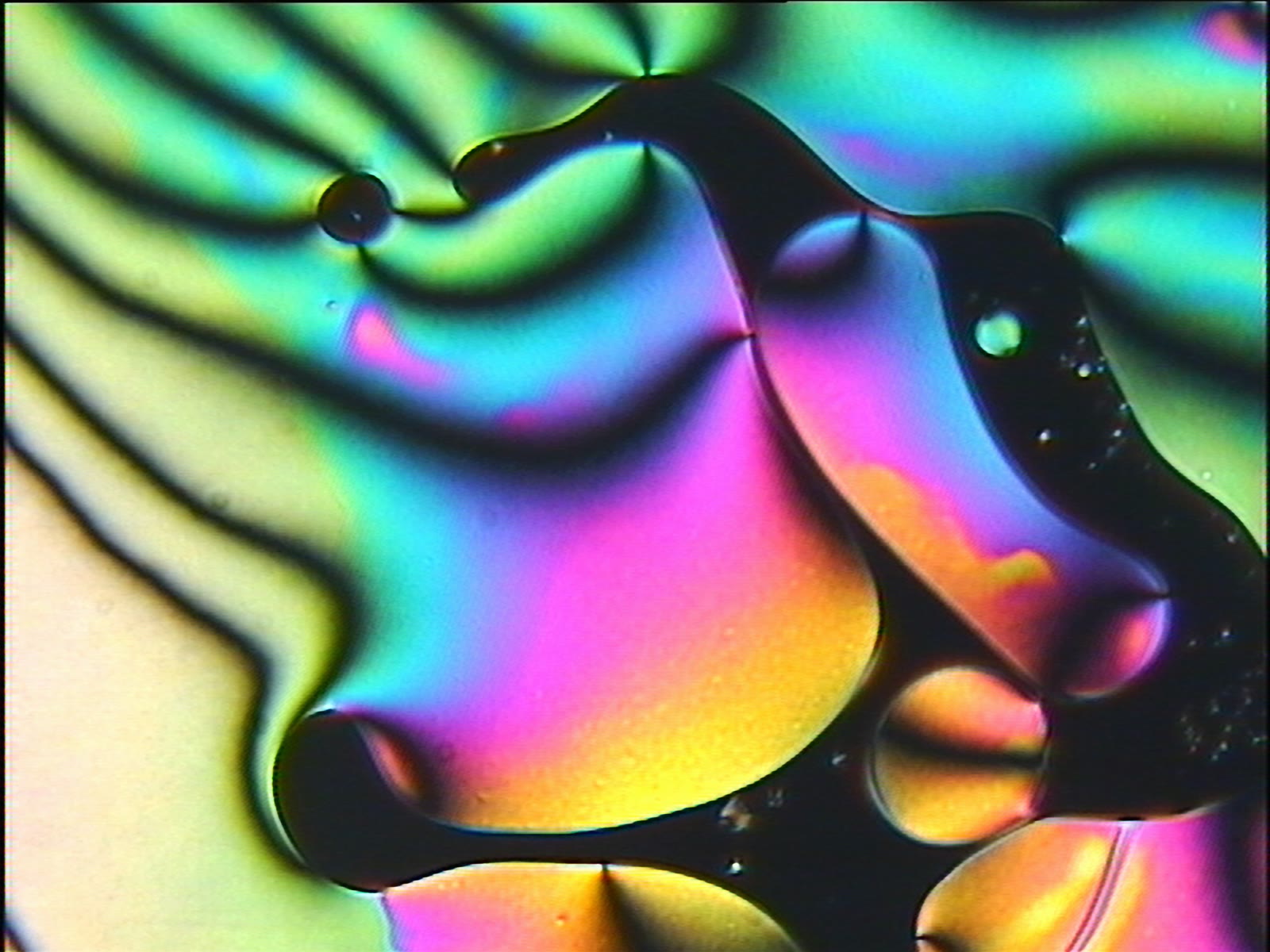
Polarising-microscope texture of a nematic thermotropic liquid crystal. The dark brushes are Schlieren defects, points where the molecular alignment direction becomes undefined — direct visual evidence of an orientational order that a liquid does not have and a solid does not need. Credit: Ingo Dierking, CC BY-SA 4.0.
Time crystal. A system whose behaviour repeats in time the way a crystal repeats in space. Frank Wilczek proposed it in 2012, and the history matters: Haruki Watanabe and Masaki Oshikawa published a no-go theorem in 2015 proving that time crystals in thermal equilibrium, as originally defined, cannot exist. What was built instead — by Christopher Monroe’s group at Maryland and Mikhail Lukin’s at Harvard, both in 2017 — is a discrete (Floquet) time crystal: a periodically driven system responding at a fraction of the driving frequency. Those are real and reproducible.
They are also, by construction, not in equilibrium, which puts them outside all three categories above — every one of which is a statement about equilibrium thermodynamics. That is a fourth kind of entry, and it is why calling a time crystal a state of matter in the same sense as ice is a live disagreement about categories rather than any doubt about the result.
So how many states are there?
Counts in circulation, each defensible under some criterion:
- Three — the states most matter on Earth is found in.
- Four — adding plasma, the schoolroom answer, though the gas–plasma boundary is a crossover under ordinary conditions rather than a transition.
- Six — adding the two ultracold condensates. The common popular-science set, and the framing behind the infographic that prompted this page.
- A dozen or more — also counting superfluid, supersolid, liquid crystal, quark–gluon plasma and degenerate matter, though that mixes phases with regimes.
- More still — modern condensed-matter physics also classifies by topological order, which distinguishes phases carrying the same symmetry and has no local order parameter at all. It appears nowhere on this page and is a working part of the field.
Six is a teaching convention, and a good one: memorable, covering the extremes, clearer than any list trying to be complete. The point of laying the alternatives out is not that six is wrong.
It is that the disagreement is narrower and more interesting than “nobody knows.” The number of thermodynamic phases is not unsettled — Gibbs settled how to count those, and liquid, gas and solid fall out of it without any mention of symmetry. What is unsettled is which non-phases get promoted to the everyday title: plasma, degenerate matter, driven time crystals, topologically ordered systems. Every one is real physics; none is a phase in the strict sense; all of them are called states of matter by someone with good reason.
So “how many states are there” has no answer until you say what counts as a state — not because the physics is vague, but because the phrase is doing two jobs at once. Symmetry breaking is the sharpest tool for identifying order, and where it applies (and topological order is not at issue) it settles the question completely. Where it does not apply, the state is no less real. The count is bookkeeping we impose; the behaviour is what is actually there.
Summary
Grouped by how each entry earns its place, because that is the whole argument.
Phases with a broken symmetry
| State | Symmetry broken | Real case |
|---|---|---|
| Solid | Continuous translation and rotation of space | Ice, diamond |
| Superfluid / condensate | Global U(1) phase | Helium-4 (1937), helium-3 (1972), rubidium-87 BEC (1995), potassium-40 (2003), BCS superconductors |
| Supersolid | Translation and U(1) phase, together | Dipolar condensates, 2019 |
| Liquid crystal | Rotation (nematic); also partial translation (smectic) | LCD displays |
Phases with no symmetry change
| State | How it is distinguished | Real case |
|---|---|---|
| Liquid | First-order line vs gas; identical symmetry | Water |
| Gas | First-order line vs liquid; identical symmetry | Air |
Above the critical point the two merge into a supercritical region where the distinction is undefined — a feature of the phase diagram, not a further state. Supercritical CO₂ is used industrially, including to decaffeinate coffee.
Regimes, not phases — no non-analyticity to point at
| Regime | What changes | Real case |
|---|---|---|
| Plasma | Smooth ionisation crossover under ordinary conditions | The Sun, the intergalactic medium |
| Quark–gluon plasma | Crossover ~156.5 MeV; chiral symmetry restored | RHIC, CERN heavy-ion |
| Degenerate matter | Equation-of-state regime; Pauli pressure | White dwarfs, neutron stars |
Driven, out of equilibrium — outside the scheme entirely
| Entry | What changes | Real case |
|---|---|---|
| Discrete time crystal | Discrete time-translation symmetry, under periodic driving | Trapped ions, NV centres, 2017 |
Everything in all four tables is Proven as experimental physics. The disagreements above are about categories, not results.
Where this touches PBT
Everything above is standard, independently confirmed physics, and that is the entire content of this page. Pressure-Based Theory is this site’s own unproven, still-developing framework — see The Theory and Why Pressure — and nothing here depends on it or is evidence for it. The organising idea here, that identical particles behave completely differently depending on the conditions they sit in, is structurally the kind of claim PBT makes about its own hypothesised medium. That is a resemblance in the shape of an argument, not a result: standard statistical mechanics accounts for every state on this page completely, across many orders of magnitude in temperature and density, without needing PBT’s proposed mechanism anywhere.
One temptation is worth heading off, because it is the one a sympathetic reader will reach for first. Pressure appears throughout this page — as a phase-diagram axis, as degeneracy pressure, as the thing a supercritical fluid is defined against. That is ordinary thermodynamic pressure, fully explained by the momentum transfer of the constituent particles themselves. It is not evidence for a background medium, and treating the shared word as a shared mechanism would be an equivocation. See Pressure for how PBT uses the term differently.
Catalog status: Proven Systems
Every state and regime described here is established, experimentally confirmed physics. The open questions on this page are taxonomic — whether a discrete time crystal is a state of matter, and whether crossover regimes deserve the title — and taxonomy is not the same as doubt.
Try this yourself
Put a pot of water on to boil with a thermometer in it and watch the moment it starts. The temperature stops rising while the bubbles form and will not move again until the last of the liquid is gone — every joule going in is spent overcoming the attractions between molecules rather than raising temperature. (The covalent bonds inside each H₂O molecule are untouched; boiling separates molecules, it does not break them.) That flat spot is a first-order phase transition made visible in five minutes.
Then consider what you watched. It is the most familiar phase transition on Earth, and no symmetry broke — the water and the steam have exactly the same symmetry as each other. Hold the pressure above 22.064 MPa instead and the flat spot would vanish entirely, because above the critical point there is no boundary left to cross. The clearest demonstration of why this page needed four tables instead of one is sitting on a stovetop.
Notes on sources, and how firm each claim is
- Dates, attributions and prize citations were verified against primary or institutional sources rather than written from memory: NIST and Nobel Foundation records for the 1995 BEC and the 2001 prize; JILA/NIST for the 16 December 2003 fermionic condensate; the 1996 Nobel citation for superfluid helium-3; the 1978 citation for Kapitsa; Brookhaven National Laboratory’s own newsroom page for the 2005 “perfect liquid” result and the February 2010 quark–gluon plasma announcement, read directly rather than via summary; Watanabe and Oshikawa’s 2015 no-go theorem for the time-crystal history.
- Firm. The classical four, the condensates, liquid crystals, supercritical fluids and degenerate matter — textbook results with decades of independent confirmation.
- Firm, with the caveat stated inline. The gas–plasma boundary is a crossover under ordinary conditions, though a first-order plasma phase transition is predicted and increasingly supported in warm dense hydrogen. The supercritical region has no liquid–gas boundary at all. The QCD transition at collider conditions is a crossover, not a sharp transition.
- Quantitative values. The QCD pseudocritical temperature of 156.5 ± 1.5 MeV is a lattice result at near-zero baryon chemical potential; $1.8\times10^{12}$ K is arithmetic on that figure. Water’s critical point is 373.946 °C and 22.064 MPa. The QCD value is observable-dependent, which is why no sharper number is quoted.
- Deliberately hedged. “Plasma is very likely the most abundant state of ordinary matter.” Stars and cold galactic gas are around 10% of the baryon budget and the remainder is predominantly ionised, but a substantial fraction of baryons went undetected in direct observations for years. The hedge reflects the state of the measurement, not doubt about ionised gas dominating.
- Firm result, unsettled label. The discrete time crystal. The experiments replicate; whether the category fits is an open question among the people who do the work.
- Not independently derived here. This page reports established results; unlike this site’s papers it contains no original calculation, so there is nothing in it to check by recomputation.
- Review. Two adversarial objection-finding passes ran against complete drafts, and both found real errors. The first killed the original thesis: the draft had presented broken symmetry as the criterion defining a state, which the liquid–gas transition falsifies outright. It also caught four factual errors — the baryon-budget claim, the direction of the QCD symmetry change, the equating of helium-3 with the 2003 result, and an over-general liquid-crystal claim. The page was restructured rather than patched. The second pass confirmed those repairs, found six further problems in the new framing (including supercritical fluid still listed as a peer state and a time crystal filed under equilibrium physics), and supplied the thermodynamic free-energy definition that now anchors the page. Every objection was verified independently before being accepted.
Image credits
- Bose–Einstein condensate velocity distribution — NIST/JILA/CU-Boulder, public domain.
- Solar prominence eruption — NASA/SDO/AIA, public domain.
- Lead-ion collision, NA49 experiment — CERN PhotoLab, CC BY 4.0.
- Nematic liquid crystal texture — Ingo Dierking, CC BY-SA 4.0.
See also
- Spheres in Nature — the same cross-scale pattern question asked about shape instead of state
- Soap Bubbles in Air, Air Bubbles in Water, Water Droplets in Air — phase boundaries worked out in full detail for three specific cases
- Pressure and Subatomic Particle — how PBT uses “pressure,” and why it is not the thermodynamic quantity on this page
- Physics Catalog — how this site classifies the epistemic status of everything it covers
Written 2026-08-13, prompted by a @LensScientific post presenting six states of matter. That graphic is doing a different job than this page — introducing the extremes memorably, which it does well. This page takes up the question it necessarily sets aside: what actually makes something a separate state, and why the count is not settled at any particular number. No part of that graphic is reproduced here; every image on this page is independently sourced and credited above.