Quantum Magnetic Navigation: Flying the Pacific With No GPS
September 2026
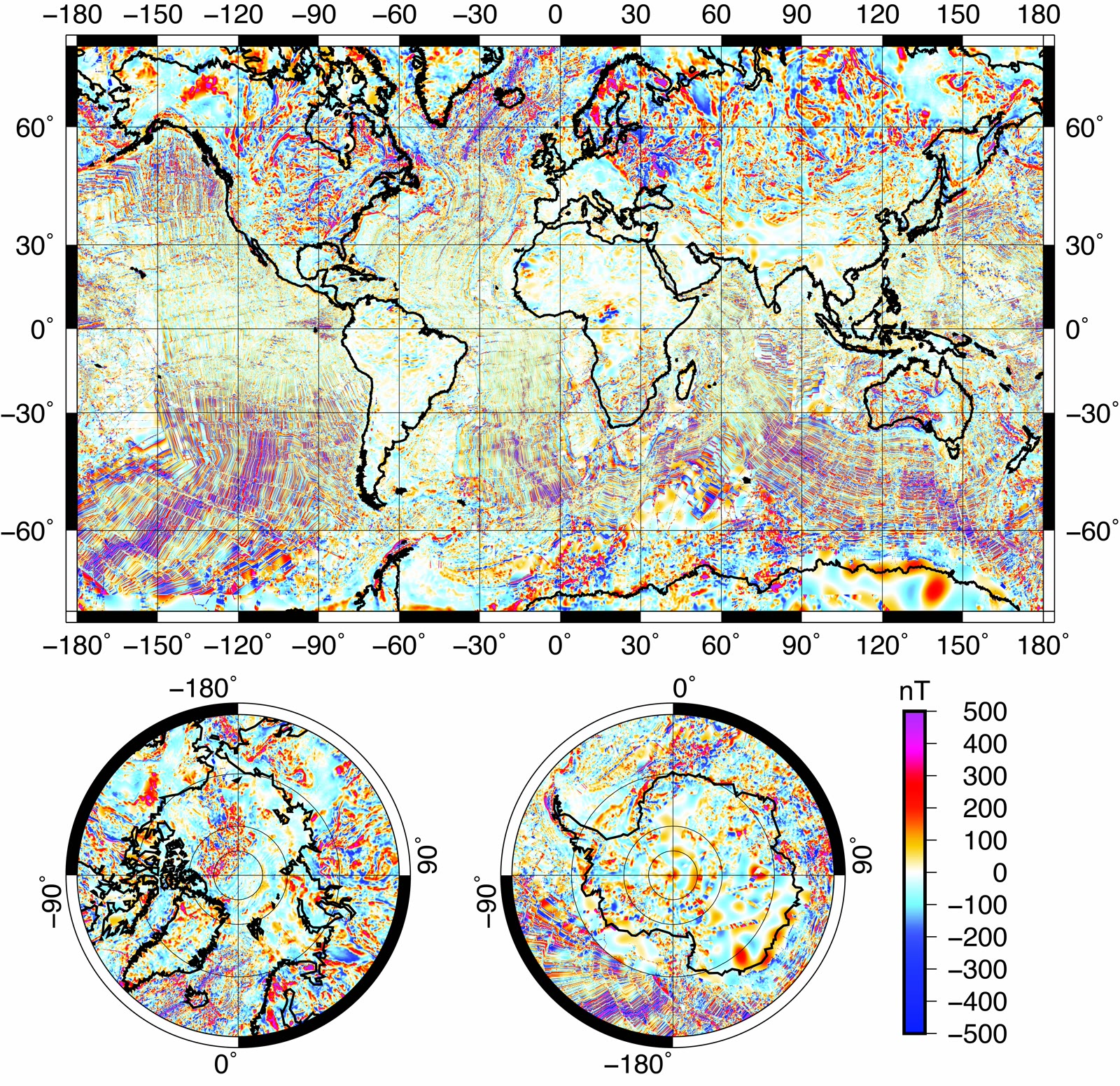
Map: World Digital Magnetic Anomaly Map, Commission for the Geological Map of the World / WDMAM project, CC BY 4.0. This is the kind of crustal magnetic pattern MagNav reads to fix a position.

Original post: @AtomsNotBits on X, 2026-09-05. If the embed above doesn’t load, everything it showed is written out below.
What actually happened, per Honeywell and the Defense Innovation Unit
Everything in this section is Honeywell and the Defense Innovation Unit’s own reported account, not an independently verified measurement; see Catalog status below for what that distinction means here.
Honeywell Aerospace and the Defense Innovation Unit (DIU) announced on September 4, 2026 that they had flown a modified Embraer 170 for 4 hours and 23 minutes over the Pacific, from Seattle’s Puget Sound to southern Alaska and back, navigating without GPS. DIU says the system, called MagNav, delivered an 89% improvement in position accuracy over the aircraft’s traditional backup navigation methods (inertial sensors, radar mapping, visible landmarks) and streamed the result live to standard tablets in the cockpit, rather than requiring new instruments. DIU Deputy Director Kyle Norman, quoted in that announcement: “This is a significant win for the department’s quantum sensing priorities, showcasing that MagNav capabilities are no longer a distant research goal. We moved from problem sourcing to solicitation to prototype in a matter of months.” Honeywell and DIU say they plan a second demonstration on a U.S. Air Force C-17 Globemaster III later in 2026.
The original X post rounded up to “more than four hours.” DoD and industry reporting on the same DIU announcement give the precise figure as 4 hours 23 minutes.
Per that same reporting, MagNav is one of two quantum-sensing navigation programs Honeywell is running under DIU’s Transition of Quantum Sensing initiative: MagNav (formally QUEST, Quantum Enabled Sensor Technologies) for magnetic-anomaly navigation, and a separate program called CRUISE for a quantum-sensor inertial measurement unit. DIU says it selected Honeywell from 72 applicants after opening the program in 2024. None of these program specifics have a source beyond DIU’s own account either.
How magnetic anomaly navigation works
Earth’s core produces the broad, smooth background field a compass reads. The crust adds something finer on top of it: local variations from differences in rock and mineral content, stable over human timescales and distinct enough, in aggregate, to work like a fingerprint. Survey that pattern once (the World Digital Magnetic Anomaly Map pictured above is a real, public version of it), and a later flight can read its own local field strength, compare it against the map, and back out its position. The idea matches old terrain-contour-matching cruise missile guidance, which compares a radar altimeter reading against a stored elevation map. Here, magnetic field stands in for elevation. No signal has to arrive from a satellite, and nothing can jam or spoof a rock formation.
Why “quantum”
A classical magnetometer (a fluxgate, the kind in a phone compass) drifts and needs regular recalibration. A quantum magnetometer instead reads the field through atomic spin precession: an atom’s magnetic moment, tilted off the field axis, rotates around that axis at the Larmor frequency, set by the field strength and a fixed physical constant, the gyromagnetic ratio. The governing equation, $\frac{dS}{dt} = -\frac{g\mu_B}{\hbar}\, S \times B$, is this site’s own Spin Precession Equation (Larmor/Bloch Equation), standard and independently confirmed physics decades before this flight, running continuously today in ESR spectroscopy, NMR, MRI, and atomic clocks. Because that relationship is fixed rather than calibrated, the reading doesn’t drift the way a fluxgate does, which is what makes it precise enough to match against a crustal map rather than just point roughly north.
One thing worth stating plainly: neither Honeywell nor DIU has published which specific quantum sensor MagNav uses (an optically pumped atomic vapor cell, a spin-exchange relaxation-free design, or something else). The physics class is well established. The exact hardware inside this particular system is not public.
Why it matters
GPS is a weak signal broadcast from satellites roughly 20,000 km away. It’s easy to jam with cheap ground equipment and easy to spoof into reporting a false position, both real, demonstrated vulnerabilities in contested environments. A navigation method that reads a physical property of the ground itself removes that failure mode entirely. That’s the actual driver behind testing this on a C-17 next: an aircraft that can find its own position with no signal to jam is a different category of resilient than one relying on GPS with a backup plan.
Catalog status
Spin precession and magnetic-anomaly map matching are both Proven Systems: established, decades-confirmed physics and engineering, with nothing about the underlying mechanism new or in question. The 89% accuracy figure and the flight itself are a different kind of claim. They come from DIU and Honeywell’s own account, and every outlet reporting on it cites the same DIU statement rather than an independent third party’s measurement. That doesn’t make the figure wrong. It does mean this specific result hasn’t been externally replicated the way the physics underneath it has.
Where this touches PBT
Nowhere distinctively. The spin precession equation this system depends on is used on this site exactly as standard physics defines it. Pressure-Based Theory proposes a different mechanical origin for the electron’s g-factor specifically (see Paper 5 and Paper 6), not for precession itself, and has nothing to add to how a magnetometer or a navigation algorithm works. This is real, working engineering built on settled quantum mechanics, not an open question PBT or anything else needs to resolve.