Two New Preprints Claim Counterexamples to Grad's 1967 Conjecture
September 2026
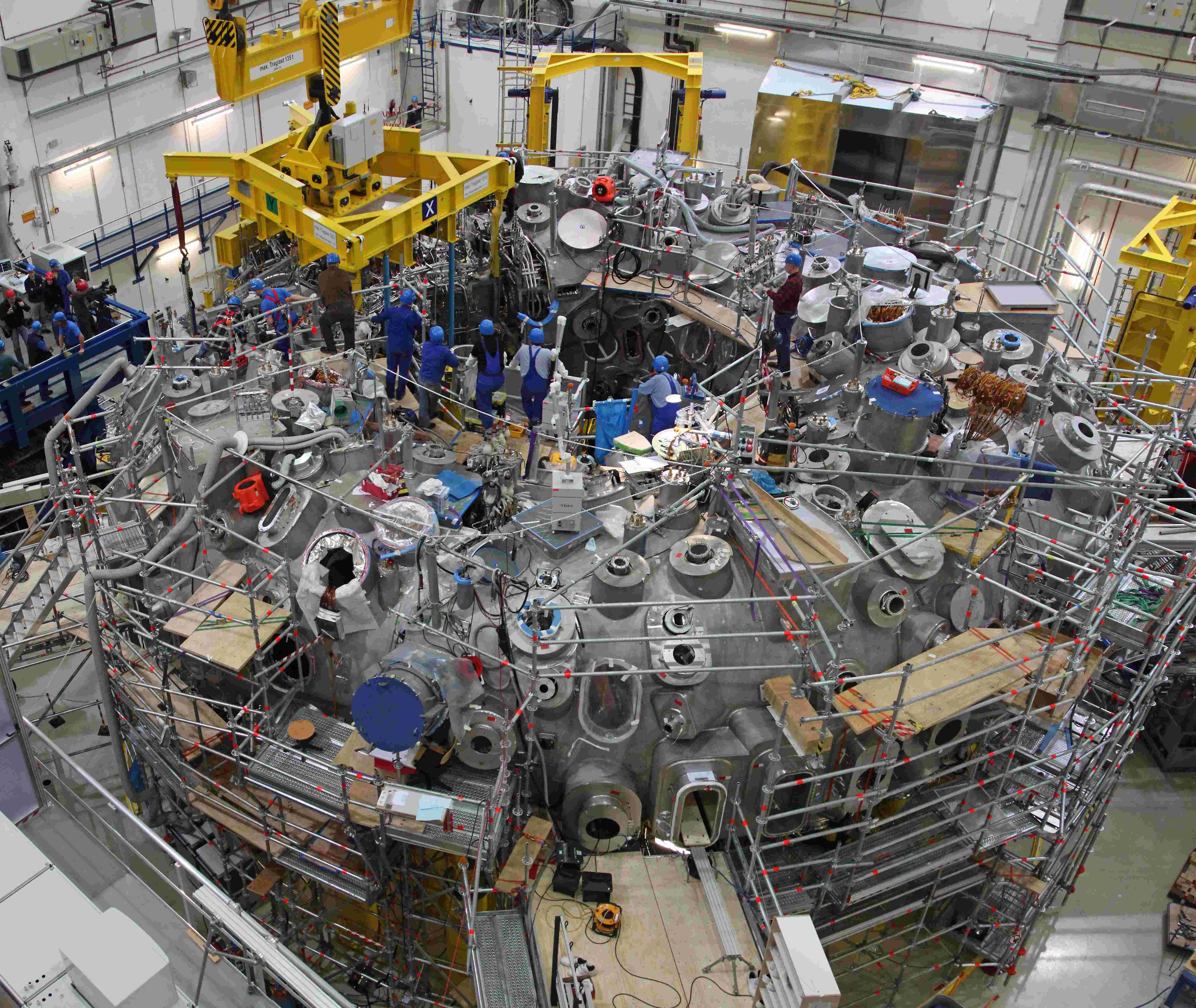 Wendelstein 7-X, under construction, 2011. Photo by Tino Schulz, Max-Planck-Institut für Plasmaphysik, CC BY-SA 3.0.
Original post: @0x_impai on X, 2026-09-24. If the embed above doesn’t load, everything it showed is written out below.
What Grad conjectured, and what already existed before this month
A magnetically confined plasma, the hot, ionized gas inside a fusion device, sits in equilibrium when the outward pressure of the plasma exactly balances the inward force of the magnetic field. The cleanest way to picture that equilibrium is as nested surfaces of constant pressure, like the layers of an onion, with the magnetic field lines wrapping around inside each layer. A tokamak confines this with an axisymmetric field, the same shape all the way around the torus. A stellarator deliberately breaks that symmetry, twisting the coils into a shape with no rotational symmetry at all, in exchange for plasma behavior a tokamak can’t achieve.
In 1967, the plasma physicist Harold Grad argued that, outside the classical symmetric cases, “we find it very unlikely that there exist a general class of toroidal equilibria with smooth p”: smooth, non-axisymmetric equilibria belonging to a continuous family (Toroidal containment of a plasma, Physics of Fluids 10(1), 1967). He sharpened this in a 1985 follow-up, stating no such family exists “other than the stated symmetric exceptions.” Both new papers cite a more precise modern formalization, from Constantin, Drivas & Ginsberg: a smooth, unforced equilibrium with nested pressure surfaces that isn’t isolated (that belongs to a continuous family, not a one-off solution) must have plane-reflection, axial, or helical symmetry. That “not isolated” clause matters for what counts as a counterexample below, so it’s worth carrying forward rather than treating as fine print. Landreman’s paper states plainly why this is a foundational question rather than an obscure one: “the existence of three-dimensional equilibria with nested pressure surfaces is the central mathematical question of stellarator theory.”
That doesn’t mean real stellarators, including Wendelstein 7-X pictured above, have been running on an unproven foundation. Their equilibria are computed numerically (codes like VMEC, DESC, and SPEC, run for decades) rather than derived as exact closed-form solutions, so the conjecture’s status was never an operational question for existing machines. It’s a question about the underlying mathematics: does the smooth, idealized picture used to reason about these devices actually exist, or does non-axisymmetry force something less clean, like pressure discontinuities?
That question had real partial answers before September 2026, not silence. High-aspect-ratio expansions (Mercier, Solov’ev & Shafranov, Garren & Boozer) approximate non-axisymmetric equilibria without proving exact solutions exist. Lortz proved existence for mirror-symmetric cases with zero rotational transform, mathematically real but not useful for confinement. Bruno & Laurence, and more recently Enciso, Luque & Peralta-Salas, constructed equilibria with pressure jumps across interfaces rather than smooth nested surfaces. None of that prior work produced a smooth, non-axisymmetric equilibrium with nested toroidal surfaces and a finite, non-zero rotational transform. That’s the specific gap both new papers claim to close.
Two papers, a day apart
In September 2026, two papers posted to arXiv a day apart. Different authors, different institutions, no shared authorship between them. Each presents what its authors describe as counterexamples to Grad’s conjecture: smooth, non-axisymmetric equilibria with nested toroidal pressure surfaces, belonging to a continuous family rather than standing as one-off solutions, and lacking the symmetries the conjecture names.
Matt Landreman (University of Maryland, a stellarator physicist whose SFINCS and REGCOIL codes are already used to design and analyze real machines) posted an explicit, closed-form family of solutions on September 22, with a revised version on September 28. The paper presents the equations directly in Cartesian coordinates using elementary functions, with no perturbative expansion in aspect ratio or in the deviation from axisymmetry: one family with a uniform rotational transform, a second with a sheared profile. Its acknowledgments state plainly that “these solutions were discovered using the artificial intelligence model GPT-6 Astra Pro,” with Landreman confirming every equation by hand afterward. What “discovered” meant in practice, how much of the search versus the final form came from the model, isn’t detailed beyond that sentence. It’s the paper’s own characterization, not an independently audited account of the process.
Javier Gómez-Serrano, Lukas Liehr, and Mitchell A. Taylor (Gómez-Serrano is a Brown University mathematician who has collaborated with DeepMind on using AI to search for singularities in fluid-dynamics equations) posted a different construction on September 21, using a Nash-Moser method to build solutions whose symmetry group is a cyclic rotation through $2\pi/N$ for large $N$. The paper’s own abstract states these form “a smooth one-parameter family,” satisfying the CDG formalization’s “not isolated” requirement, with none of the plane-reflection, axial, or helical symmetries Grad’s conjecture names. Worth being precise about what that means: a large-$N$ cyclic rotation is still a real residual symmetry, just not one of the three the conjecture singles out, so “no symmetry at all” would overstate it. The paper’s claim is narrower, and that’s the claim this entry is reporting. It includes a Lean 4 formal certification of its core analytic estimates, not a machine-checked version of the entire existence argument, but the underlying calculations that support it. Its AI-usage disclosure is more detailed than Landreman’s: the authors set up the problem and a mathematical roadmap themselves in July 2026, then used several large language models (GPT-5.6 Sol, Claude Fable 5, and Claude Opus 5, later switching to GPT-6 Astra and Claude Fable 5.1) to fill in technical calculations, produce the Lean code, and proofread, stating the models “did not contribute to any of the mathematical content of the article,” with the authors taking “full responsibility for their correctness.” Worth reading that sentence with a little care: the same paragraph credits those models with filling in the technical calculations underneath the Lean certification, which is a boundary the authors draw rather than a self-evidently clean line.
That distinction between the two papers is worth holding onto, because it’s easy to flatten into one claim and it isn’t one. Landreman’s paper credits an AI model with the discovery itself, checked afterward. Gómez-Serrano, Liehr, and Taylor’s paper credits the humans with the direction and the mathematical roadmap, and the AI with fill-in labor underneath it. Both are real disclosures on real preprints, describing two different divisions of labor, not one.
Catalog status: Unproven Systems At Large
Both papers are days-old preprints, not yet through peer review. That’s the reason for this category rather than Proven Systems, regardless of how rigorous the internal construction is. A Lean-certified set of estimates or an explicit closed-form solution is a claim about a proof’s internal logic, not evidence that the broader field has had time to check it. Grad’s original 1967 conjecture sat in this same category for 59 years: serious, credentialed, with real partial results the whole time (described above), and, as of this entry, two new preprints whose authors present them as the first to reach a full counterexample. That’s a claim this site is reporting, not independently certifying.
Where this touches PBT
Pressure-Based Theory doesn’t currently have a specific account of confined-plasma magnetohydrodynamic equilibria. The mathematics here (the Grad-Shafranov-family equations governing how pressure, current, and magnetic field balance inside a torus) is standard plasma physics, developed independently of PBT and not in dispute. Paper 3 gestures at plasma and collider data as a future test of PBT’s mechanical account of magnetism, in passing, without making a specific claim about equilibrium structure. That’s the same distinction Vortexes in Space draws for magnetohydrodynamics elsewhere: real physics, not yet a derived PBT result, and not presented as one here.
Notes on sources, and how firm each claim is
Every specific claim above was checked directly against the live arXiv abstract and full-text pages, not against the X posts that first surfaced this story or against this entry’s own earlier draft: Grad’s original 1967 and 1985 wording, the modern formalization both papers cite, the prior partial results (Mercier, Solov’ev & Shafranov, Garren & Boozer, Lortz, Bruno & Laurence, Enciso/Luque/Peralta-Salas), both papers’ submission dates, the exact AI-disclosure wording, and the authors’ credentials. The X thread’s own framing (“two found with GPT-6 Astra”) is accurate for Landreman’s two solution families. It doesn’t capture the narrower, roadmap-then-fill-in role AI played in the second paper, or the fact that this problem had 59 years of real partial progress behind it, not silence. This entry states both of those explicitly rather than repeat the post’s shorthand.
Review. This entry went through two adversarial passes before publication, each instructed to attack methodology, citation accuracy, and any overstatement of what either paper actually claims. The first pass found the draft implied the conjecture’s resolution mattered for whether existing stellarators are soundly engineered (it doesn’t; their equilibria are computed numerically, independent of this question), erased 59 years of real partial results, described the Lean certification as covering the whole proof rather than its core estimates, and stated several of the papers’ own characterizations as this entry’s own narration rather than as attributed claims. Those were rewritten against the papers’ primary text, not patched with qualifiers. The second pass, run against that rewrite, found the fix still incomplete in three places: the title and catalog wording still read as asserting the conjecture’s resolution as settled fact despite the Unproven Systems classification, “independent papers” was still this entry’s own assertion rather than a stated fact (different authors, different institutions, no shared authorship), and the Gómez-Serrano et al. paragraph had dropped their own “smooth one-parameter family” language, which is what satisfies the “not isolated” clause in the formalization this entry quotes. All three are fixed above. A further pass could likely still find narrower technical framing points. That’s expected for a days-old, not-yet-peer-reviewed claim, which is exactly why Matthew’s own read-through, not a review pass, is what actually decides whether this goes live.
Image credit. Wendelstein 7-X installation photo by Tino Schulz, Max-Planck-Institut für Plasmaphysik, CC BY-SA 3.0, via Wikimedia Commons.