Diamond Electricity: Thin Membranes Do What Bulk Diamond Can't
September 2026
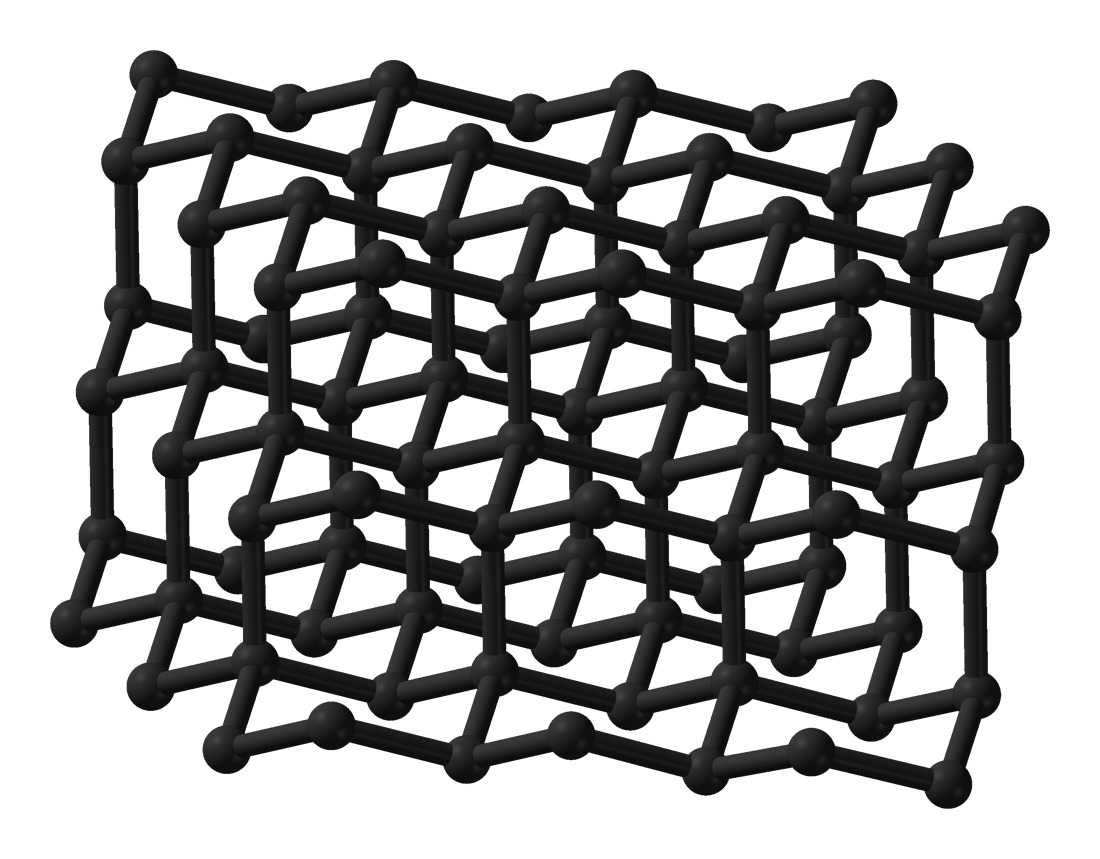
Model: Diamond cubic crystal structure, Ben Mills (Benjah-bmm27), public domain. This is the same tetrahedral symmetry that, in bulk form, is the reason diamond was never expected to do what this entry describes.

Original post: @BrianRoemmele on X, 2026-09-07. If the embed above doesn’t load, everything it showed is written out below.
What actually happened, per the HKU team’s own paper
A team at the University of Hong Kong, led by Professor Zhiqin Chu and Professor Yuan Lin with first author Jixiang Jing, published “Uncovering piezoelectric effect in polycrystalline diamond membranes” in Science Advances (accepted 2026-02-12, published 2026-03-18, DOI 10.1126/sciadv.aea8318). HKU’s own press office covered the result separately on 2026-05-21, about two months after the paper itself was already in print.
They grew polycrystalline diamond films by microwave plasma CVD on silicon (sub-10 nm diamond seeds, 3400 W microwave power, 900°C, 15 sccm methane, 40 minutes), then freed the film from its substrate by exfoliation to get a freestanding membrane as wide as 5 cm and as thin as 1 micrometer. Gold-coated on both sides for electrical contact and mounted on a flexible backing, one end fixed and the other bent by hand: that was the whole measurement. Bending the membrane produced a real, repeatable voltage and current, not just a theoretical prediction.
The effect changes with thickness, and not in a straight line. The piezoelectric coefficient (d₃₃) rose from about 2 pC/N at 1 μm to a peak of 4 pC/N at 5 μm, then fell back toward roughly 1 pC/N by 20 μm. At that 5 μm peak, a 1.4% bending strain produced about 70 millivolts. The membrane’s piezoelectric voltage coefficient (g₃₃, 82.2 mV·m/N) beat several established piezoelectric materials the paper names directly: PZT, BaTiO₃, AlN, GaN, MoS₂, and Half-Heusler compounds.
The paper’s own words on why this matters beyond the lab: the effect held steady even heated to 600 K, “suggesting that they are suitable for harsh environments such as the outer space or inside the body.”
Why bulk diamond can’t do this, and thin membranes can
Diamond’s crystal structure, pictured above, is exceptionally symmetric. Every carbon atom sits at the center of a tetrahedron of four identical neighbors, in a pattern called diamond cubic. Piezoelectricity needs an asymmetry: a structure where squeezing it in one direction shifts positive and negative charge by different amounts, so a net voltage appears. A perfectly symmetric bulk crystal has no such asymmetry to exploit. That is exactly why diamond has been treated as non-piezoelectric for more than a century.
Polycrystalline membranes aren’t one perfect crystal. They’re many small diamond grains grown together, and where two grains meet, the lattice’s symmetry breaks locally. The HKU team’s first-principles calculations trace the effect to exactly that: charge polarization building up at grain boundaries as the membrane deforms. They tested and ruled out an alternative explanation, generic point defects, because that mechanism doesn’t track the way the effect actually rises and falls with thickness in the data above.
This is the one place the post gets the mechanism wrong. It attributes the effect to “dislocations in tiny grains,” but the paper’s own conclusion is grain-boundary asymmetry. The paper does test and rule out point defects as a competing mechanism, but it never mentions dislocations at all. Dislocations are a different, distinct category of crystal defect from the point defects the paper actually considered and ruled out.
Catalog status
The underlying reason bulk diamond can’t be piezoelectric, crystal symmetry forbidding it (a special case of Neumann’s principle), is Proven Systems: standard, settled solid-state physics, independent of whether this specific paper holds up. The membrane result itself is a different kind of claim. It’s one peer-reviewed paper, from one group, not yet independently replicated by a second lab. That doesn’t make it wrong. Science Advances is a serious, selective journal, and the measurement is direct and repeatable within the paper itself. But “peer-reviewed” and “independently confirmed by someone else” are not the same status, and this result currently holds the first one, not the second.
Where this touches PBT
Nowhere. This is condensed-matter physics: crystal symmetry, grain boundaries, and mechanical strain in a solid. Pressure-Based Theory makes no claim about crystal structure or piezoelectricity, and has nothing to confirm or conflict with here. Recorded because it’s real, well-explained physics worth a durable home, which is exactly what this section of the site is for.