Why Some Magnets Last and Others Don't — and What Powers the Earth's
21 July 2026
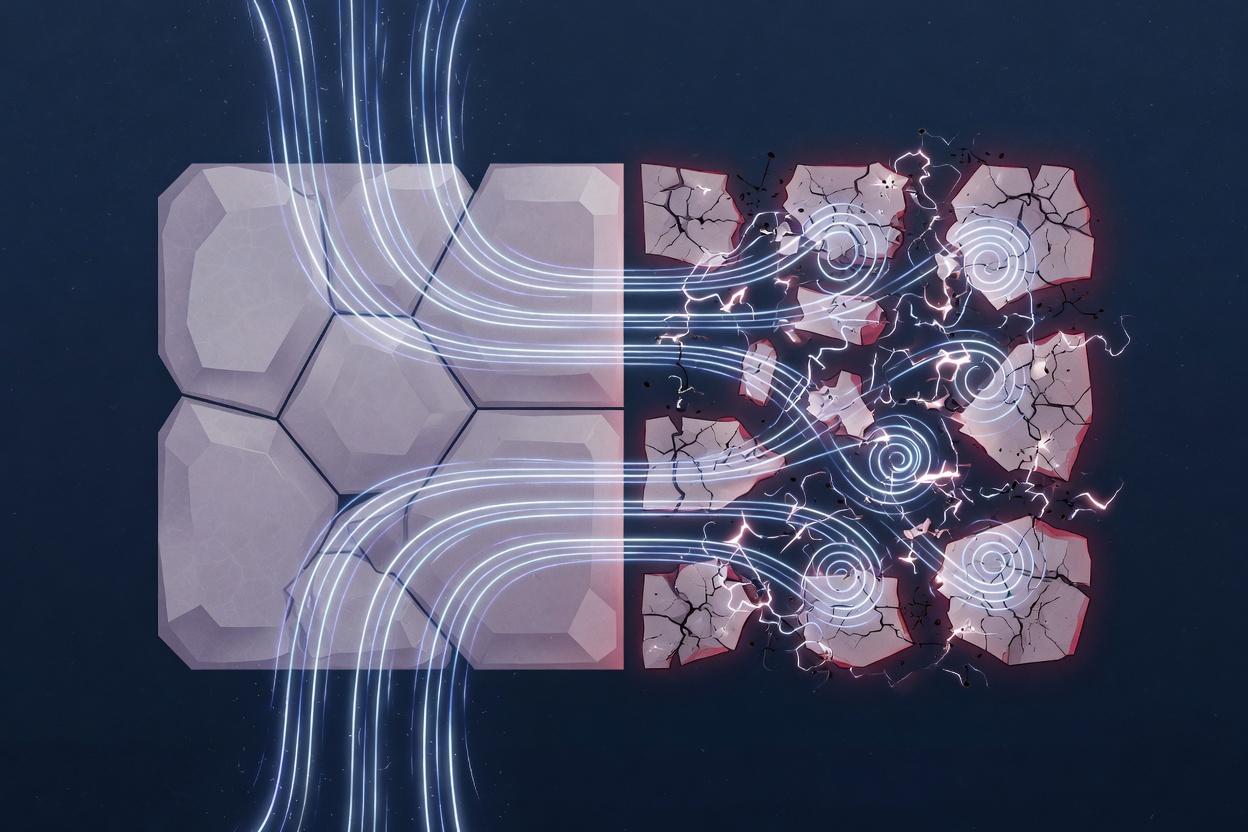
Generated via Grok.
Some magnets hold their field for years; others barely hold one at all once the driving field is removed. Some flip polarity easily; others strongly resist it. Those two properties often move together — and the reason they do points at a real gap this piece originally found in Paper 3’s mechanism, since refined rather than left standing.
The gap, as first named. Paper 3 originally stated that subatomic particle flows are lossless — “infinite bounces ensuring closed loops without dissipation.” Real magnets decay. Something had to give.
Revised 2026-07-21: Paper 3’s wording has since been softened to “dissipation negligible at any timescale a single material or observation could probe — not exactly zero.” That’s not a retreat from the finding below; domain-wall pinning remains the real, dominant reason ordinary magnets decay on human timescales. What changed is the idealized case: a real defect-free flow, at any finite temperature, isn’t claimed to be exactly, eternally lossless anymore — just close enough to it that nothing could ever measure the difference in practice.
What mainstream physics already has. Magnetic domains — regions of aligned atomic moments — form spontaneously from quantum-mechanical exchange interaction, a real, measured effect. That part isn’t in question; it explains why materials order into domains at all, not what happens to a domain’s boundary once it exists.
The resolution: on Paper 3’s own particle assumptions — near-zero mass, near-infinite speed — nothing internally stops a directional flow once it starts. In a real magnet, that flow is the ordered circulation associated with a domain’s aligned moments. What varies by material is whether its microstructure lets the domain boundary keep moving or pins it in place. That’s domain wall pinning, a real, named mechanism: grain boundaries, dislocations, and impurities either pin domain walls in place (a defect-rich microstructure: high coercivity, long-term retention, hard to reverse — hardened steel, alnico, neodymium — all engineered around microstructure that resists domain reversal) or let them glide freely — a smooth, defect-poor microstructure: low coercivity, low remanence. Annealed soft iron is chosen for transformer cores precisely because it never holds a useful field once the driving current stops, not because it holds one and loses it quickly. Idealized, defect-free material stays close to Paper 3’s now-negligible-not-zero claim; ordinary, defect-rich material introduces a real, calculable lossy channel on top of it.
The idealized case has a real-world example, and it isn’t perfectly lossless either. Superconductors carry persistent currents with no measurable decay across years of careful experiments — as close to frictionless as anything physics has ever measured. But even they aren’t claimed to be exactly zero-loss forever: real type-II superconductors show flux creep, a genuine, slow decay from thermally-activated magnetic flux vortices hopping between pinning sites — the same logarithmic decay law as ordinary magnetic viscosity below, just at a vastly slower rate. Same law, same underlying idea (pinning sites, thermal activation), radically different timescale. That’s the whole point: “negligible” and “exactly zero” are different claims, and real materials — from soft iron to superconducting magnets — sit at every point along that same spectrum.
And the decay rate is genuinely calculable, not just qualitative. Real hard-magnetic materials show magnetic viscosity — magnetization fades roughly logarithmically with time over typical observation windows, $M(t) = M_0 - S\ln(t)$, governed by a thermally-activated relaxation time $\tau = \tau_0 \exp(\Delta E/kT)$, with the barrier height $\Delta E$ set by pinning strength (the same Barkhausen-jump physics behind the audible “crackle” of a domain wall hopping between pinning sites). A bigger barrier — rougher microstructure — means a longer retention time. This is an existing, measured, per-material quantity, not something PBT needs to invent. Taken literally to unlimited time, that same logarithmic law drives any nonzero-loss system toward zero eventually — a real mathematical property, not just a rhetorical point, and one Matthew’s own notes anticipated decades before tonight: a 2002 page (change proportional to time.pdf) already argued that “anything/everything can happen given the right amount of time.” Same principle, here applied to loss instead of probability.
What keeps the flow recruiting more particles, rather than just “nothing stops it.” This specific mechanism isn’t frictionless — a moving charged particle through a medium of other charged particles leaves a wake behind it, and that wake carries real energy from leading to trailing particles, dragging them into the flow. This isn’t speculative — it’s the operating principle behind real plasma wakefield accelerators (the technology behind facilities like AWAKE at CERN), where a fast-moving charged bunch through a plasma creates a trailing wake that a second bunch rides. That’s a small-scale, particle-level effect, separate from the macroscopic “frictionless medium” claim already published for large bodies moving through the ambient medium. The two aren’t in tension; they operate at different scales.
Earth is not a bigger version of the same story. Earth’s outer core is liquid iron and nickel at thousands of degrees — far above iron’s Curie temperature (~770°C), the point above which a material can’t hold aligned magnetic domains at all. There’s no retained domain structure down there to decay. Earth’s field is generated fresh, continuously, by the geodynamo: convective flow of liquid conductive metal, organized into self-sustaining currents by the planet’s own rotation (via the Coriolis effect). It’s actively driven, not passively stored — closer to a running generator than a bar magnet, and not the same phenomenon as a magnet’s polarity flipping, either — geomagnetic reversals are dynamo reorganizations, not domain-wall depinning. One of several real contributors to the heat that sustains that convection, alongside secular cooling and inner-core solidification, is radiogenic heating from uranium, thorium, and potassium in the mantle and (more uncertainly) the core. On PBT’s own reading, that’s the same “reaction exceeds containment” process that describes radioactivity at atomic scale, now showing up as a planetary heat source rather than a bonding mechanism — a notebook-level connection, not yet a published claim.
Bottom line: two real, distinct regimes — passive retention governed by microstructure (materials), and actively driven flow sustained by a real energy source (planets and stars) — not one mechanism doing both jobs. The materials side maps onto measured domain-wall pinning and magnetic viscosity closely enough to be a real refinement of Paper 3, not just a patch.