Where Newton Stopped Short — And the One Piece That Actually Checks Out
28 July 2026
Generated via Grok.
Newton’s law of gravity is one of the most successful equations in the history of science. It predicted orbits, tides, and cannonball trajectories to extraordinary precision for three centuries before anything better came along. And Newton himself, in the Principia, declined to say why mass pulls on mass the way his equation says it does: hypotheses non fingo — I feign no hypotheses. He wasn’t ruling out a mechanism forever; he just wasn’t going to publish one he couldn’t test.
General Relativity finally gave gravity a complete explanation — mass curves spacetime, and falling is just moving in a straight line through curved geometry. It’s spectacular, and confirmed by everything from Mercury’s orbit to gravitational-wave detectors. But it’s a geometric explanation, not a mechanical one — not a physical process, made of moving parts, that produces the pull. That’s not a flaw in General Relativity. It’s just a different kind of answer than “here’s the machine.”
This site’s shadowing idea is an attempt at that other kind of answer: a body sitting in an even, all-directions flux of tiny particles blocks part of that flux from reaching anything nearby, and the resulting lopsided push reads as attraction. A mechanism like that is worthless if it can’t first reproduce the law it’s trying to explain. Paper 14, this site’s own audit of the theory, found that it does — to within 0.01% for ordinary objects at ordinary distances.
A real mistake, caught before publishing — and a better answer underneath it
The first version of this article, and the companion paper it was based on, made a real error working out exactly how far that match extends: it measured how much of the sky a body blocks, and assumed that number was the same thing as the force. It isn’t. Force depends on a slightly different quantity — the blocked flux weighted by direction, since flux blocked off to the side cancels out more than flux blocked straight ahead. Once that’s done correctly, the answer changes, and it’s actually a better one: the force from this simple shadowing picture is exactly inverse-square at every distance outside the body doing the blocking, not just approximately so far away. That’s not a coincidence — it’s the same reason Newton’s own law gives an exact result outside a uniform sphere at any distance, not just from far off.
That correction matters, and it’s worth being upfront about it happening: a dedicated adversarial review — Grok explicitly asked to find every objection a hostile physicist could raise, not give friendly editorial notes — caught the error before anything went out with it in place. That’s exactly what that process is for.
What this still doesn’t establish
This isn’t a demonstration that push-gravity is correct, and the corrected geometry doesn’t change that. The idea it descends from — Le Sage’s 1748 shadowing theory — is settled, disproven physics today, and the geometry was never really the reason. The real, historical problem is different and harder: real objects aren’t perfect, idealized blockers. If a body is solid enough to cast a shadow at all, its own outer layers can partly shield its inner layers from the same ambient flux — which threatens the one thing gravity is measured to do with extraordinary precision: pull exactly in proportion to mass, regardless of what a body is made of or how dense it is. That’s the actual, still-unresolved crux of this whole idea, not a footnote next to it.
On top of that, real gravity is between two extended bodies, not one point and one sphere — a further calculation nobody has done here either:
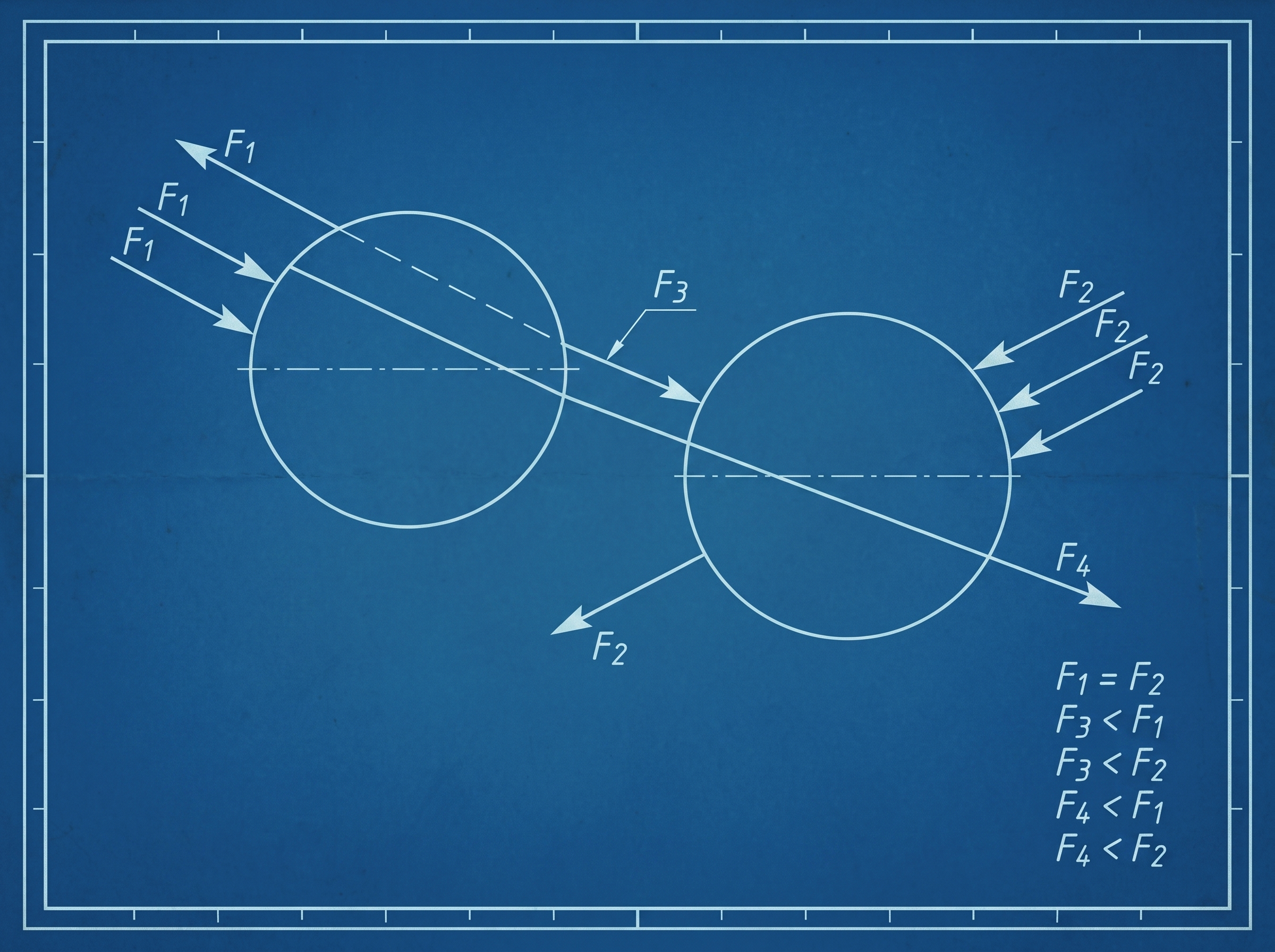
Adapted from Matthew’s own working sketch, redrawn as a technical blueprint via Google Gemini.
This is exactly the open question, sketched out directly: two bodies, each partially shadowing the other. The force along the line connecting them (F3, and F4 on the far side) comes out smaller than the force from directions with a clear, unblocked view (F1, F2) — the real mutual-shadowing effect this mechanism depends on. Whether that effect actually reproduces gravity’s real behavior between two extended, realistically-imperfect bodies — not just an idealized point and a single sphere — is precisely the calculation Paper 15 flags as the next real step, not yet done.
Paper 14’s drag-and-heating problem — the one that killed Le Sage’s original version — has since been given a theoretical answer: detailed balance turns what looked like unbounded energy buildup into a bounded thermostat problem instead, a 2026-08-06 result. That closes one historical objection; it costs something elsewhere (it rules out identifying this medium with the universe’s dark sector) and doesn’t touch the harder, still-open problem above.
Newton stopped short of a mechanism entirely. This corrects and narrows one small piece of what a mechanical answer would need — the geometry, done right, turns out to be exact rather than approximate — while stating plainly that the actual hard parts (whether it works for real, imperfect, extended matter; drag; heating) are still open. A foundation stone, more precisely laid than the first draft managed; still not a building.