Where Did We Get the Word 'Pull'? Newton's Caution, and Why It Never Stuck
21 July 2026
Once you see that gravity isn’t actually pulling anything — you’re not being yanked down, the floor is just stopping you from following spacetime’s straightest path — the obvious question is: why does everyone, including physicists, still say “gravity pulls”?
It’s a story about a scientist who used that word while explicitly refusing to explain it, and about language that outlasted the caution of the man who chose it.
Newton’s actual word was “attraction,” and he was careful about it
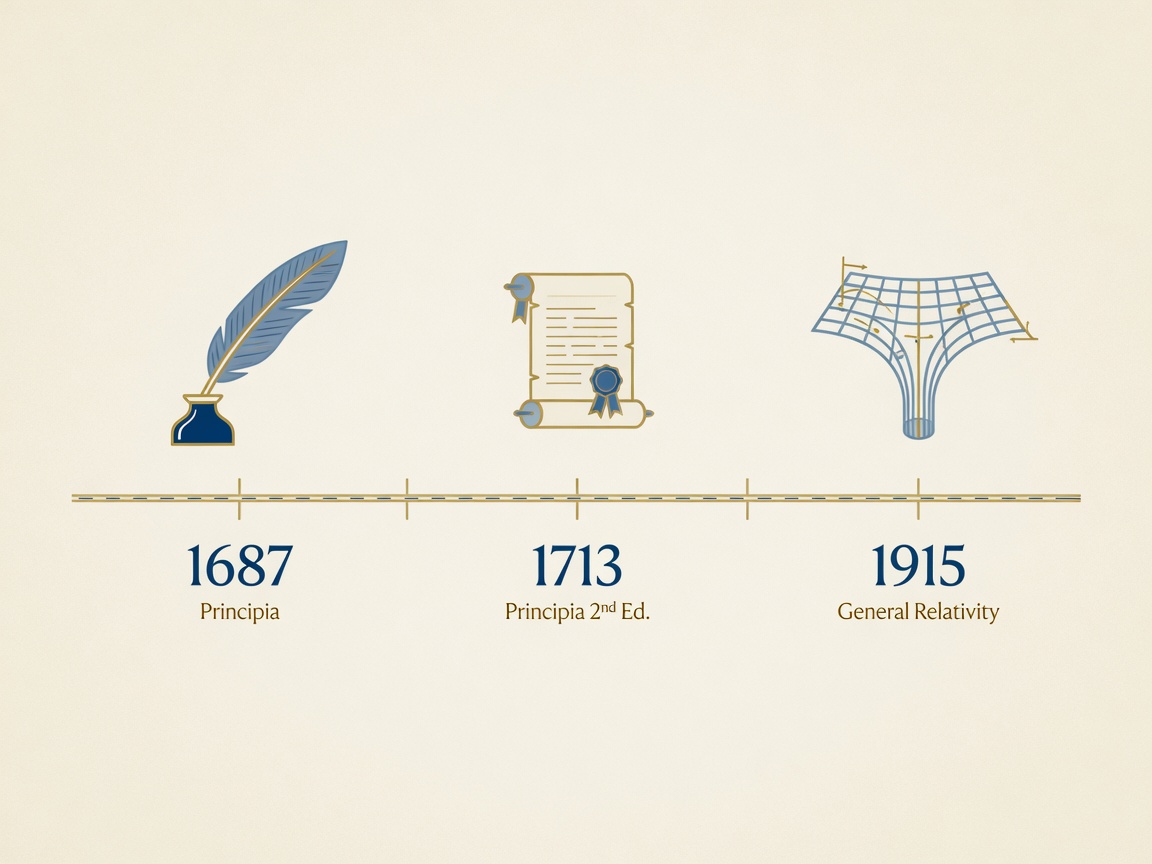
When Isaac Newton published the Principia in 1687, he described gravity mathematically as a force of attraction between masses — $F=GMm/r^2$. “Attraction” names the effect he could measure and predict precisely, without claiming it described an actual mechanism — and he wasn’t the first to reach for that word. Centuries earlier, the 7th-century Indian astronomer Brahmagupta had already described falling objects as an expression of an attractive tendency in matter itself. People noticed the effect and reached for “attraction” long before anyone had a force law.
Newton’s own caution about that word became explicit in 1713, in the same breath: he added the General Scholium to the Principia’s second edition, responding to critics who accused him of smuggling in “occult” causes, with the famous line hypotheses non fingo — “I frame no hypotheses.” He’d shown gravity’s effects matched the math. He would not guess at what gravity was.
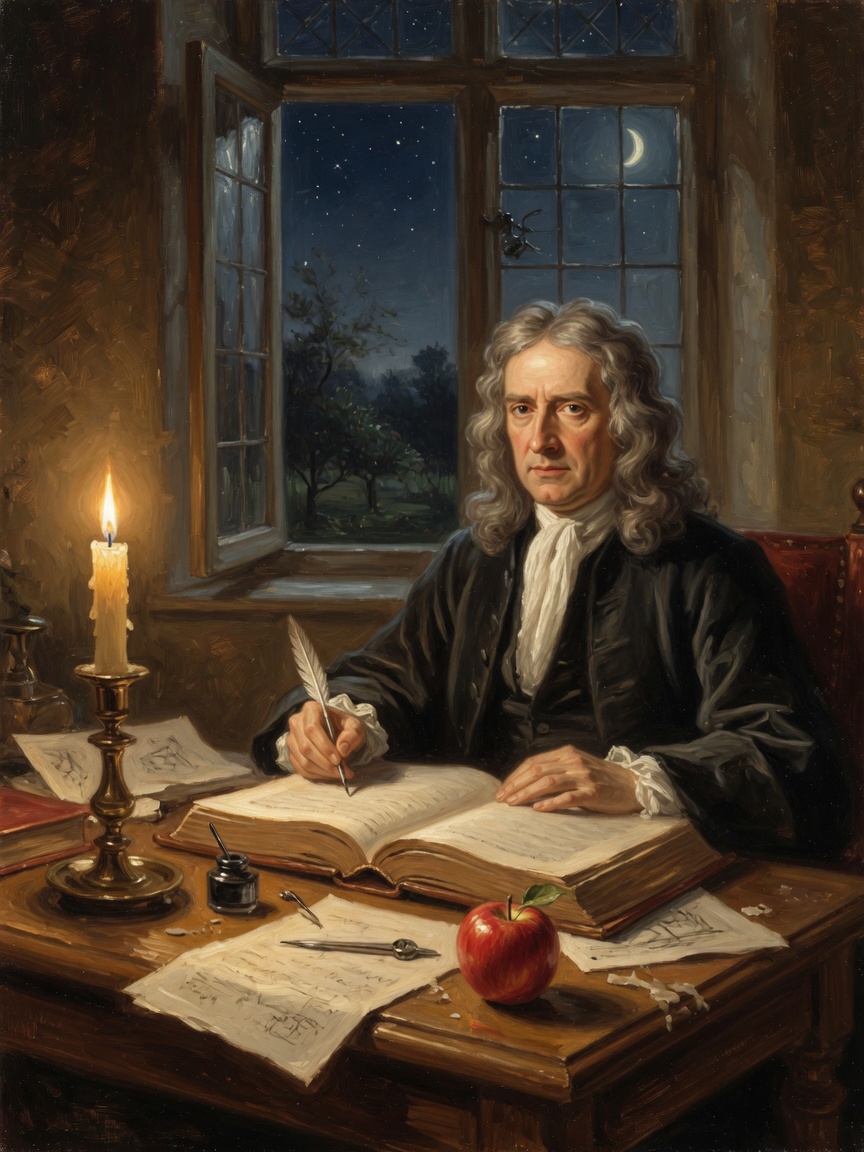
Even Newton couldn’t quite leave it there
And then, in that very same paragraph, he did anyway. Immediately after writing “I frame no hypotheses,” Newton went on to speculate about “a most subtle Spirit which pervades and lies hid in all gross bodies,” by whose “force and action” the particles of bodies “mutually attract one another at near distances.” Disclaimed the mechanism, then guessed at one, in the same breath. Even the person most careful about this exact question couldn’t fully resist reaching for a “how.”
Three hundred years where “attraction” had no rival
From 1687 until 1915, Newton’s force of attraction wasn’t a simplification of a better theory — it was the best theory anyone had. Every textbook and lecture for those 228 years built on his Latin attractio, taught and translated generation after generation into the plain-English “attraction,” and from there into its everyday cousin, “pull.” That’s a long enough run for a word to stop sounding like a hypothesis and start sounding like a fact.
Then, in 1915, Einstein reframed gravity as the curvature of spacetime — no pulling, no force, just geometry. But by then “pull” wasn’t Newton’s technical term anymore; it was three centuries of ordinary language, describing an effect GR still reproduces almost exactly outside of black holes, cosmology, and precision astrophysics.
A gap in the record
I looked for the specific moment the English phrase “gravitational pull” was itself coined or first popularized, the way you can trace hypotheses non fingo to an exact page and year. It isn’t there to find. What’s real and traceable is Newton’s own attractio and his explicit caution about it — the plain-English phrase looks like the natural residue of centuries of teaching that idea, not a single coined moment. I’d rather say the record doesn’t cleanly show this than invent a tidy origin that sounds better than the truth.
Why the word never got recalled
Nobody ever “corrected” the language, because for nearly every situation anyone deals with, it doesn’t need correcting — it works. GR’s own equations collapse into Newton’s force law in exactly the regime “pull” was built for. The word survived Einstein not because people didn’t know better, but because it kept being useful, to enormous precision, in everyday and even most scientific contexts.
So when you hear “gravity pulls,” you’re not hearing a mistake. You’re hearing the last living word of a 300-year-old theory that turned out to be an excellent approximation of a deeper picture its own author deliberately wouldn’t claim — Newton locked in attractio, then told you upfront not to trust any guess about why.
References
- Newton, Isaac. Philosophiæ Naturalis Principia Mathematica, 2nd ed. (1713), General Scholium — source of both hypotheses non fingo and the immediately following “subtle Spirit” passage.
- Brahmagupta. Brahmasphutasiddhanta (628 CE) — an early recorded description of gravity as an attractive tendency of matter, predating Newton by roughly a thousand years.
- Einstein, Albert. (1915). General Theory of Relativity — the reframing of gravity as spacetime curvature.
Credits
This grew directly out of the same real conversation as the two pieces before it — checked against real sources rather than assumed, including catching that the exact origin of the phrase “gravitational pull” itself isn’t something the historical record actually documents.