What the Clocks Were
11 September 2026
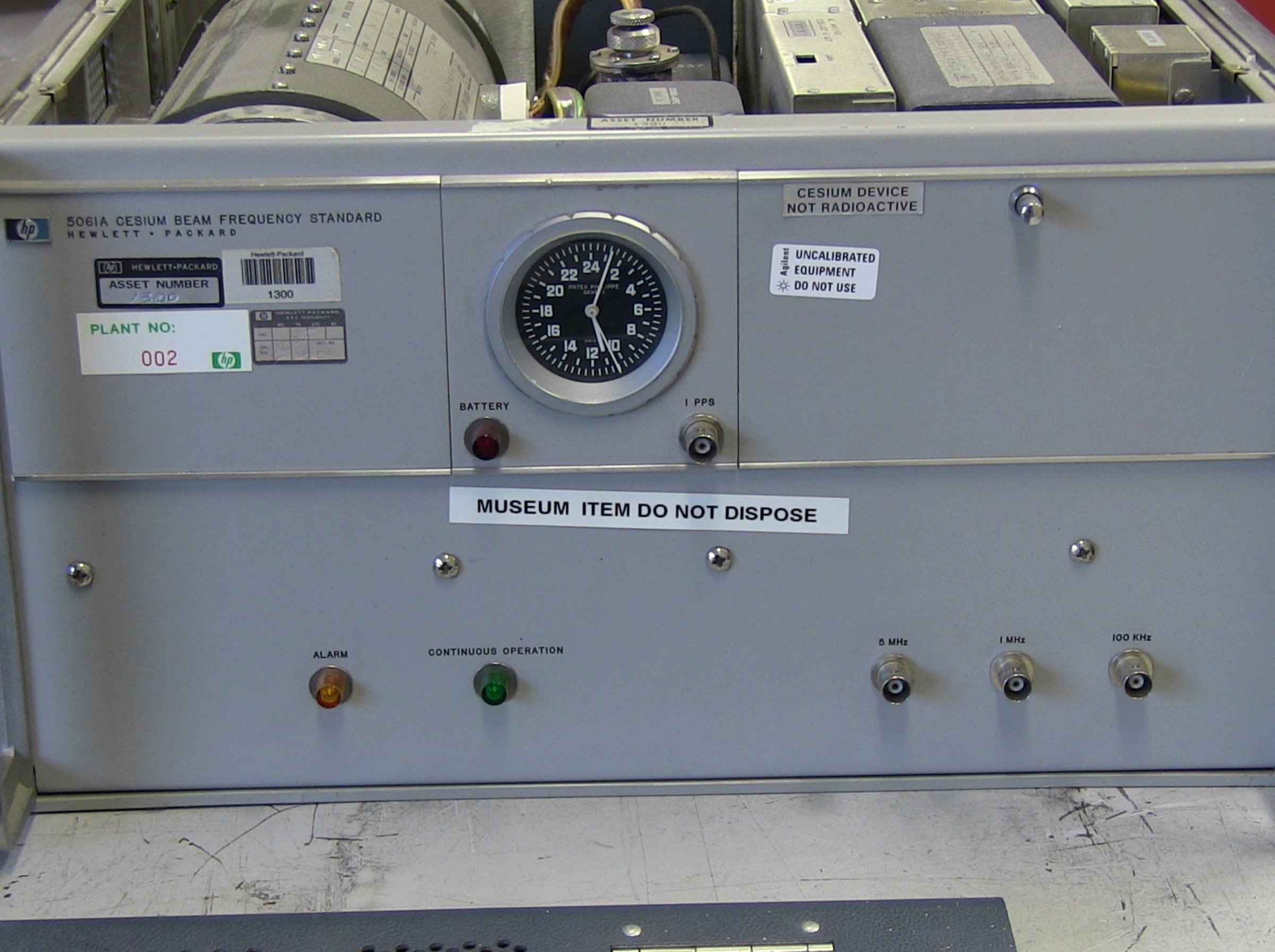 One of the HP 5061A cesium-beam clocks flown in the 1971 Hafele-Keating experiment. Photo: Binarysequence, via Wikimedia Commons, CC BY-SA 3.0; cropped, and shared under the same licence.
This piece is the instrument audit. Reading order on this site: The Test Confirms the Effect (measurement versus explanation), then this article, then Why Universal Time (the reading), then How It Could Work (the model).
Textbooks and popular accounts present time dilation as one of the best-confirmed facts in physics, backed by many independent lines of evidence. Before deciding what those lines prove, it is worth asking a plainer question. What were the instruments?
What the instruments were
Here is what the experiments most often cited actually compared, sorted by what sets the tick.
- Hafele-Keating, 1971. Four Hewlett-Packard 5061A cesium-beam atomic clocks, flown on commercial airliners and read against the U.S. Naval Observatory’s clock ensemble. The tick is a transition between two spin states of the cesium atom’s outer electron and nucleus, split by their magnetic interaction. The interaction is electromagnetic.
- GPS. Cesium and rubidium atomic frequency standards on the satellites. The same kind of tick.
- Ives-Stilwell, from 1938 to the modern storage-ring versions. The frequency of a spectral line emitted in flight, by hydrogen atoms in the original and lithium ions in the modern versions. An electronic transition, read as light.
- Chou and colleagues at NIST, 2010. Two aluminum-ion optical clocks, one raised 33 cm above the other, and one moving at about 10 metres per second. An optical transition in an ion.
- Pound-Rebka and Pound-Snider. A gamma-ray frequency from iron-57 nuclei. Here the level spacing is set by nuclear structure, so this is a nuclear clock, and it agreed with the prediction to about one percent.
- Muon and pion decay in storage rings. A muon is a heavy, unstable relative of the electron; its lifetime is set by the weak force, so it is a third kind of clock. In these experiments the muons circulate in a ring at nearly light speed, and the speed used in the comparison comes through a relativistic relation from the beam’s momentum, one calibration step this project has not independently confirmed. So the muon test carries less weight on its own than it is usually given. The Test Confirms the Effect sets that out.
Apart from muon and pion decay and the coarser nuclear case, every high-precision entry on that list is one physical process type: an oscillation set by the electromagnetic interaction between an electron and a nucleus, read by different methods. Clock transport, satellite operation, spectroscopy, and a laboratory optical comparison are genuinely different experimental methods. They are not different physical processes.
How many times
People cite the flight experiments as if they were a large body of repeated trials. Here is the actual count for aircraft.
| Experiment | What was flown | Trials | Result |
|---|---|---|---|
| Hafele-Keating, October 1971 (Science 177, 166 and 168) | four cesium clocks, together | one flight eastward, one westward | eastward predicted −40 ± 23 ns, observed −59 ± 10; westward predicted +275 ± 21, observed +273 ± 7 |
| Alley and colleagues, University of Maryland, 1975 to 1976 | three cesium and three rubidium clocks aloft at about 9,000 m, a matching set on the ground, radar-tracked, compared in flight by laser pulse | five flights of about 15 hours | designed so the gravitational term dominates, with the velocity term computed from the radar track and subtracted; agreement to about one percent |
| National Physical Laboratory, 1996 | improved cesium clocks, London to Washington and back | one round trip | observed 39 ± 2 ns against 39.8 predicted |
| National Physical Laboratory, June 2010 | cesium clocks, London, Los Angeles, Auckland, Hong Kong, London | one round-the-world trip | predicted 246 ± 3 ns, observed 230 ± 20 |
Four aircraft experiments and nine flights. In the original, the quoted uncertainty is the scatter among four clocks on one flight, not repeated-trial statistics. Westward agreement was close to exact; eastward ran about 19 ns more negative than predicted, roughly 0.8 standard deviations once both uncertainties are combined. Consistent, and nothing to overstate in either direction. One flown clock sits outside this table: Gravity Probe A, a hydrogen maser on a 1976 rocket flight to 10,000 km, which confirmed the combined effect to about a part in ten thousand, the most precise flown clock of all.
The stronger evidence is elsewhere. GPS runs its corrections on every satellite every day and would drift within minutes if the magnitude were wrong. Different groups have repeated Ives-Stilwell for eighty years. The 2010 NIST comparison resolved a 33 cm height difference as a fractional shift of (4.1 ± 1.6) × 10⁻¹⁷. As a phenomenon, the shift of an atomic clock’s rate with speed and height is about as well measured as anything in physics. As an aircraft experiment, it is four experiments. Both statements are true, and they are different claims.
Clocks of another kind
Nobody has flown a pendulum clock, or a spring-driven watch, or a quartz oscillator as the compared clock, and read a nanosecond difference off it. No clock of any other kind is stable enough in flight to resolve the effect. That limits what the flights can be said to show; it is not a flaw in them.
At atomic-clock precision, only electromagnetic clocks have been tested at speed or height. Two coarser cases exist. The iron-57 nuclear transition, whose spacing is set by nuclear structure, redshifts with height by the same fraction as the atomic clocks, to about one percent. And the spin of the binary pulsar PSR B1913+16, a neutron star’s rotation rather than any atomic oscillation, shows the periodic time-dilation-and-redshift modulation general relativity predicts as it swings through its orbit, an effect measured for decades and consistent with it. Both are far coarser than the atomic-clock comparisons. That gap in precision is the real one.
So what the experiments show is this: an atom’s electromagnetic oscillation changes, compared with a clock that stayed behind, with its speed and its height in a gravitational field, by a specific and now very well measured amount. What they do not show, on their own, is that every kind of clock would have changed by the same amount. The step from “this oscillation changed” to “time itself changed” is an interpretation added to the reading. It is the standard interpretation, it is consistent, and it is a different thing from what the instrument recorded.
The standard answer deserves stating fairly. Mainstream physics holds that every known interaction shares the same symmetry, so every clock built from any of them must change identically, whatever it is made of. For electromagnetism the isotropy of light speed is tested to about a part in 10¹⁸ and the dilation of an ion’s transition to about two parts in a billion. For the nucleon sector, spin-comparison experiments of the Hughes-Drever type, most recently by Smiciklas and colleagues in 2011, bound any orientation dependence directly. Comparisons of clocks of different make at varying gravitational potential, cesium fountains against hydrogen masers over seven years and two transitions of the same ytterbium ion more recently, find no difference, though all of those are still electromagnetic transitions. For the weak force the argument rests on the muon, with the caveat above. The measurement that would settle it, a clock whose tick is set by something other than electromagnetism, compared at speed or height with atomic-clock precision, has not been made. The instrument that could make it now exists: the thorium-229 nuclear clock, whose transition was first driven by laser in 2024.
What this project makes of it
An atom whose oscillation changes with its motion and its surroundings is exactly what this project would expect. In its model the electron is a standing wave sustained around the nucleus in a medium (the light-carrying medium of that model, not the pressure medium of this site’s gravity work); move the atom through the medium, or lower it in a potential, and the wave’s round trip changes. How It Could Work presents that model with its parameters listed and re-runs it against three of these measurements: Ives-Stilwell, the Pound-Rebka and Pound-Snider shift, and the GPS net figure all come out of it in absolute time, with the clock’s mechanism doing the work. For Hafele-Keating it gives the sign only. Alley, the two NPL flights, Gravity Probe A, and the 2010 NIST comparison have not been run.
The audit changes nothing about the readings and one thing about their use. “Time dilation has been confirmed many times” reads, on inspection, as “the rate of an electromagnetic oscillation has been measured to change, many times, by several methods, and physicists have adopted one theory’s account of why.” That is a strong result, and a different one from the sentence it replaces.
Where this leaves it
What this project did: it went back to the primary papers for Hafele-Keating and the NIST comparison and to the standard secondary accounts for Alley and the two NPL flights, listed what each instrument was, counted the flights, and logged the audit in its own working notes before writing this. In the course of writing it, two entries in those notes were corrected: the 2010 NPL flight had been missed, and the iron-57 and pulsar cases had been folded in with the atomic clocks when they belong in a different column. The re-runnable part is the model package linked above.
Compared against the documented standard: the Standard-Model Extension already treats Lorentz symmetry as something to test sector by sector, with separate coefficients for photons, electrons, nucleons, and the weak interaction, which is the formal version of the point made here. This project does not map onto those coefficients, and it has no clock of another kind to offer either.
The next measurement that would matter is the nuclear clock, compared at height or speed against an atomic one. Until then, the nearest non-electromagnetic data are the muon storage rings, and this project’s own bound from them (the Bailey 1977 row in the How It Could Work package, built from the two measured lifetimes and the fact that the muons cannot exceed light speed, without the momentum step objected to above) says only that the weak force’s clock cannot run on a signal faster than light by more than six parts in ten thousand. Everything beyond that is a measurement nobody has yet made.