What Magnetism Actually Explains — and What It Doesn't
19 July 2026
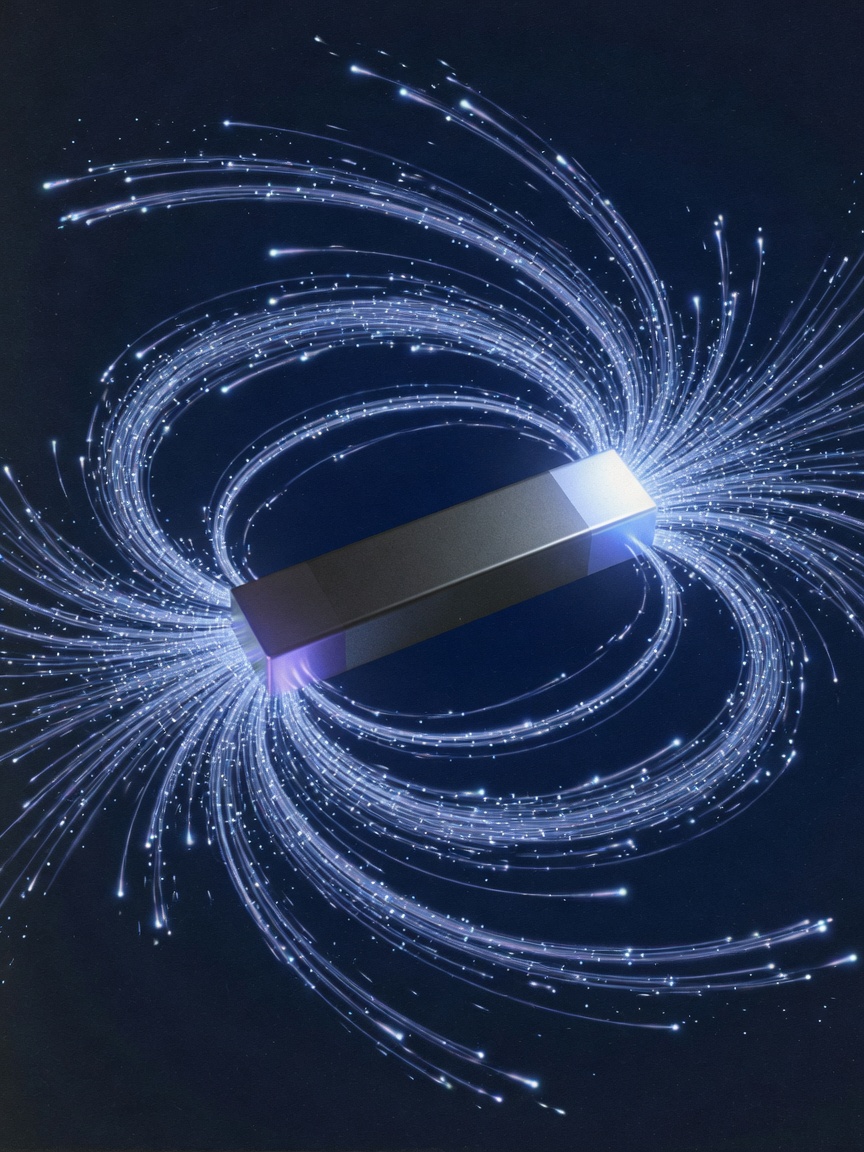
Field lines as directional particle flow, not abstract lines — the visual PBT itself uses. Generated via Grok.
Standard physics has a verified mechanism for why neighboring electron spins interact the way they do. It has no mechanism for what spin itself is — that’s treated as a foundational given, not something derived from anything deeper. That distinction is the actual gap, and it’s narrower than “magnetism is unexplained.” Two posts on X this week prompted a closer look: one laid out the four standard categories of magnetic ordering (paramagnetism, ferromagnetism, antiferromagnetism, ferrimagnetism) with an arrows-on-a-grid diagram — a classification, not a mechanism, and the natural place to draw the line precisely.
What’s actually established
The mechanism underneath that diagram is quantum mechanical exchange interaction: when two electrons’ wavefunctions overlap, Coulomb repulsion combined with the Pauli exclusion principle (no two fermions can share a quantum state) produces a calculable spin-dependent energy term. Depending on its sign, neighboring spins are favored to align or anti-align — ferromagnetism and antiferromagnetism, with ferrimagnetism and paramagnetism as the unequal-strength and no-net-coupling variants. Neutron scattering measurements probe this energy directly and match the calculations. Mainstream physics has a real, mechanistic answer for spin-to-spin interaction.
Where the explanation stops
That mechanism explains how spins interact, given that spin already exists — it says nothing about what spin physically is. Spin is real and precisely measured, confirmed since the 1920s Stern-Gerlach experiments, and it’s mathematically required: it falls necessarily out of the Dirac equation, the result of combining quantum mechanics with special relativity. But that’s a measurement and a derivation, not an underlying physical picture. The old “the electron is a tiny spinning ball” image is known to be impossible — a point particle would need faster-than-light surface speed to produce the measured angular momentum. Spin isn’t an open research question the way dark matter or quantum gravity are. It’s also not derived from any deeper substrate. It sits as a foundational given.
Where PBT picks up
Pressure Based Theory models magnetic fields as directional flows of subatomic particles in the finer hierarchical levels of its pressure medium — field lines as average particle trajectories, not an abstract field. Paper 3 develops this with real formalism: a magnetic field derived from flux gradients, a Lorentz force derived as a push, and simulated dipole streamlines matching observed field patterns. A flow-based mechanism is exactly the kind of thing tensor mathematics — the subject of the second post this week — is built to describe (the electromagnetic field is already expressed as a tensor, $F_{\mu\nu}$, in relativistic physics), which points toward the natural next step for extending Paper 3’s math rather than replacing it.
Bottom line
The gap is real, and it’s exactly where Paper 3 places PBT’s own explanation — including its own recorded limitation: “quantum spin as vortices” is noted there as pending, not resolved. Worth continuing to develop. Not yet a finished answer either.