What's Actually Holding Us Down? The Real Answer, With Real Numbers
21 July 2026
If those grass clippings aren’t being pulled, and they aren’t being pushed either — they’re just following a straight line through curved spacetime, a “geodesic” — then what’s holding me down right now, sitting still?
That question deserved a real answer, not a comfortable metaphor. The goal was never to defend a theory. It was to understand what’s actually true.
Nothing is holding the clippings down while they fall
That’s the whole point of a geodesic. While the clippings are in the air, no force is acting on them at all. They’re doing the one thing a free object naturally does: following the straightest path available through spacetime. Near Earth, spacetime happens to be curved in a way that makes “straightest path” curve toward the ground. That’s it. No rope, no hook, no hidden mechanism — because nothing is grabbing them in the first place.
So what IS holding me down, sitting in this chair?
Here’s the reframe that untangles everything: once you’re standing on the ground — or sitting in a chair, or lying in bed — you are no longer in free-fall. The ground (or the chair, or the bed) is pushing up on you. That upward push is a completely ordinary, everyday force — the same electromagnetic repulsion between atoms that stops your hand from passing through a table. And that’s what’s “holding you down,” in the sense of keeping you from continuing along your natural path, which would carry you toward Earth’s center.
Standing still is actually the unnatural, force-having state. Free-fall is the natural, force-free one.
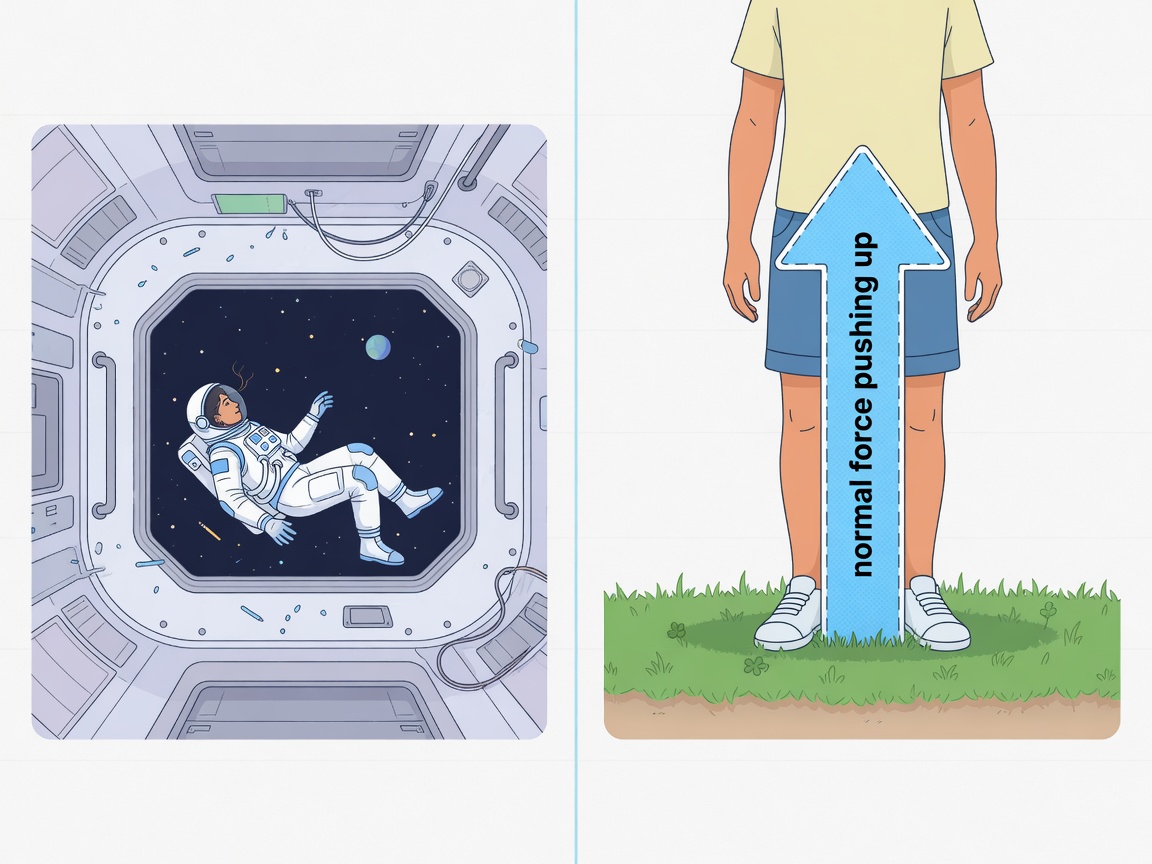
This is Einstein’s actual starting point, called the equivalence principle: standing on Earth’s surface feels exactly like standing inside a rocket accelerating at a steady 1g in deep space, nowhere near any planet. And free-fall feels exactly like being far from everything, with no force acting on you at all — which is exactly why astronauts on the International Space Station are weightless. They haven’t escaped gravity. They’re in free-fall the whole time, just like the grass clippings mid-air, except they’re moving sideways fast enough to keep missing the ground.
Why does a “straight line” curve toward the Earth at all?
Picture two people standing on the equator, a few feet apart, each walking due north. Neither one turns. Neither one steers toward the other. And yet, because they’re walking on a curved surface, their paths converge, and they bump into each other at the North Pole. That’s what curvature does to “straight lines” — it can make them meet without either path ever bending on its own terms.
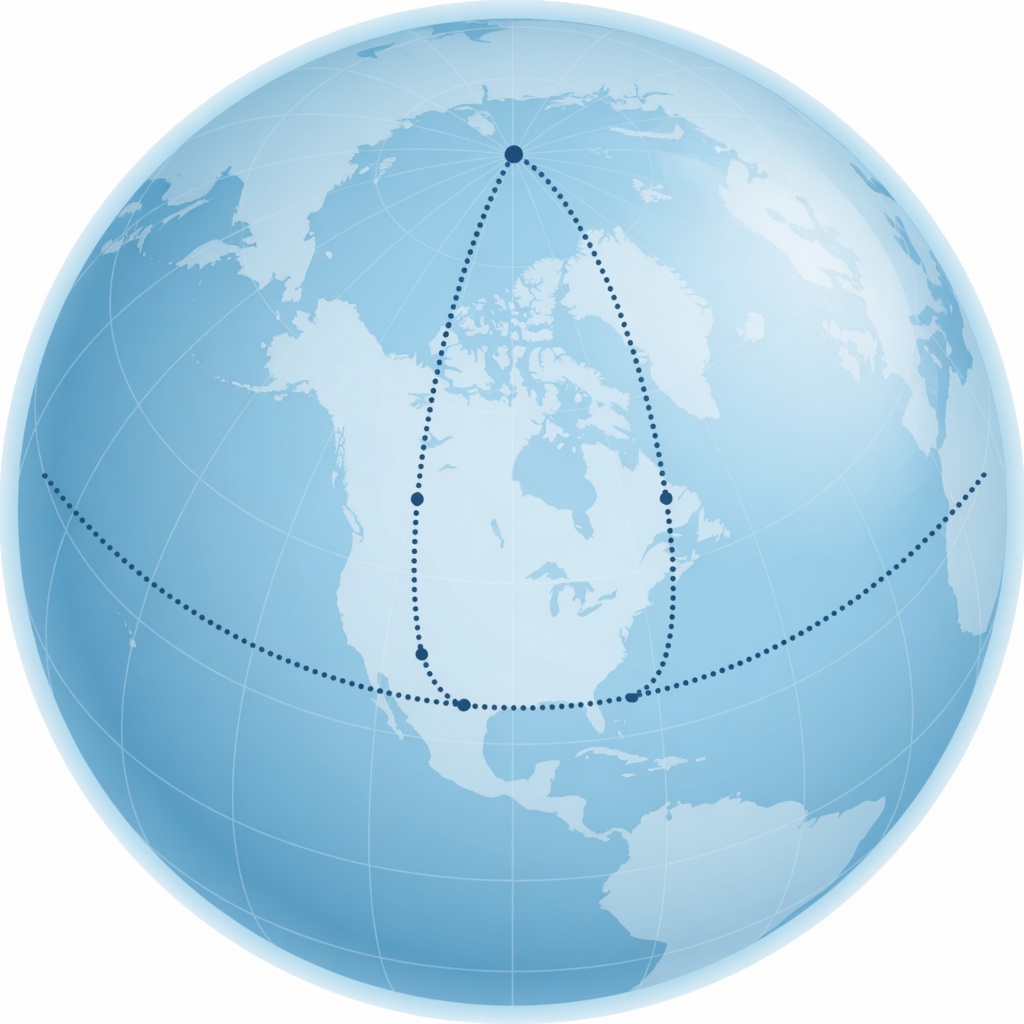
Gravity works the same way, except the “surface” being curved is spacetime itself — and here’s the part that’s easy to miss: the dominant curvature, for everyday gravity, is in time, not space.
Every object, even one sitting perfectly still, is moving through spacetime overwhelmingly through the time direction — you’re barely moving through space at all, compared to how fast you’re moving through time. Mass curves time: clocks run very slightly slower the closer they are to a massive body. Because you’re already hurtling through time at that pace, even a tiny mismatch in the rate — time ticking a little differently a few feet lower down versus a few feet higher up — is enough to bend a path that starts out moving almost purely through time into one that also drifts through space, toward the ground.
A real, measured number, not a metaphor
Gravitational time dilation has been measured directly, more than once, at increasingly small scales. In 1959, Pound and Rebka measured it using a 22.5-meter tower at Harvard, comparing gamma-ray frequency at the top versus the bottom. In 2022, physicists at JILA (Bothwell et al., Nature) measured the same effect across a gap of just one millimeter — roughly the width of a sharp pencil tip — using two tiny clouds of atoms in the same optical clock.
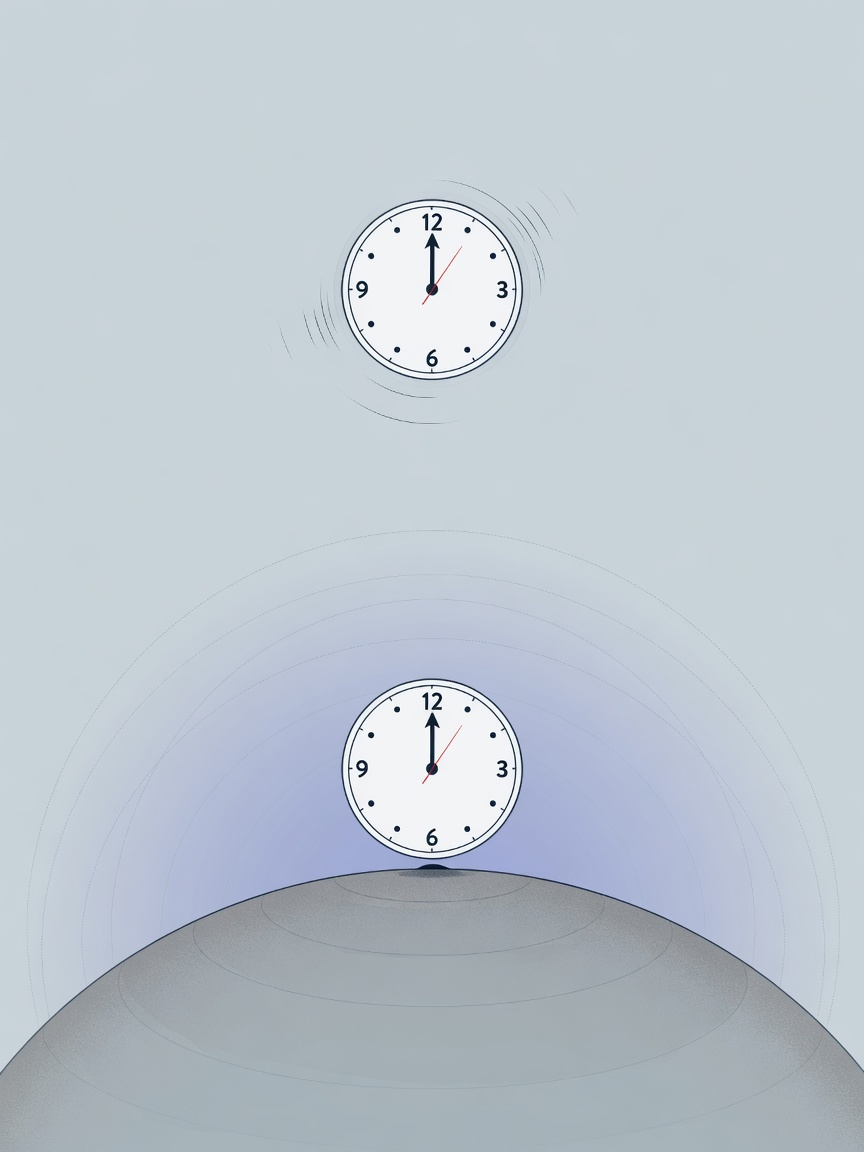
The rate at which time speeds up with height is just this, using nothing but Earth’s real, independently measured mass and radius:
$$\frac{d}{dr}\left(\frac{\Phi}{c^2}\right) = \frac{GM}{r^2 c^2} = \frac{g}{c^2}$$
Plugging in the real numbers ($G = 6.674\times10^{-11}$, $M_{\oplus}=5.972\times10^{24}$ kg, $r_{\oplus}=6.371\times10^6$ m):
$$\frac{g}{c^2} \approx 1.093\times10^{-16} \text{ per meter}$$
That’s the fractional rate at which time speeds up for every meter you rise near Earth’s surface. General relativity’s own geodesic equation turns that time gradient directly into an acceleration — $g = c^2\times(\text{that fraction})$ — which comes out to $9.82$ m/s², matching $g$.
Run the same fraction over the two real experiments’ actual heights and it holds up at both ends: over the Pound-Rebka tower’s 22.5 m, it predicts a shift of $2.46\times10^{-15}$, against their real measured $\approx2.5\times10^{-15}$. Over JILA’s 1 mm, it predicts $1.09\times10^{-19}$ — right at the scale their 2022 clock was built to resolve.
Why this mattered to me
I didn’t go looking for this to defend any theory of my own. I went looking for it because a question I couldn’t answer bothered me, and the real answer turned out to be better, stranger, and more solid than either “something is pulling” or “something is pushing.” Nothing is doing either. You’re not being held down by a force right now — you’re being held up, away from the straight path you’d otherwise be following, by whatever is under you. That’s not a consolation prize for giving up a simpler story. It’s the real one, and it’s been checked, twice, down to a fraction of a millimeter.
References
- Pound, R. V.; Rebka, G. A. (1960). “Apparent Weight of Photons.” Physical Review Letters 4, 337. The original 22.5-meter tower measurement of gravitational redshift.
- Bothwell, T., Kennedy, C.J., Aeppli, A. et al. (2022). “Resolving the gravitational redshift across a millimetre-scale atomic sample.” Nature 602, 420–424. https://www.nature.com/articles/s41586-021-04349-7
- Newton, Isaac. Letter to Richard Bentley, 1692/93 — the original statement of discomfort with unmediated action-at-a-distance.
- Einstein, Albert. (1915). General Theory of Relativity — the geometric account of gravity as spacetime curvature, with no force required.
Credits
This grew directly out of a real conversation working through the question directly, formula by formula, rather than settling for a comfortable analogy.