Gravity Is a Push: Walter Wright's Magnets and the Test of a Working Model
14 November 2026
This article explains who Walter C. Wright Jr. was, what his book Gravity Is a Push claims, why its specific mechanism cannot match what gravity is measured to do, and why his insistence on physical models points at the standard any solution has to meet: it must work, and it must work again when someone else repeats it. You can read the whole book free at the Internet Archive and check every quote below.
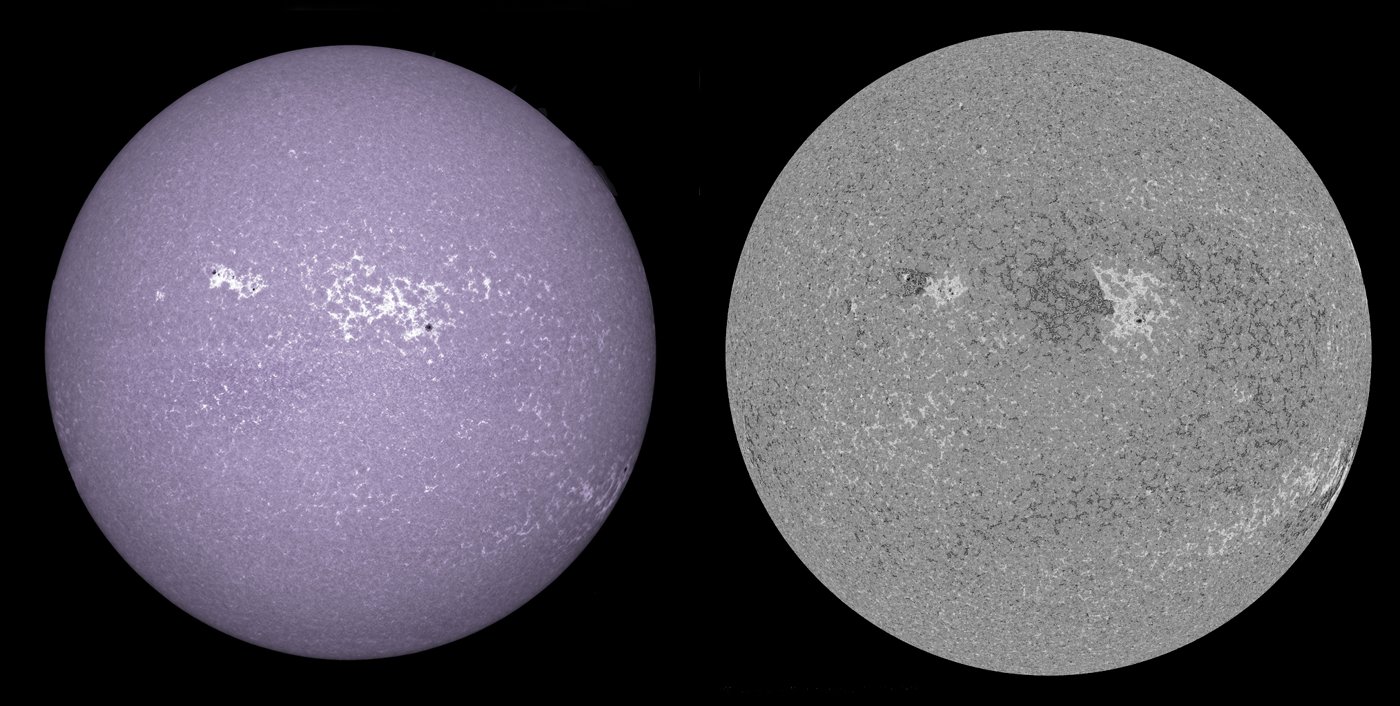 The Sun on 19 July 2015. Left: calcium-K light, photographed by john.purvis (Flickr). Right: NASA’s SDO magnetogram, where light and dark mark opposite magnetic polarity. Wright believed this magnetism was gravity. Composite: john.purvis, CC BY 2.0, via Wikimedia Commons.
Where Wright fits on this site
In How I Realized the Absurdity of Pull Gravity, I described watching grass clippings fall while mowing and starting to wonder whether things are pushed into place rather than pulled. When I began researching push gravity, one of the first authors I found was Walter Wright, with his 1979 book Gravity Is a Push. Later I found Einstein’s early interest in mechanical explanations, and then Le Sage.
 Where this started for me: grass clippings falling from the mower. Image created with Google AI, first used in the 2025 article.
Wright mattered to me for a simple reason. He showed me I wasn’t the only one who thought it more likely that things are pushed rather than pulled. That is a gift, and I want to treat his work with the gratitude it deserves. I agree with Wright that gravity is a push, which I would now state more precisely as a pressure differential principle. I part ways with many of his later speculations, including the magnetic mechanism, the anti-matter Sun and universal repulsion. Gratitude also means taking his ideas seriously enough to test them. So this piece does both: it lays out what Wright proposed, in his own words where possible, and then checks his specific mechanism against measurements.
Who Walter Wright was
The book’s jacket says Wright was born on June 21, 1918, in Cement, California, moved to nearby Fairfield in 1928, and worked for the Southern Pacific Railroad as a signal maintainer for over forty years. He held a First Class FCC Radio-Telephone Commercial License and taught electronics in adult education and at Napa Community College. A 1979 UPI story described him as “a retired railroad signalman and self-taught physicist,” aged 60, whose Fairfield home “overflows with black boxes housing small magnets that spin, twist and roll.”
The book itself was published by Carlton Press in New York, copyright 1979, 176 pages, ISBN 0-8062-1263-2 (Google Books). The SVP Wiki lists it as 1976, but the copyright page reads 1979, and the March 1979 UPI story says the book was still due “in the next two months.” The 1976 date may come from an earlier booklet, “Tides Are A Push,” which Wright says he copyrighted on August 12, 1976.
The same UPI story quoted Eugene D. Commins, a physics professor at the University of California, calling push-gravity “totally false,” along with Wright’s reply: “Other scientists tell me they don’t believe me, but they can’t disprove my theories.”
Wright was candid about where he stood. “First, I am not a scientist,” he wrote. “Secondly, I am not a writer, but I do have a space science story to tell.” He wrote the book, the jacket says, “for the younger generation to study and realize that maybe Newton and a few more are wrong.”
How the idea started
The story begins with a child’s questions. In 1962 one of his sons, then six, told him he did not believe Newton’s theory of gravity. Six years later Wright asked why, and the boy gave three reasons about tides, the first being: “If the side of our earth that is facing our moon has a high tide, then why does our earth also have a high tide at the same time on the opposite side?”
That is a good question, and many textbooks answer it poorly. Wright took it seriously. On September 8, 1968, he and his two sons sat down, in his words, “to probe the heavens with our knowledge of electronics…” At the end of that three-hour session they wrote down six conclusions, including:
- Gravity does not exert a pull between heavenly bodies.
- Gravity exerts a push between heavenly bodies.
- Gravity is a form of magnetism.
- Gravity is coming at earth from outer space; no doubt from our sun.
They named the effect that presses objects to the ground a “magnetic circular squeeze factor” and defined gravity as “a ‘push,’ a ‘squeeze,’ and a ’twist.’”
What Wright proposed
Wright’s picture has several connected parts.
The Sun is the source. He reasoned that the Sun’s rotation and its hot core and cooler surface generate magnetism. To make that magnetism push rather than pull, he proposed that the Sun is made of anti-matter, so its field would act “just the opposite” on the matter of the planets. Two observations stand against this. The Sun is matter: the solar wind reaches Earth and the other planets without annihilating. And the Sun’s magnetic field already reverses its polarity about every 11 years with the sunspot cycle (NASA Goddard), while the planets’ orbits show no such flip.
Heavenly bodies repel. His central law mirrors Newton’s with one word changed. Under the heading “Wright’s Law,” he wrote: “every particle of matter in the universe repels every other particle with a force proportional to the product of their masses and inversely proportional to the square of the distance between them.” He saw this as the answer to his “bunch of grapes” question: if gravity pulled, why aren’t all bodies “stuck together like a bunch of grapes”?
Orbits are a balance. If the Sun only pushed outward, the planets would fly away. Wright saw this and added an inward push from “the many millions of heavenly bodies beyond our local universe” that “push back on the earth against the outward push of the sun.” Each planet sits where the two pushes balance. In his account that position is set by a planet’s “chemical make-up, which is called permeability in magnetism,” not by its mass.
Repulsion drives expansion. Citing Hubble’s work, he argued that the magnetic fields of all bodies “repelled all other heavenly bodies and that is why the universe is still expanding.”
Twist. He argued that incoming gravity carries a “twist factor,” pointing to seashells, vines, air currents and draining water.
Models over formulas. He challenged critics to “bring your physical exhibits to prove your points about gravity and not just a blackboard, a piece of chalk and formulas,” adding, “The ‘Proof of the pie is in the eating,’ and my pie is homemade.” He built floating-magnet exhibits, a water-filled ball that raised “tides” on both sides with magnets, and many more, and in August 1976 he showed sixteen models for five days at the Town and Country Fair in Napa.
One thing he got right numerically deserves credit. His formula for planetary orbital speed, in miles per second, works out to 188 divided by (1.06 times the square root of the distance in millions of miles). That gives about 18.4 miles per second for Earth, and it runs a steady 0.6% below the Newtonian circular-orbit speed, the square root of GM/r, for every planet from Mercury to Pluto. He fitted one constant to the speeds in his table, and the shape it reproduces is Kepler’s third law (pp. 57 to 61). His table listed Mercury at 27.2 miles per second, so when the formula gave 29.5 he wrote, “There is something definitely wrong with the formula here,” and looked for a magnetic cause of the gap. Mercury’s real average speed is about 29.4 miles per second. The formula was right and the table was wrong. The question is whether his mechanism produces that scaling.
Where the mechanism runs into measurements
The short version: a repulsive inverse-square law, and a magnetic origin for gravity, each conflict with things that are measured very precisely. That is the test any model faces, including ours.
A repulsive inverse-square force cannot hold an orbit
Under a repulsive inverse-square force, a body’s potential energy is positive everywhere and its kinetic energy is never negative, so its total energy is always positive. A body with positive total energy cannot stay bound. Every path under such a force is a hyperbola that bends away from the center. This is exactly the physics of Rutherford scattering, where alpha particles are deflected by the repulsion of atomic nuclei and never orbit them. Two mutually repelling bodies drift apart. They do not circle each other. Under Wright’s Law alone, an apple released above Earth would move up, which is why Wright assigned falling to a separate effect, the squeeze.
Wright’s balance from distant bodies does not rescue this. If the outer bodies surround the solar system more or less evenly, the shell theorem applies: an inverse-square force from an even shell of matter cancels everywhere inside it. Any leftover push would have to come from uneven clumps, and it would be nearly the same at Mercury as at Pluto, so it could not supply the strong, distance-dependent inward force each planet needs. The orbital-speed formula Wright found is precisely what an inward inverse-square force from the Sun produces. His numbers fit Newton’s attraction, not his own repulsion.
Placing planets by composition creates a further problem, which leads to the next test.
Gravity ignores composition and magnetism
A magnetic force depends strongly on what a material is made of. Iron is pulled hard toward a magnet. Aluminum barely responds. Water, wood and bismuth are weakly pushed away. Two magnetic dipoles also interact with a force that falls off roughly as the fourth power of distance, not the square (Force between magnets). If gravity were magnetic, a lump of iron and a lump of wood would fall at very different rates.
They don’t. Loránd Eötvös and colleagues compared different materials with torsion balances in the early 1900s and found no difference at a level of about 5 parts in a billion (measurements made 1906 to 1909, published in 1922). The Eöt-Wash group later tested beryllium against titanium and found the two accelerate toward Earth alike to about 2 parts in ten trillion (Schlamminger et al., 2008). The MICROSCOPE satellite compared titanium and platinum in orbit and found their Eötvös ratio to be (-1.5 ± 2.3 statistical ± 1.5 systematic) × 10⁻¹⁵, consistent with zero (Touboul et al., 2022; Phys. Rev. Lett. 129, 121102). Whatever gravity is, it treats all matter alike to within a few parts in a quadrillion. A force whose strength depends on permeability or chemical make-up would have shown up long ago.
A push from one direction has to wrap around
Wright’s fourth conclusion says gravity comes at Earth “no doubt from our sun.” A push arriving from the Sun’s direction would press day-side objects toward the ground and night-side objects away from it. The book’s answer is the circular squeeze, but it gives no mechanism or calculation for how a one-directional source becomes an equal inward push all around the planet. Weight does not change between noon and midnight beyond a tiny tidal variation, so any such mechanism would have to do that wrapping almost perfectly.
Tides follow the inverse cube
His son’s two-bulge question has a measured answer. Tides come from the difference in the Moon’s pull across the Earth. The near ocean is pulled a little more than Earth’s center, and Earth’s center a little more than the far ocean, so the oceans stretch out on both sides. Wright objected that the 3% difference in distance across the Earth seemed too small to matter. In fact the small size of that difference is the point: it is why tides are only a few meters high, not a large fraction of Earth’s radius. The tidal effect falls off as the cube of distance, which is why the Moon raises roughly twice the tide the Sun does even though the Sun’s overall pull on Earth is far stronger (Tide). A water balloon with magnets can show two bulges, but the real test is whether a model gives the right heights, timing and Moon-to-Sun ratio.
Expansion and bound structures
Wright wrote in 1979 that the universe “continues to expand faster and faster each and every second.” The phrase resembles what was reported in 1998 (Riess et al.; Perlmutter et al.). The book gives no measurement or calculation behind the phrase, so it is best read as an intuition, not a prediction. Universal repulsion also has a harder problem: galaxies, star clusters and the solar system itself hold together. Under universal repulsion, each of those bound systems would need its own extra inward push, and the book does not supply one at those scales.
Other push and pressure ideas, for contrast
Wright was not the first to propose a push, and his version differs in a key way from the better-known ones: in the others, the net effect still drives bodies toward each other.
Fatio and Le Sage. Nicolas Fatio de Duillier in the 1690s, and later Georges-Louis Le Sage, beginning in 1748 and most fully in his 1784 Lucrèce Newtonien, proposed that tiny particles stream through space from every direction. Each body shades its neighbor from part of that stream, so bodies are pushed together. This shadowing gives an inverse-square attraction in effect, which is why it fit Newton’s law. It was set aside mainly over drag and heating, as described on this site’s Disproven Theories page.
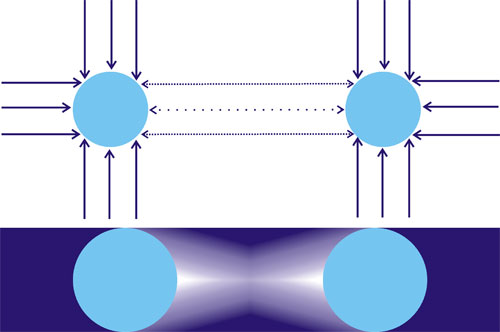 The shielding picture: each body shades the other from a flux arriving from every direction, so the net push drives them together. Diagram: D.H, CC BY-SA 3.0, via Wikimedia Commons.
Euler’s pressure thrust. Leonhard Euler suggested that gravity might be the thrust of a fluid ether whose pressure drops near massive bodies, like buoyancy in reverse. Mayeul Arminjon gives a detailed account of Euler’s idea in Gravity as Archimedes’ thrust.
Arminjon’s scalar ether. Arminjon built a scalar theory in which gravity is a pressure-gradient force in an ether. It is a close conceptual predecessor of medium-based approaches like the one explored on this site, and his own papers present its tests and open questions.
This site’s pressure-medium work (PBT). PBT starts from a what-if: what if gravity is a pressure differential in a medium? What we are after is a working solution, provable and physically repeatable, and ultimately a unified account. Push against pull is also not the whole field: general relativity describes gravity as neither, but as the geometry of spacetime, and its predictions have passed the precision tests made so far. My working picture for the Pressure-Based Theory is offered as an alternative to that geometric explanation, not to a simple pull, and it is better described as subatomic pressure dynamics than as a simple push. High and low pressure in the medium mechanically balance out the positions of the clumps of mass inside the system. That is a working picture, not an established result. In the one case calculated so far, two ordinary masses in a weak field, our own model’s shadowing deficit matched Newton’s attraction to within 0.01%, a single check on our own work and not an independent test, as tested in The Working Range of Push Gravity, which also shows where that mechanism fails. PBT does not descend from Wright’s book. Both start from the sense that something pushes, but they part ways where it counts. Wright’s magnetic repulsion pushes bodies apart. In the pressure picture the net effect on each body is toward other mass, as measurements require, and the balance comes from the medium rather than from magnetism.
What a working model has to show
First, what he does not settle. Push explanations of gravity are old and crowded: Fatio, Le Sage, and many after them. They were set aside for quantitative reasons, drag and heating first, and any push or pressure model today also has to meet the relativistic tests, light bending, the Shapiro delay, gravitational waves, that came later. Sharing Wright’s intuition earns nothing on its own. A pressure model earns its place only by passing those tests, which is the subject of the companion piece on Euler, Arminjon, and what a medium theory has to prove. What Wright gave me was company, not evidence.
Wright believed a theory should be something you can build, set on a table and watch. “Watching my freedom-of-movement models in action is worth a million words,” he wrote. That instinct is right as far as it goes. A physical model makes an idea concrete, invites questions, and draws people in. His exhibits clearly did that for the students, fairgoers and club audiences he describes.
The other half of the standard is that a model has to match measured data, not only behave in a way that looks right. Magnets on a table can show repulsion, balance and even two tidal bulges. They cannot show iron and wood falling together to within a few parts in a quadrillion, or the square of a planet’s period following the cube of its orbit size, unless the mechanism actually produces those numbers. Wright’s own orbital formula is the clearest example: the formula was right because it matched the sky, and that is exactly why it points back to an inward force.
The standard Wright set for his critics is a good one, and it applies to this site too. Bring the exhibit. Then check it against the measurements. I’m grateful to Walter Wright for the first half of that, and for showing me early on that I wasn’t the only one who thought it more likely that things are pushed rather than pulled.
Sources
- Wright, Walter C., Jr. (1979). Gravity Is a Push. Carlton Press, New York. 176 pp. ISBN 0-8062-1263-2. Internet Archive.
- UPI (March 1979), reproduced at Natural Philosophy Wiki: Walter C Wright.
- Google Books record.
- SVP Wiki: W C Wright (newsletters and model photos).
- Touboul, P., et al. (2022). MICROSCOPE mission: final results of the test of the Equivalence Principle. Phys. Rev. Lett. 129, 121102. arXiv:2209.15487.
- Schlamminger, S., et al. (2008). Test of the equivalence principle using a rotating torsion balance. Phys. Rev. Lett. 100, 041101. doi:10.1103/PhysRevLett.100.041101.
- Arminjon, M. (2004). Gravity as Archimedes’ thrust and a bifurcation in that theory. Found. Phys. 34, 1703-1724. arXiv:physics/0404103.
- Riess, A. G., et al. (1998). Astron. J. 116, 1009. Perlmutter, S., et al. (1999). Astrophys. J. 517, 565.
Text licensed under CC BY 4.0. Quotations from Gravity Is a Push remain the work of Walter C. Wright Jr. and are quoted for commentary. Images carry their own licences, as credited.