Vortexes in Space: What Black Holes and Their Jets Actually Look Like
29 July 2026
While talking through some of the open questions in physics (see Visuals: Four Real Open Problems in Physics), a simpler question came up: what does a black hole actually look like, physically, if you picture it less like a hole in a sheet of fabric and more like a vortex — matter spiraling inward around a central point, the way water spirals down a drain?
That’s a mental picture, not a derived mechanism — this site doesn’t currently have a PBT-specific account of why infalling matter should form a vortex rather than falling straight in. But the picture turns out to match real observation more closely than expected. Here’s what actual telescopes and simulations show.
The accretion disk itself: a real vortex, viewed face-on
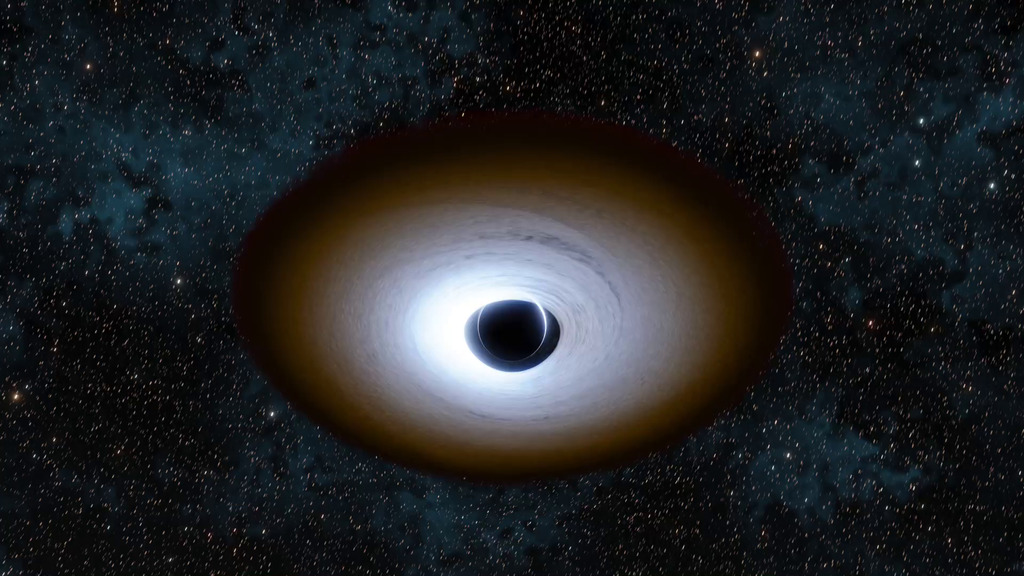
Credit: NASA/JPL-Caltech/R. Hurt (IPAC)
This is a NASA visualization of matter spiraling into a black hole, built from real general-relativistic physics rather than artistic guesswork. Gas doesn’t fall straight in — conservation of angular momentum forces it into a flattened, spiraling disk first, the same reason water spirals rather than dropping straight down a drain. Detailed simulations (general-relativistic magnetohydrodynamics, run by groups including the Event Horizon Telescope collaboration) show this spiral flow breaking into large individual vortices near the disk’s inner edge, peeling away as they’re fed toward the center. Viewed from directly above, as here, it genuinely reads as a bright vortex wrapped around a dark center — not a metaphor stretched to fit, just what the physics produces.
The other end: a real photograph of the outflow
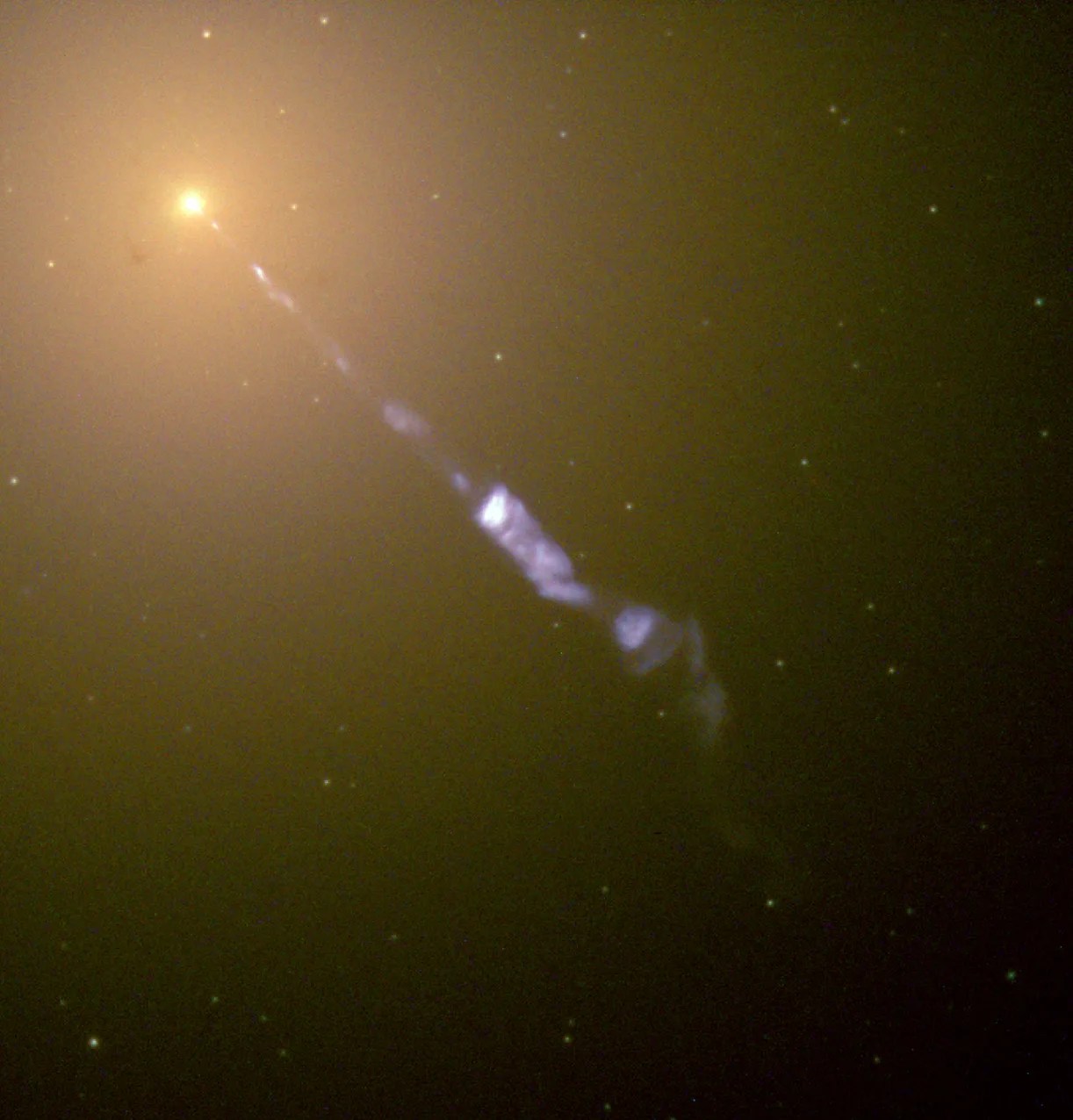
Credit: NASA and the Hubble Heritage Team (STScI/AURA)
This one isn’t a simulation — it’s a real Hubble photograph of the supermassive black hole at the center of galaxy M87, roughly 2.6 billion times the Sun’s mass. The same spiraling disk that produces the vortex above also winds up its own magnetic field lines like a coiled spring; that twisted field is what launches and confines this jet, a stream of particles blasting outward at nearly the speed of light for about 3,000 light-years. If the disk is the “suction end,” this is the exhaust — the same twisting structure, doing work at the opposite pole.
A vortex you can see with your own eyes, wound up by a black hole’s rotation
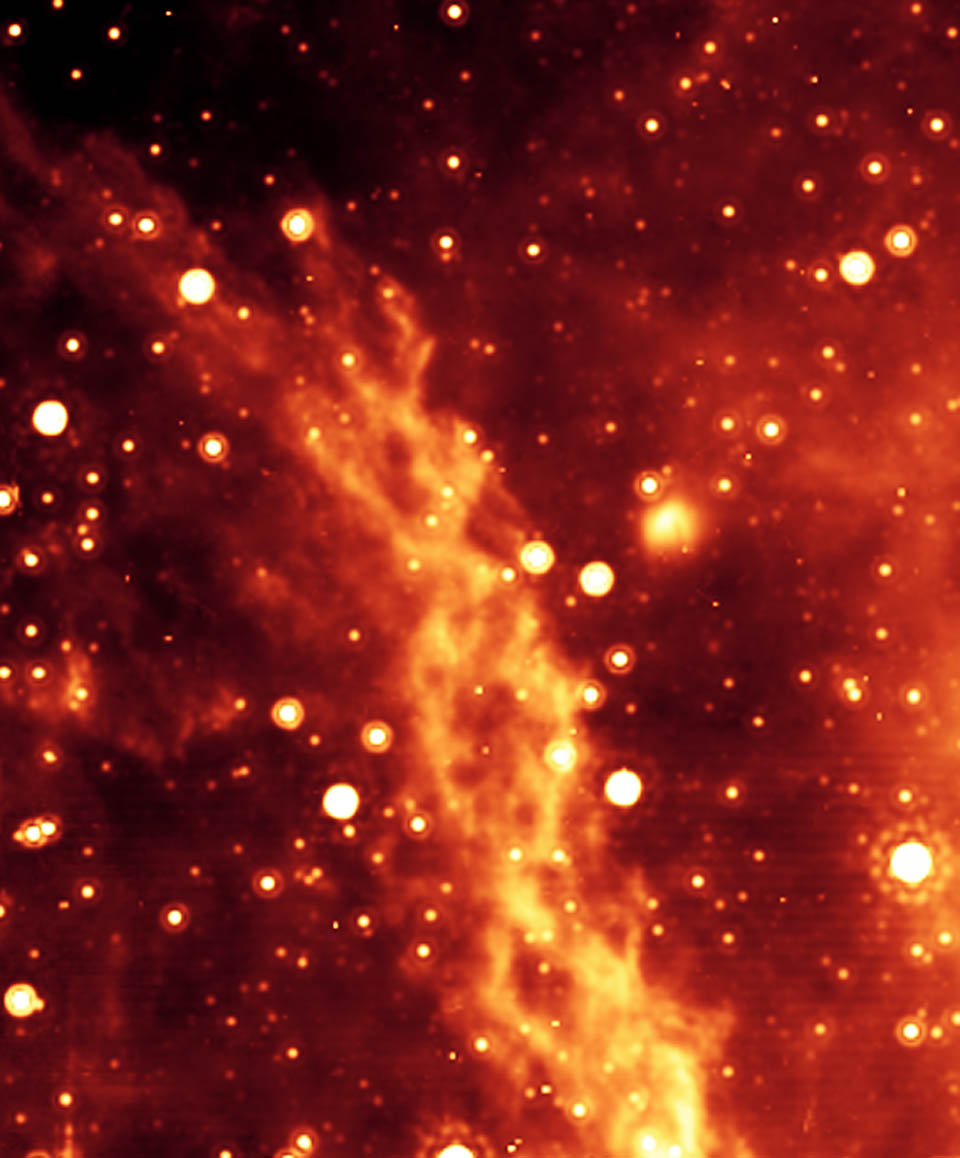
Credit: NASA/JPL-Caltech/M. Morris (UCLA)
Discovered in 2006 and published in Nature, this is real infrared gas and dust about 300 light-years from Sagittarius A*, the Milky Way’s own central black hole. The prevailing explanation: the disk of material orbiting that black hole winds up magnetic field lines at its base, sending a torsional wave rippling outward at roughly 1,000 km/s, physically twisting this nebula into a double-helix shape over about 100,000 years. The twist is subtle in the raw data above compared to illustrated versions often reproduced in press coverage, but it’s the same real image scientists used to make the case. This is the clearest evidence in this set: a black hole’s rotation directly, physically twisting matter into a vortex shape, observed rather than simulated.
One nickname worth ruling out
A fourth image turned up in the same search: a 2025 James Webb Space Telescope release nicknamed the “Cosmic Tornado” for its helical shape. It’s a real and striking structure, but it’s unrelated to any of the above — a jet from a young forming star (a Herbig-Haro object), not a black hole. Worth knowing about, but it doesn’t belong in this set.
Where this touches PBT
This is a real visual pattern, not a claimed PBT result. Paper 1 and Paper 3 describe gravity and magnetism as mechanical, flow-based effects in principle, but neither derives why infalling matter should organize into a spiraling vortex specifically — that’s standard angular-momentum conservation and magnetohydrodynamics, physics that exists independently of PBT and isn’t in dispute. Framing a black hole as “the suction end of a vortex” is a genuinely useful way to picture what’s actually happening, and worth continuing to explore — but it isn’t, yet, a mechanically derived PBT claim, and shouldn’t be presented as one until it is.