Gravity Doesn't Pull — But the Picture We Use to Say So Still Does
31 July 2026
Two posts landed in my feed on 30 July 2026, under three minutes apart, both saying the same thing: gravity is not a pull. One called it geodesics. The other put it in a box labeled “General Relativity (1915).” Neither was arguing with anybody. This is just what mainstream physics says now, stated plainly to a general audience.
I agree with both of them, and this site has been saying the first half of it since I was cutting grass in 2025.
The claim is right. The picture attached to it is the part worth a second look — because in both posts, the illustration chosen to show that gravity isn’t a pull is a picture of something rolling downhill into a well. That’s the whole point of this piece.
Before going further, the disclosure this piece obviously needs: this site exists to develop Pressure-Based Theory, which would very much like the question of a physical mechanism for gravity to stay open. That’s a live interest in the answer, and you should read what follows knowing it. I’ve tried to keep it from bending anything below, and I’ll flag the exact places where a critic would say it did anyway.
The claim, arriving twice in one afternoon
Original post: @LensScientific on X, 30 July 2026. If the embed doesn’t load: the post reads “Gravity doesn’t pull planets through space in the way we often imagine. According to Einstein’s general relativity, mass curves spacetime, and objects naturally follow the straightest possible paths through that curved geometry. These paths are called geodesics.” The attached diagram shows the Einstein field equation $G_{\mu\nu} = \frac{8\pi G}{c^4}T_{\mu\nu}$, the condition $\delta\int ds = 0$, a satellite and a light ray tracing curved paths around Earth on a dimpled grid, and two insets contrasting a straight geodesic in flat spacetime with a bent one near a mass.
Everything in the text is correct, and the diagram is better than most — it labels its vertical axis “Spacetime (t)” rather than pretending the picture is purely spatial, and it makes a point of showing that light follows geodesics too. See General Relativity for how thoroughly that has been confirmed.
Three minutes later, the second one:
Original post: @cosmosarcive on X, 30 July 2026. If the embed doesn’t load: it’s a four-panel graphic, “Einstein’s Greatest Discoveries,” covering General Relativity (1915), the Photoelectric Effect (1905), Special Relativity (1905), and Mass–Energy Equivalence (1905). The general relativity panel reads: “Gravity is not a force but the curvature of spacetime caused by mass and energy.” Its illustration is a glowing Sun sitting in a deep funnel in a blue grid, with Earth off to one side.
Where this site already agrees
I got here from the other direction, and much less elegantly. I was mowing the lawn, watching clippings fall, and asking by what mechanism each one was being pulled — what latches on, where the anchor point is, where the hooks go when they aren’t hooking. That question doesn’t have an answer, which is the point of How I Realized the Absurdity of Pull Gravity. Where Did We Get “Pull”? traces how the word got into the language in the first place, and Newton himself was uncomfortable with it.
So on the headline, there’s no dispute here at all. Newton’s pull is not what’s happening. Two popular science accounts and this site agree on that sentence, from opposite directions — which is worth saying plainly, because most of what follows is a disagreement about the drawing rather than the physics.
The picture that still pulls
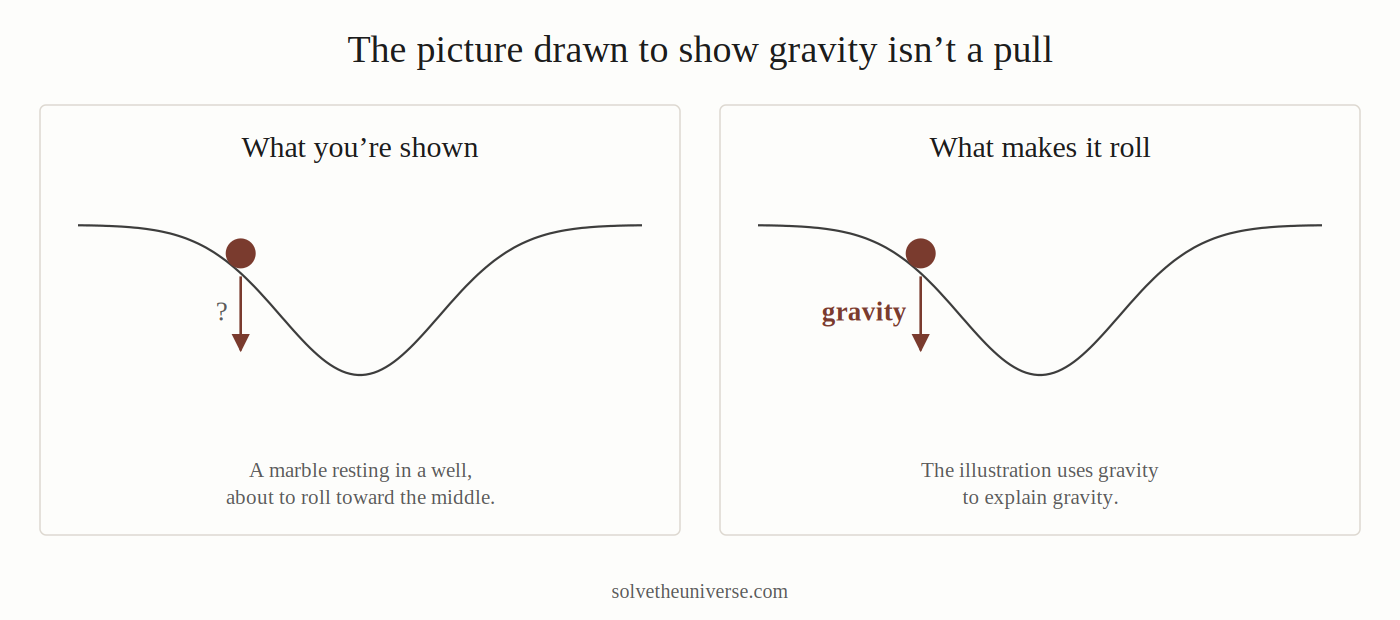
Look again at what both illustrations are actually doing. There is a dimple, or a funnel, and something rests in it or rolls around it. The reason your eye accepts the picture instantly is that you already know what happens to a marble on a curved sheet: it rolls downhill.
It rolls downhill because of gravity.
This is the standard objection to the rubber-sheet picture, and it isn’t a fringe complaint — it’s a known problem in physics education, studied directly. A mass sitting in an elastic sheet only dents it because some other gravity field is pulling it down into the sheet, so the illustration uses gravity to explain gravity. Kersting and Steier surveyed exactly this in Science & Education in 2018, cataloguing what the analogy helps students see and what it quietly teaches them wrong. The other failure modes on their list are just as real: the sheet is a two-dimensional stand-in for a three-dimensional slice, and it has no time dimension at all — which, as the next section gets to, is where the actual physics lives.
None of that is controversial. Ask a working relativist about the rubber sheet and you’ll get the same list.
There’s also a nice concrete footnote to it. Middleton and Langston actually built the demo — a marble on a warped spandex fabric — worked out the theory, and measured it. The orbits obey their own Kepler-like relation:
$$T^3 = \frac{(28\pi^2/5g)^{3/2}}{\sqrt{2\alpha}}\cdot\frac{r^2}{\sqrt{M + \pi\sigma_0 r^2}}$$
Here $M$ is the central mass, $\sigma_0$ is the areal mass density of the fabric itself, and $\alpha$ is a constant from the fabric’s elastic response. Where the fabric’s own weight is negligible against the central mass, that reduces to $T^3 \propto r^2$. Kepler’s third law — which real planets obey, and which general relativity recovers in the Newtonian limit — is $T^2 \propto r^3$. The exponents are swapped. And where the fabric’s own mass isn’t negligible, the $\pi\sigma_0 r^2$ term takes over and the sheet’s own weight starts dominating the orbit, which has no counterpart in the thing being modeled.
Being careful about what that does and doesn’t show: Middleton and Langston weren’t debunking anything — they were comparing their result to orbits around a mass in the presence of constant vacuum energy, and it’s a genuinely nice piece of undergraduate physics. And a marble rolling on a lab-gravity elastic membrane was never going to be a quantitative stand-in for spacetime geodesics; nobody claimed it was. So this isn’t the argument against the picture. The circularity and the missing time dimension are the argument. This is just the tidy confirmation that the demo doesn’t survive being taken literally, which is exactly how a lot of people do take it.
The part of the diagram people skip
Here’s what makes this more than a complaint about a drawing. The funnel picture shows curvature in space — a two-dimensional sheet dented downward into a third dimension. But for everyday falling — slow things, weak fields — the curvature that dominates is in time.
You are, right now, moving through spacetime almost entirely in the time direction. Mass makes clocks run slower nearby — measured on a 22.5-metre tower by Pound and Rebka in 1959, and across a gap of one millimetre by Bothwell and colleagues in 2022. Because you’re already travelling through time at that pace, a tiny difference in the rate between your head and your feet is enough to tip a path that started out almost purely temporal into one that also drifts through space, toward the ground. What’s Actually Holding Us Down? works that through with the real measured gradient, $g/c^2 \approx 1.093\times10^{-16}$ per metre, and turns it back into $9.82\ \text{m/s}^2$.
Two qualifications on that, because it’s a slogan that gets over-driven:
It’s the weak-field, slow-motion statement, not a universal one. It’s the Newtonian limit of general relativity recovered from the time-dilation term — a consistency check that the geometry reduces correctly, not an independent measurement that beats Newton at his own arithmetic.
And it does not carry over to light. For a light ray grazing the Sun, time dilation supplies only half the deflection; the other half comes from spatial curvature. That’s precisely the origin of the famous factor of two over the naive Newtonian estimate — the thing the 1919 expedition went to measure. So “it’s time, not space” is right for a falling apple and wrong for a passing photon, and I’d be handing you a bad intuition if I let that ride.
That’s the real content of the geodesic claim, and no funnel picture contains it. The claim is right; the picture is what carries the old idea forward — smoothly enough that most people never notice they’ve been shown a pull and told it isn’t one.
One principle, two vocabularies
Now the part I actually wanted to write about — and the part where the first draft of this article was wrong, which I’d rather show than quietly fix.
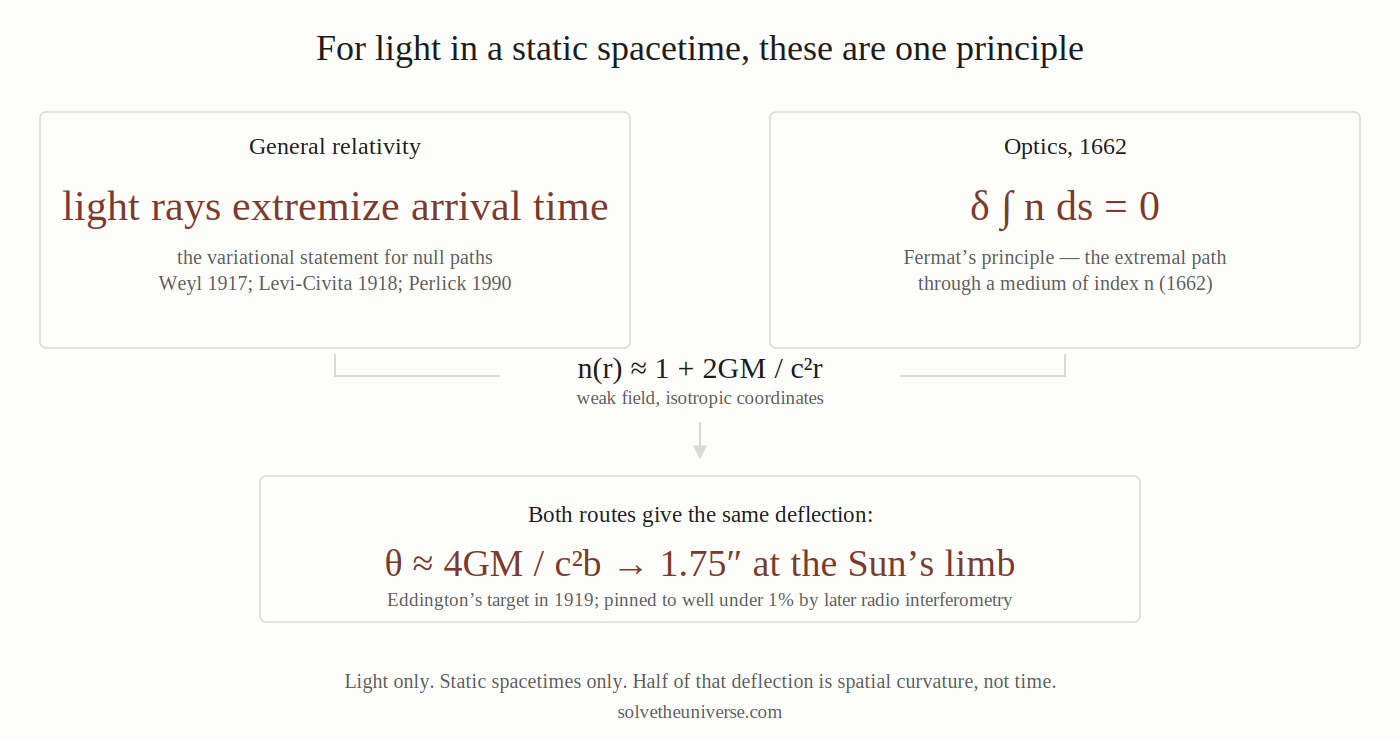
That first diagram gives the geodesic condition as $\delta\int ds = 0$: of all available paths, the one taken makes the total interval stationary. My first draft set that beside Fermat’s principle from 1662 — the rule that light through a medium of refractive index $n$ takes the path making $\int n\,ds$ stationary —
$$\delta\int n\,ds = 0$$
— and said “same mathematical form.” That was sloppy in a way that matters, and an adversarial review pass caught it before this went anywhere. For a light ray, $ds = 0$ along the entire path. The interval is identically zero, so $\delta\int ds$ carries no information at all; null geodesics can’t be got from an arc-length principle and need an affine parameter instead. $\delta\int ds = 0$ is the timelike statement — it’s about falling apples and orbiting satellites, not about light. Putting it next to Fermat and pointing at light bending was the exact popular-science blur this article is complaining about, committed one section later by me.
The corrected version is not weaker. It’s considerably stronger, and it’s older than I realized.
For light in a static spacetime, general relativity’s account of light rays can be stated exactly as Fermat’s principle. Not “resembles” — an equivalent characterization, with the translation written down. Light rays are the curves that make the arrival time stationary. (The fundamental object is still the metric and its null geodesics; Fermat is a theorem about them, not a replacement for them.) This is not a recent observation: Weyl had a version for static spacetimes in 1917, Levi-Civita published La teoria di Einstein e il principio di Fermat in 1918, and Volker Perlick proved the general case in 1990 — on an arbitrary Lorentzian manifold, lightlike geodesics are exactly the curves of stationary arrival time. The translation between the two vocabularies is explicit: in the weak field, in isotropic coordinates, the equivalent refractive index is
$$n(r) \approx 1 + \frac{2GM}{c^2 r}$$
That expression is already on this site, on the Weak-Field Light Bending page, because it’s the route Paper 2 and Paper 12 take to reproduce $\theta \approx 4GM/(c^2 b)$ — the 1.75 arcseconds Eddington’s team went to Príncipe and Sobral to measure in 1919, and which radio interferometry has since confirmed to well under a percent. (The 1919 measurement itself was nowhere near that precise; the modern number is a separate, much later achievement.)
Here is what I think that actually means, stated as carefully as I can, and including the parts that cut against me.
It is not evidence that a medium exists. Two descriptions that are mathematically equivalent produce identical predictions by construction. Getting the right deflection out of a refractive index is a check on the arithmetic, not a discovery, and the formula page has said so since before I noticed the correspondence.
It has been standard bookkeeping for a century, and is taught as such. This is the objection I’d most want a reader to hold onto. The optical-metric map isn’t an overlooked clue — it’s a calculational convenience relativists have used since the 1920s, precisely because it’s equivalent to the geometry. Presenting it as a live candidate mechanism would be dressing up a hundred-year-old technique as a finding.
The equivalence is narrower than it sounds. It’s established for light — null paths — in static spacetimes. Rotating sources, where frame dragging enters, break the simple single-index picture. It doesn’t transfer automatically to massive objects; those need a different construction with its own limits. And as above, half the deflection it reproduces comes from spatial curvature, so it isn’t a “time” story either.
And general relativity’s confirmed range is untouched by any of this. Mercury’s perihelion, gravitational waves, black hole imaging, the correction running in the GPS receiver in your pocket.
What’s actually left, after all those subtractions, is much smaller than the version I wrote first, and I want to state it without inflating it. Both vocabularies fully determine which path is taken; neither leaves a hole in the physics. The only difference between them is connotation. Fermat’s language grew up describing glass and water, so it arrives already sounding like there’s a substance involved — and the geometric language doesn’t, because it was built not to need one. That is a fact about where the two sets of words came from. It is not a fact about gravity, and I’ve now caught myself twice while writing this trying to promote it into one.
The objection I can’t fully answer
A physicist reading the paragraph above will raise one thing, and they’d be right to.
When I say general relativity “names no mechanism,” I’m using mechanism in a specific and loaded way: a material something, a substance whose behaviour produces the effect. In the sense physicists normally use the word, general relativity supplies a mechanism in full — the field equations say how stress-energy determines curvature, the geodesic equation says how free bodies then move, the equivalence principle and local inertial structure fill in the rest. It’s a complete, predictive, dynamical account. Calling that “no mechanism” is defining the word so that only my preferred kind of answer counts, and then observing that general relativity doesn’t provide one.
So I’ll say it plainly instead. General relativity names no material substrate. Whether physics owes anybody one is exactly the question at issue, and it isn’t settled by pointing out that the theory doesn’t currently provide it. Some very good physicists think the demand itself is a leftover from mechanical intuitions that the twentieth century earned the right to drop.
I think it’s still worth asking. That’s a position, not a result, and this site is where I try to turn it into something checkable — see the Catalog for how far that has and hasn’t got.
Which brings up 1905
That second post is useful for something its author probably didn’t intend. Put the four panels in order and notice what kind of answer each one is.
In the paper Annalen der Physik received on 18 March 1905, Einstein didn’t merely describe how light behaves when it hits a metal. He proposed a mechanism: light arrives in discrete packets. That’s the work the 1921 Nobel Prize was for. A paper received on 30 June reworked space and time; a short follow-up received on 27 September gave mass and energy a single identity.
Then in November 1915 he presented the field equations, and the geometry has held up magnificently for over a century.
I’m not staging that as mechanism-versus-no-mechanism. The domains aren’t comparable, and after the section above I’d be contradicting myself if I tried: general relativity’s account of gravity is complete on its own terms, in a way that has nothing to do with whether a substrate exists. The narrower point is the only one I’d defend. In 1905 the useful move happened to be a material one — light comes in packets — and it turned out to be right. Whether the same kind of move has anything left to offer for gravity is genuinely undecided, and “it hasn’t been needed so far” is a different statement from “it never will be.” A conversation I had with an AI in July 2026 landed in roughly that territory from another direction: pressed past its first answer, it granted that general relativity’s “how much” is superbly confirmed and that people are still working on whether anything sits underneath it.
(One small note on dates, since this site holds itself to checking them: the graphic gives 18 March and 27 September 1905 as publication dates. Those are the dates the journal received the papers; they appeared on 9 June and 21 November. An easy conflation, and it changes nothing the graphic says. My own first draft mis-sequenced the same three papers, so this is a note, not a scold.)
Catalog status
The geodesic account itself — Proven Systems. Nothing on this page questions it, and this page would be wrong if it did.
The rubber-sheet illustration is not a claim about physics; it’s a teaching aid, and a poor one, on grounds that have been studied rather than merely asserted.
Pressure-Based Theory’s own medium stays exactly where it already sat in the Catalog before I wrote any of this. The Fermat correspondence moves it precisely zero distance — it’s a century-old change of variables, and if it were evidence for a medium, that would have been noticed in 1920.
What to do with this
The next time one of these graphics scrolls past — and one will, they’re everywhere — don’t argue with the caption. The caption is right. Just ask the picture one question: what is making that ball roll down into the well?
If the answer is “gravity,” the illustration has assumed the thing it was drawn to explain, and you’ve seen the seam. Then go read What’s Actually Holding Us Down?, which has the version with the measured number in it — the one no funnel has ever shown anybody.
References
- Kersting, M.; Steier, R. (2018). “Understanding Curved Spacetime: The Role of the Rubber Sheet Analogy in Learning General Relativity.” Science & Education 27(7–8), 593–623. https://link.springer.com/article/10.1007/s11191-018-9997-4
- Middleton, C. A.; Langston, M. (2014). “Circular orbits on a warped spandex fabric.” American Journal of Physics 82(4), 287–294. Preprint: arXiv:1312.3893
- Perlick, V. (2004). “Gravitational Lensing from a Spacetime Perspective.” Living Reviews in Relativity 7, 9. https://link.springer.com/article/10.12942/lrr-2004-9 — see its treatment of Fermat’s principle, where light rays are critical points of arrival time among lightlike curves.
- Perlick, V. (1990). “On Fermat’s principle in general relativity. I. The general case.” Classical and Quantum Gravity 7, 1319–1331. And: Ray Optics, Fermat’s Principle, and Applications to General Relativity (Springer, 2000).
- Levi-Civita, T. (1918). “La teoria di Einstein e il principio di Fermat.” Nuovo Cimento 16, 105–114. Weyl’s static-spacetime version dates from 1917; Levi-Civita gave the stationary case in 1927.
- Einstein, A. (1905). “Über einen die Erzeugung und Verwandlung des Lichtes betreffenden heuristischen Gesichtspunkt.” Annalen der Physik 17, 132–148. Received 18 March 1905, published 9 June 1905.
- Einstein, A. (1905). “Zur Elektrodynamik bewegter Körper.” Annalen der Physik 17, 891–921. Received 30 June 1905, published 26 September 1905.
- Einstein, A. (1905). “Ist die Trägheit eines Körpers von seinem Energieinhalt abhängig?” Annalen der Physik 18, 639–641. Received 27 September 1905, published 21 November 1905.
- Einstein, A. (1915). “Die Feldgleichungen der Gravitation.” Presented to the Prussian Academy of Sciences, 25 November 1915.
- Dyson, F. W.; Eddington, A. S.; Davidson, C. (1920). “A Determination of the Deflection of Light by the Sun’s Gravitational Field.” Phil. Trans. R. Soc. A 220, 291–333.
- Pound, R. V.; Rebka, G. A. (1960). “Apparent Weight of Photons.” Physical Review Letters 4, 337. (Experiment performed 1959.)
- Bothwell, T. et al. (2022). “Resolving the gravitational redshift across a millimetre-scale atomic sample.” Nature 602, 420–424.
Credits
Written after two posts from @LensScientific and @cosmosarcive turned up in my feed minutes apart on 30 July 2026. Both are embedded above and neither is being argued with — the disagreement here is with an illustration convention they inherited, not with anything they wrote. The source images belong to their posters and are shown via X’s own embeds rather than copied here; the two diagrams were drawn for this article in the site’s own palette.
The first draft of this piece treated $\delta\int ds = 0$ as the variational principle for light and called it “the same mathematical form” as Fermat’s principle. It isn’t, for the reason given above. That was caught by the adversarial review pass this site runs on anything making technical claims, before publication rather than after, along with a handful of smaller overreaches — an unsourced Einstein quotation, a light-bending precision claim that blurred 1919 with modern radio measurements, and the wrong month for special relativity. The corrected version is left visible in the text instead of being smoothed over, because a piece complaining about a misleading picture has no business hiding its own.