Radio Needs No Medium? What's Measured, and What's Assumed
17 November 2026
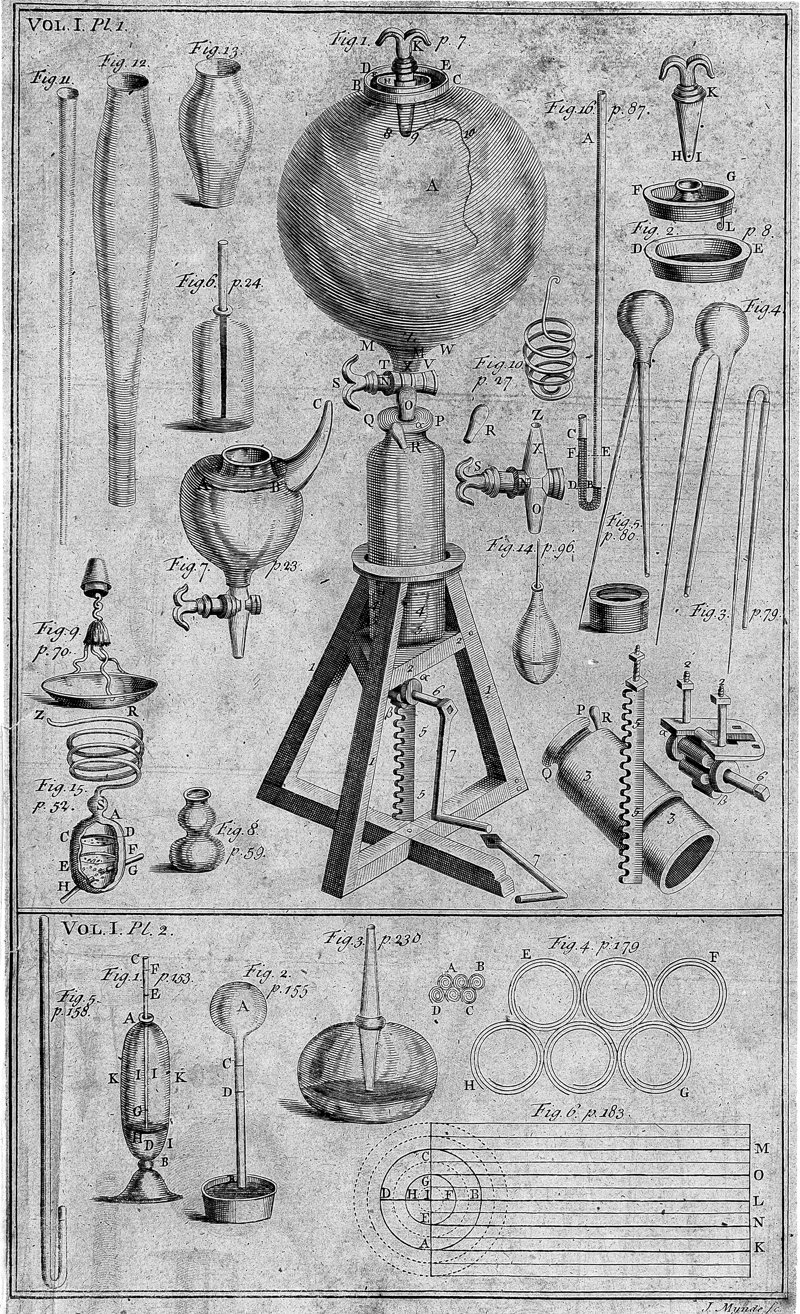 Robert Boyle’s first air pump, the apparatus behind his 1660 book New Experiments Physico-Mechanicall, Touching the Spring of the Air. The glass globe at the top is the receiver. Engraving by J. Mynde for a later edition of Boyle’s works. Wellcome Collection, CC BY 4.0, via Wikimedia Commons.
As a ham radio operator, I asked an AI a simple question: can a radio wave be described as power turned into pressure, transmitted through a medium? The answer came back the way the textbooks give it. Sound needs a medium. Radio is an electromagnetic wave, it needs no medium at all, and that is why it crosses the vacuum to reach satellites and the Moon.
I have to draw a line in the sand on that last part. How can anyone prove, right now, that radio waves and light waves need no medium to travel?
The short answer is that no one can. “Needs no medium at all” is a claim that something is absent, and an experiment cannot prove a universal negative. Careful physics claims something narrower: light and radio do not need a material medium the way sound needs air, and no medium with a detectable rest frame has been found. That narrower claim is well tested. The popular version, the one I was handed, goes beyond it, and it is worth being exact about where.
A watch in a jar, 1660
The idea that sound needs a medium and light does not has a starting point, and it is a ticking watch.
In Experiment 26 of his 1660 book, Robert Boyle opened the case of a watch, hung it by a thread inside the glass receiver of his new air pump, and sealed the jar. At first he could hear the balance ticking through the glass. As the pump drew the air out, the sound grew “fainter and fainter” until no one pressing an ear to the glass could hear anything at all. Yet they could still see the second hand moving. When he let the air back in, the ticking returned.
Light crossed the emptied jar. Sound did not. That jar is a classic early demonstration of the split between sound and light; the modern textbook line rests on much later work.
Boyle himself was careful about what he had shown. He concluded that “whether or no the Air be the onely, it is at least, the principal medium of Sounds.” And on the page before, he describes how others had heard a bell ring inside an early vacuum and concluded the opposite, that “’tis not the Air, but some more subtle Body that is the medium of sounds.” Boyle doubted that conclusion and tested it with his better pump, and for sound his result settled it: air carries it.
That history cuts both ways, and it should. Declaring “no medium” too early is a mistake. So is declaring a hidden medium too early. What settled sound was not an argument. It was a better experiment, one anyone could repeat.
What the evidence shows about light and radio
Sorted from strongest to weakest, here is what the measurements actually support.
Light and radio cross the best vacuum we can make, and space itself. Boyle’s jar showed only that light crosses air thinned by a hand pump. The decisive evidence came much later: radio and light crossing high laboratory vacuum and the space between Earth, satellites and the Moon. That proves they do not need air, water or any other ordinary matter. It says nothing about a medium too fine to pump out, and no pump could remove a medium that every part of the pump sits in.
No experiment has detected motion through a universal medium for light. If light rode a medium the way sound rides air, moving through that medium should make light’s speed differ by direction. In 1887 Albert Michelson and Edward Morley looked for that difference and found only a small fraction of what a medium “wind” should have produced. Modern versions are far finer: rotating sapphire oscillators have held any directional change in light’s speed to about one part in 10¹⁸ (Nagel et al. 2015). That rules out a medium whose rest frame shows up at that level. A null result never measures zero, though. It sets an upper limit, and anything smaller passes unseen. Our instruments reach a long way, and the very small and the very fast reach further.
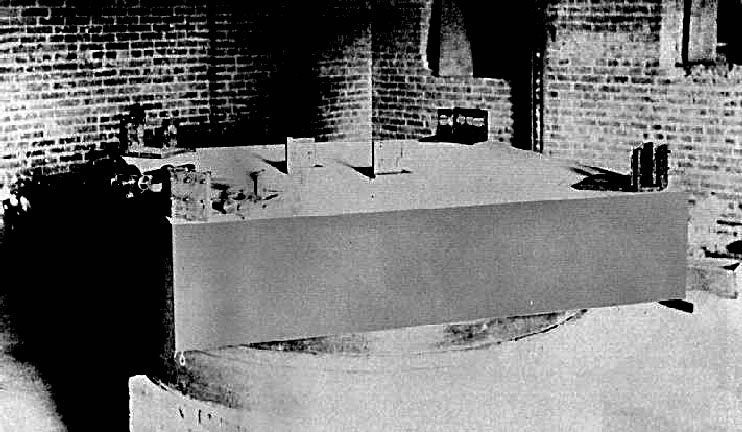 The Michelson-Morley apparatus, 1887, at what is now Case Western Reserve University. The stone slab floated on mercury so the whole instrument could turn, looking for a change in light’s speed with direction. Public domain, via Wikimedia Commons.
Modern physics does not treat the vacuum as empty, either. It is filled with fields, and measured effects such as the Casimir force are usually explained by them. The open question is whether the field is itself the carrier, or whether something underneath it is.
Maxwell’s equations work without naming a medium. The standard equations describe a light or radio wave completely on their own. That is a statement about the model, not a measurement of the world. A model that does not need a part has not shown the part is missing.
None of these proves “no medium.” Together they support something narrower: no medium with a detectable rest frame has been found, and the standard equations do not require one. The step from there to “needs no medium” is a choice of the simpler model. It is a reasonable choice, but it is not a test result. Lorentz’s ether theory keeps a medium and makes the same predictions as special relativity for these experiments, at the cost of a rest frame no experiment can find, and it has not been shown to match the rest of modern physics without further assumptions. That point is covered in The Test Confirms the Effect. It Doesn’t Prove the Explanation.
Where the sound comparison holds, and where it doesn’t
Saying radio and light need no medium is like saying sound needs no medium in an age when air was not understood. On one point the parallel is fair: air was invisible and poorly understood, yet it was real, and it carried sound. An unseen carrier can be real.
On the decisive point, the two cases part ways. Air eventually gave itself away. Wind changes the speed of sound, and a listener moving through air hears sound arrive faster from one side. Air has a rest frame you can measure. The same test for light has come back empty in every modern experiment. So a medium for light has to do something air never did: carry the wave while keeping anyone from measuring motion through it.
That is also the strongest case against a medium, and it deserves to be stated plainly. If a medium can never show itself, and the field equations predict everything without it, then it does no work, and the simpler model should win. That is why physics set the ether aside: not a proof that nothing is there, but no job left for it to do.
Look past the stars
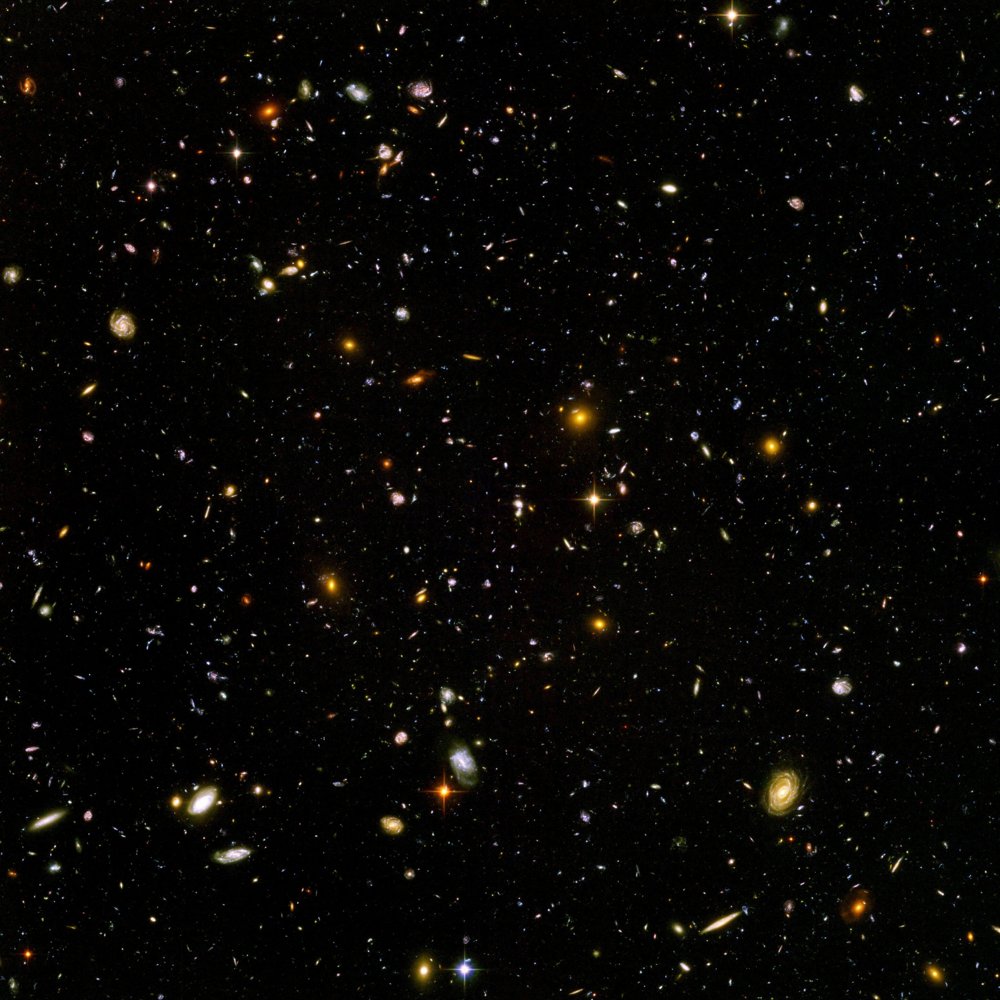 The Hubble Ultra Deep Field, 2004: a patch of sky about a tenth the width of the full Moon, holding roughly 10,000 galaxies. The few points with spikes are nearby stars; nearly every other speck is a galaxy. NASA and ESA, public domain, via Wikimedia Commons.
A medium finer than any instrument can catch sounds strange until you follow the question outward. Look past the stars. What contains them? And what contains that container? Follow it in every direction, large and small, and the conclusion I keep reaching is infinity.
The argument is as old as philosophy. Around 400 BC, Archytas of Tarentum asked what would happen if you stood at the edge of the universe and thrust out a spear. Either something stops it, and there is more beyond, or it goes through, and there is more beyond. Lucretius made the same case with a thrown javelin about two thousand years ago. Infinity, by definition, has no bounds, and every proposed edge invites the same question about what lies past it.
Physics has one serious reply. Space could be finite and still have no edge, the way the surface of a globe has none: walk any direction and you never meet a wall, and nothing outside contains it. Einstein proposed a closed universe of this kind in 1917. Space could even be finite and perfectly flat, if it wraps around on itself the way a video game screen sends you back in from the opposite side. The reply answers the container question, but it does not show space really is finite. Measurements find space flat to within a fraction of a percent, which fits an infinite universe and also fits a finite one larger than the part we can see.
The small direction tells the same story so far. Every “smallest piece” anyone named has opened up: atoms had nuclei, nuclei had protons, protons had quarks. Electrons and quarks show no inner structure yet, but that is an upper limit from our instruments, the same kind of limit as the null result above, not proof of a floor.
No measurement has decided between them, and none can reach the end of something that has none. So I take infinity as the default logical conclusion: every edge anyone has proposed has opened onto more, and the regress never stops. That is a reasoned default, not a measurement, and I state it that way. One caution from history keeps the default precise. If space were infinite, unchanging, and filled with stars forever, the night sky would blaze; that is Olbers’ paradox. The answer turned out to be a universe of finite age that expands, not finite space. Infinite space does not have to mean infinite and unchanging. Mathematics is part of why I hold it: the number line has no last number, and I read the presence of infinity there as a clue that it is real in nature. More on that in Embracing Infinity.
None of this proves a medium for light. The small direction is the part that bears on it: if there is no floor in the small, there is room for structure far finer than anything our instruments can reach, and that is part of why I keep looking. Whether light rides on that structure is a question for testable work, not for the default.
The what-if
This site’s Pressure-Based Theory starts from a what-if: what if radio and light waves travel on an unseen subatomic medium, the way sound travels on air? It is the default logic of this site: use what is seen to understand what is not yet seen. Everywhere else in nature that we can watch a wave travel, a medium carries it, so that is where we start. A wave with nothing to travel on would be the one behavior with no precedent, and the unprecedented claim is the one that carries the heavier burden of proof. It is the same picture behind Why Universal Time, How It Could Work and Dark Matter Isn’t Missing.
This piece is about the evidence, not the mechanism, and it does not supply what the what-if needs. Arguing for it does not make it true, any more than the textbook line is proven by repeating it. The what-if answers the case against a medium only if the medium does work the field picture leaves undone: a physical account of why light’s speed comes out the same for every observer, a link to gravity through the pressure differential picture, or a prediction that differs from the standard one somewhere measurable. If it does none of those, the simpler model wins.
A cause far below any instrument can still be tested, if mathematics carries it to something we can measure. Atoms were far too small to see when Einstein’s 1905 mathematics tied them to the visible jiggling of tiny particles suspended in water. Jean Perrin then measured that jiggling, and the result settled that atoms are real. Mathematics is one of our windows into the unknown, and that is the route a hidden medium has to take: from the equations to a number on an instrument. Either has to be provable and repeatable by anyone with the equipment, and that work is still in progress in the pieces linked above.
Boyle’s watch sets the standard in spirit, not in method. He did not settle the question of sound by declaring what was or was not there. He built a better instrument, ran the test, and said exactly how far it went. A universal medium cannot be pumped out of a jar, so for light the test has to be different: a mechanism or a prediction that could fail, checked by anyone who repeats it. That is what we are working toward: a working, testable account of what carries the wave, and in the end one account of light and gravity together.
Notes on sources
- Boyle’s watch experiment is Experiment 26, as numbered in the 1660 Oxford text, of New Experiments Physico-Mechanicall, Touching the Spring of the Air, and its Effects (Oxford, 1660); quotations are from the digitized 1660 text (Max Planck Institute for the History of Science), in modern spelling. The earlier bell experiment he discusses is credited there to Athanasius Kircher “and other Learned Men.”
- Michelson, A. A., and Morley, E. W. (1887), “On the Relative Motion of the Earth and the Luminiferous Ether,” American Journal of Science 34, 333.
- Nagel, M., et al. (2015), “Direct terrestrial test of Lorentz symmetry in electrodynamics to 10⁻¹⁸,” Nature Communications 6, 8174.
Text licensed under CC BY 4.0. Quotations remain the work of their authors and are used for commentary. Images carry their own licences, as credited.