Push-Pressure Theory: An Overview of the PBT Papers
1 August 2025
Push-Pressure Theory or Pressure-Based Theory (PBT) offers a mechanical framework for understanding the universe, treating forces as push effects from particle fluxes in an infinite pressure vessel. This series of papers develops the theory from basic push mechanics to relativistic and electromagnetic extensions, resolving issues like dark matter, singularities, and force unification. The work integrates hierarchical scaling to bridge scales from cosmic to quantum, providing calculations and simulations that align with observations.
Status note, added 2026-07-22: this overview repeats several specific numbers (the ~220 km/s rotation-curve figure, the drag threshold) that a later site-wide audit found errors in — see Paper 1’s own 2026-07-22 revision for the rotation-curve figure specifically, and the Catalog for how this site now classifies PBT’s claims. Read this overview alongside the papers’ own corrections, not in place of them.
Infinite Push-Pressure Theory
The foundational paper introduces the universe as an infinite pressure vessel filled with infinitely small particles moving at infinite speeds, creating push forces through shadowing. Bodies are modeled as low-density bubbles balanced against external pressures, with forces emerging from flux imbalances. Hierarchical levels allow energy density to scale with size, unifying gravity with nuclear and atomic interactions.
Key calculations include the gravitational constant $G$ derived as $\varepsilon\sigma^2/(4\pi M_n^2)$, matching the observed value of $6.6743\times10^{-11}$ m³ kg⁻¹ s⁻². Nuclear bindings are estimated at ~8 MeV/nucleon, and tidal heights at ~0.7 m for the Moon. Simulations show flat galactic rotation curves without dark matter, and black hole collapse stabilizes without singularities.
Classical objections, such as heating and drag, are addressed by infinite-speed jumps and elastic bounces. The theory is falsifiable through astronomical data, like galaxy dynamics.
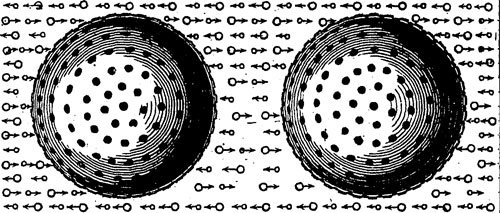
Figure 1: Le Sage’s Illustration of particle shadowing in push gravity theory.
Hybrid Push-Aether Theory for Relativistic Unification
The second paper extends PBT by incorporating a dynamical Einstein-aether field to achieve Lorentz invariance, eliminating preferred frames. The aether u^μ evolves with the metric, representing average flux, while pushes distort it for emergent forces. Light propagation is treated as waves in the medium, with bending from refractive index gradients.
The action includes aether couplings with c1–c4 < 10^{-15} to match GR closely. Drag is negligible — recomputed as $\approx9.8\times10^{-16}$ m/s² in Paper 2’s 2026-07-21 revision, not the originally stated $10^{-19}$ m/s² — still below detection thresholds either way. Light deflection is calculated as θ ≈ 4 G M / (c² b) ≈ 1.75" for the Sun, matching GR’s own confirmed prediction. Simulations claim flat rotation curves at ~220 km/s for the Milky Way — see Paper 1’s 2026-07-22 revision, which found this specific figure isn’t reproduced by the paper’s own stated parameters — and singularity avoidance in collapse, a separate claim also flagged there.
This model unifies forces mechanically in a relativistic context, with predictions for subtle frame effects in gravitational waves, testable by LIGO or LHC.
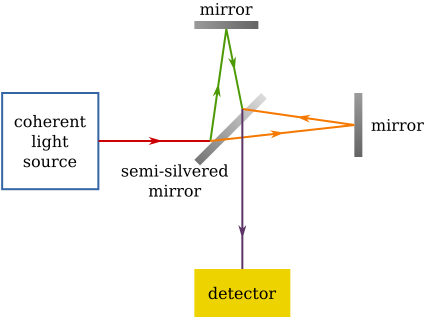
Figure 2: Michelson-Morley Experiment Diagram, testing for luminiferous aether — see Disproven Theories for what this experiment actually ruled out, and Einstein-Aether Theory for why PBT’s dynamical aether isn’t the same thing being tested here.
Hybrid Push-Aether Theory for Electromagnetic Forces
The third paper incorporates magnetism and electromagnetism, describing magnetic fields as subatomic particle flows from charge-induced aether flux gradients. The Lorentz force F = q (v × B) is derived mechanically from push interactions. Simulations model dipoles with curvature κ ≈ 10^2 m^{-1}, unifying EM with gravity via hierarchies.
The theory predicts anisotropies in superconductors and resolves EM without photons, falsifiable in high magnetic fields. It extends the mechanical unification to all forces, addressing quantum effects through finer scales.
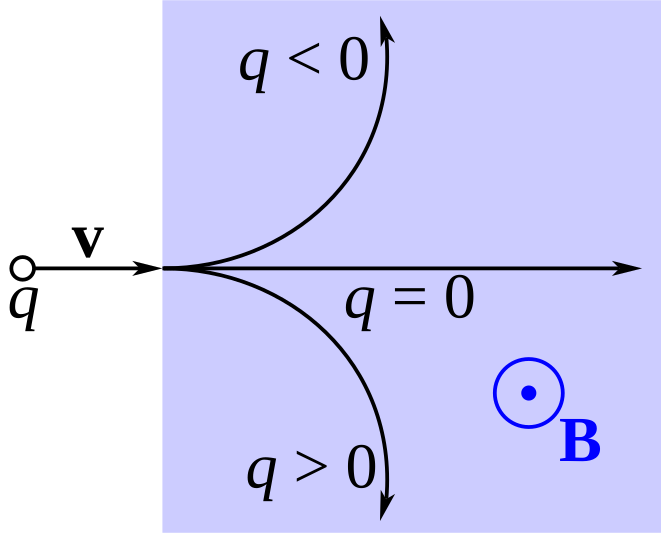
Figure 3: Lorentz Force Diagram showing force vectors.
Significance of the Work
PBT provides a mechanical alternative to standard models, eliminating the need for dark matter by explaining rotation curves by hierarchical pushes. It resolves singularities by stabilizing collapse and unifies forces without quantum gravity conflicts, offering a testable framework for anomalies in cosmology and particle physics. The theory’s falsifiability via surveys like Euclid or experiments at LHC positions it as a potential paradigm shift, encouraging empirical validation to advance our understanding of the universe.
This article was edited with assistance from Grok, an AI built by xAI, to refine structure, clarity, and flow while preserving the original voice and ideas.
Image Credits
- Figure 1: From Wikimedia Commons, public domain.
- Figure 2: From Wikimedia Commons, public domain.
- Figure 3: From Wikimedia Commons, public domain.
References
- Foutch, M. (2025). “PBT Papers.” Solve the Universe. https://www.solvetheuniverse.com/p/papers.html
- Foutch, M., & Grok. (2025). “Infinite Push-Pressure Theory: A Hierarchical Mechanical Framework for Unifying Forces and Resolving Gravitational Anomalies.” Solve the Universe. https://www.solvetheuniverse.com/p/pbt-paper-01.html
- Foutch, M., & Grok. (2025). “Hybrid Push-Aether Theory: Mechanical Unification of Forces in a Relativistic Framework.” Solve the Universe. https://www.solvetheuniverse.com/p/pbt-paper-2.html
- Foutch, M., & Grok. (2025). “Hybrid Push-Aether Theory: Mechanical Unification of Magnetism and Electromagnetic Forces.” Solve the Universe. https://www.solvetheuniverse.com/p/pbt-paper-3.html