One Trade-Off, Not Two — What Happens When You Try to Fix Push-Gravity's Oldest Objection
28 July 2026
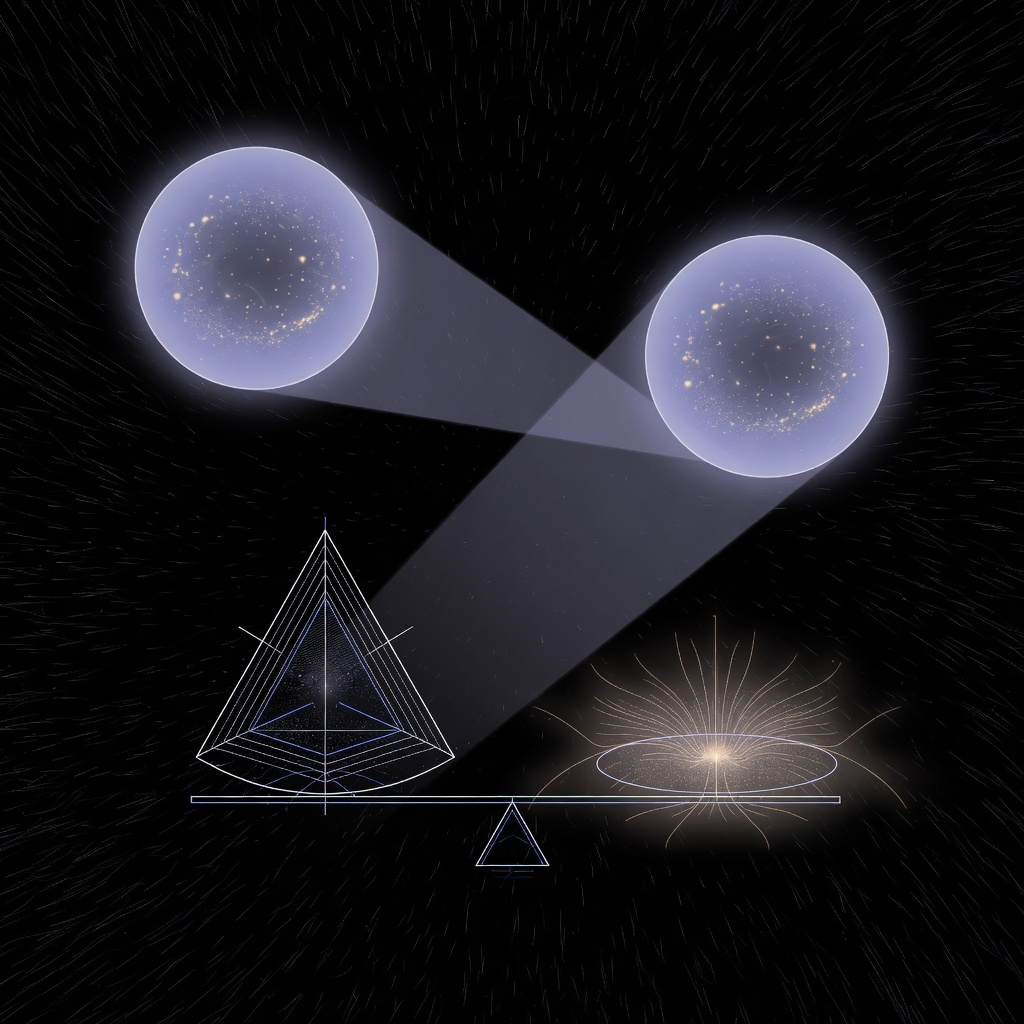
Generated via Grok.
Paper 15, this site’s last piece of work, corrected a real math mistake and landed on something genuinely elegant: a point particle outside a perfectly opaque sphere feels an exactly inverse-square shadowing force, at any distance, not just far away. But it was upfront about what that idealized case doesn’t cover — real matter isn’t a perfect, mathematical blocker, and gravity is between two extended bodies, not a point and a sphere. Those two gaps were the actual crux left standing, not footnotes next to a finished result.
This piece attempts both. The short version: the math works out cleanly, and it’s a real, checkable result — but it doesn’t do what we first hoped.
What the calculation actually shows
Real absorption isn’t all-or-nothing; a body only partially blocks flux passing through it, more so the denser or bigger it is. Redo Paper 15’s calculation with that real attenuation instead of a perfect blocker, and something clean falls out in the regime where the absorption is weak (most of the flux passes through with only a small fraction absorbed): the force comes out exactly proportional to the body’s total mass, with no leftover dependence on how big it is or how dense — a genuine mathematical fact, not an approximation, verified independently. Extend that to two extended bodies instead of a point and a sphere, and the same trick (borrowing Newton’s own 300-year-old Shell Theorem) shows the mutual force between them is exactly Newton’s inverse-square law, at any real separation.
That’s a real answer to the question Paper 15 left open: does shadowing preserve gravity’s exact proportionality to mass for realistically imperfect bodies? In this specific regime — weak absorption, most of the flux passing straight through — yes, exactly.
Why that isn’t the win it sounds like
Here’s the catch, and it’s not new — this site is late to it by about 150 years. The regime where this works (weak absorption, most flux passing through) is exactly the regime James Clerk Maxwell flagged in 1875 and Henri Poincaré made mathematically explicit in 1908: if a body only weakly interacts with the flux, producing ordinary gravity’s actual strength requires an enormous amount of flux passing through everything, constantly — and even a small fraction of that being absorbed as heat would cook the Earth (and everything else) many times over. Paper 14, this site’s own prior work, already found this same heating problem unresolved for exactly this mechanism.
So the two objections aren’t independent. They’re the same trade-off, seen from both sides: dial the absorption up, and the shadow calculation breaks (bigger, denser bodies would stop pulling in exact proportion to their mass, which real gravity measurably does to extraordinary precision). Dial it down to fix that, and the heating problem gets worse, not better, because now vastly more flux has to be passing through everything to add up to gravity’s real strength. There’s no dial setting that avoids both.
A note on how this paper changed shape
The first draft of the underlying work described the self-shielding problem as “resolved.” Before anything got published, the same adversarial review process that caught a real math error in Paper 15 was run on this one — and it correctly rejected that framing, even though the math itself checked out on the first pass. A 150-year-old, well-documented objection doesn’t become new just because we rediscovered one side of it with fresh algebra. The paper that came out of that correction is a narrower, more accurate claim: not “we fixed push-gravity’s oldest problem,” but “we can now say exactly where the boundary of that problem sits, and it’s exactly where Maxwell and Poincaré already said it was.”
Newton stopped short of proposing a mechanism. This site’s attempt at one keeps finding the same wall from a different angle — precisely enough, this time, to show the wall and the fix are the same object.