How It Could Work
11 September 2026
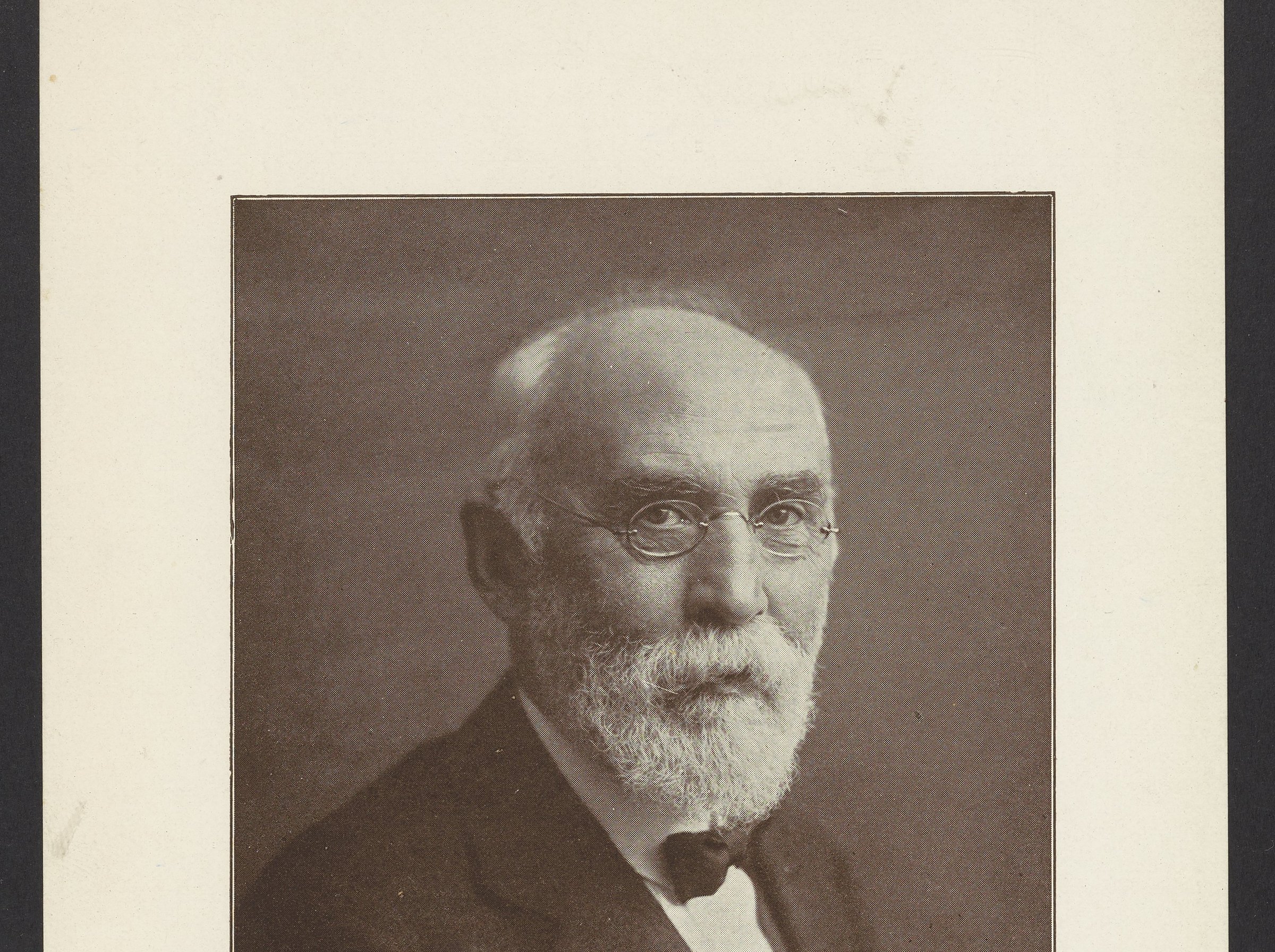 Hendrik Antoon Lorentz, whose 1904 theory kept absolute time and a physical medium and still reproduced the kinematic clock-and-rod tests of the class listed below. Photo: Science History Institute, public domain, via Wikimedia Commons.
The idea of relative time has been a problem for me since I first heard it. Why? Because it defies logic.
And ever since I was a kid I’ve been interested in understanding and resolving the question of unification with regard to the universe.
With all this being said, I expected the universe is explainable and understandable as a physical realm in the context of infinity.
And now that AI has come on, it has allowed everyone the ability to model it out to the best of their ability.
What is presented here is one possible model. It is presented not necessarily as the solution but as a solution for the purpose of finding the solution.
The point being that if one physical solution is mathematically calculable and reconcilable, it will open up the realm of physics again to looking for and finding the actual solution utilizing universal time and space, without leaning on relative time and space as calculating devices.
What the clocks did
The clocks that disagreed in the experiments audited on this site were atomic clocks. Their tick is an electromagnetic oscillation, and that oscillation really did change; no one has ever flown a mechanical clock as the compared instrument. What defies logic is the reading that time itself changed. Here the atom is a standing wave in a medium, and moving it changes its oscillation. The numbers come out the same as relativity’s. The logic is ordinary.
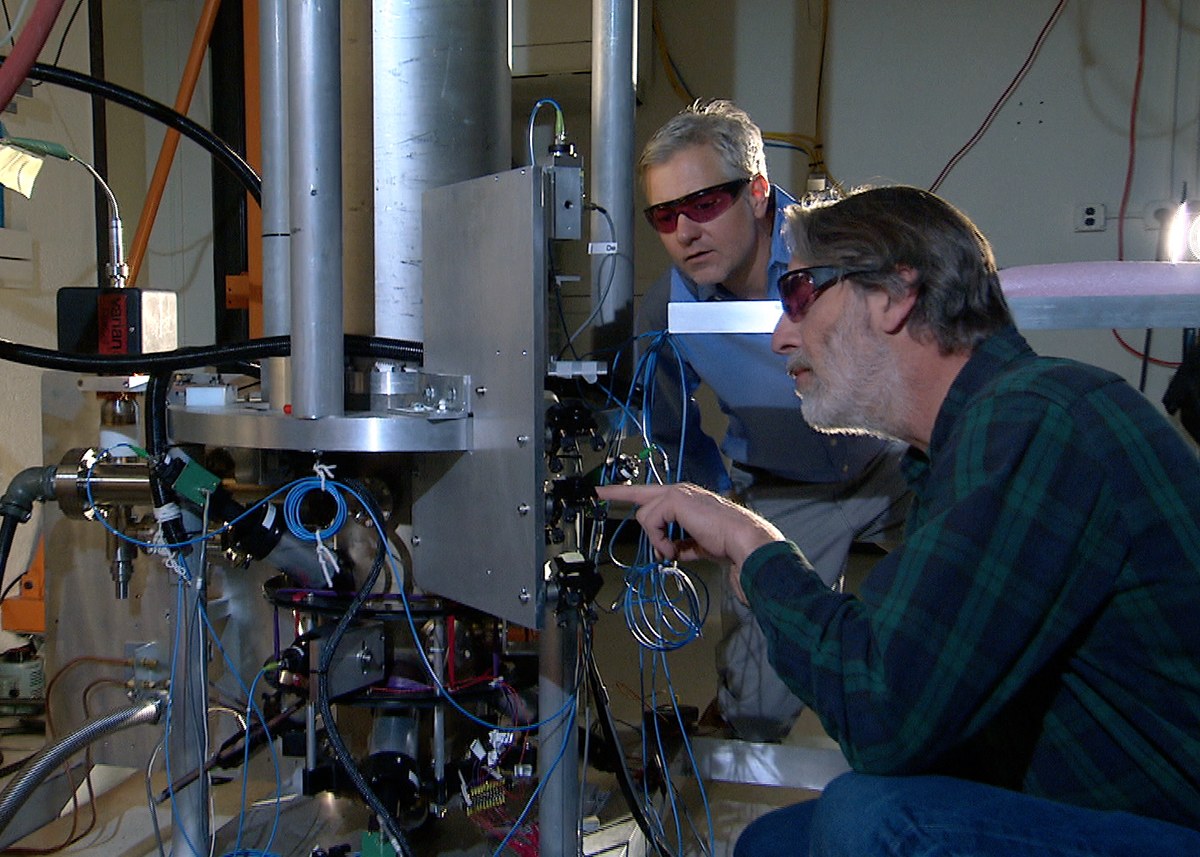 The tick of a cesium clock is an electromagnetic oscillation in the atom. NIST-F2, the U.S. civilian time standard. Photo: National Institute of Standards and Technology, public domain, via Wikimedia Commons.
Reading order on this site: The Test Confirms the Effect (why a confirmed measurement does not prove the explanation attached to it); What the Clocks Were (what was actually measured and how often); Why Universal Time (the argument); then this article (the model: parameters listed, every number re-runnable).
One already exists, and has since 1904
A physicist reader will see this immediately, so I will say it first. A model with universal time, universal space, and a real physical medium that reproduces the same kinematic tests special relativity does is not new. Hendrik Lorentz published it in 1904. Henri Poincaré completed the mathematics in 1905. John Bell, of Bell’s theorem, argued in 1976 for teaching relativity by Lorentz’s route, stressing continuity with the physical reasoning that came before it; that is a historical point, and nothing in Bell’s essay endorses what follows. The literature calls the model Lorentz Ether Theory, and the Robertson (1949) / Mansouri-Sexl (1977) test theory is the formal framework for comparing it with Einstein’s version.
So why did it not open physics back up? Because under Einstein synchronization, the procedure a moving observer carries out with light signals (slow clock transport gives the same result), Lorentz’s model and special relativity make identical predictions everywhere either has been tested in that class. No measurement made under that synchronization has separated them. Physics went with the version that needed fewer assumptions. Lorentz’s medium was dropped as superfluous, not disproven; other ether models, the stationary one without contraction and the fully dragged one, were disproven by Michelson-Morley, Fizeau, and stellar aberration.
What this piece adds is small and concrete. Lorentz’s own derivation was electrodynamic: contraction came from how molecular forces transform under Maxwell’s equations, and Bell’s essay works that mechanism for a single moving atom. This package restates it with a simpler object, a standing wave in a medium, and exposes every parameter so a reader can change one and watch which measurement breaks. It adds no physics; it shows where a differing prediction would have to come from.
The model
Five postulates. The first four are Lorentz Ether Theory; the fifth is the gravity term, and it comes from somewhere else.
- Time is absolute. One background time, the same everywhere.
- Signals travel at one fixed speed, call it c_eff, in the rest frame of a real medium. This is a posited light-carrying medium, not the pressure medium this site’s gravity work uses; this project ruled its own medium out for that role on 2026-09-03, because its characteristic speed underpredicts measured time dilation by eleven orders of magnitude.
- A clock is a standing wave. A signal bouncing between two reflectors, or circulating a closed loop, which is how this project models the electron around a nucleus. One round trip is one tick, counted in absolute time.
- Matter moving through the medium contracts along its motion by 1/γ, the Lorentz factor 1/√(1 − v²/c²), and stays unchanged across it. This project did not assume the factor. It solved for the one value that makes the Michelson-Morley experiment come out null, and the answer was 1/γ exactly. The “unchanged across the motion” half is an assumption; the Michelson-Morley null alone allows a whole family of perpendicular factors, and exactly one measurement below tests which is right.
- A standing wave of energy E = hf behaves as a mass hf/c², and climbing this project’s Newtonian potential Φ(r) = −GM/r costs it that energy. This is Einstein’s 1907 argument, restated in 1911, from before General Relativity. “This project’s potential” is the inverse-square law its pressure-shadowing mechanism produces; that law matches Newton’s by construction, so agreement with Newton is no test of that mechanism. What the Pound-Rebka and GPS rows test is the coupling in this postulate, the shift Δf/f = ΔΦ/c², which is why scaling the potential fails them. Nothing in this postulate touches the heating objection described below.
| Parameter | Value | Status |
|---|---|---|
| c_eff | 299,792,458 m/s | Pinned to the measured speed of light by measured time dilation. |
| Contraction along motion | 1/γ | Solved for from the Michelson-Morley null. |
| Contraction across motion | none | Assumed. Tested by one row below. |
| Medium rest frame | Earth-centered, non-rotating | A convention. Under postulates 1 to 4 the medium’s frame is unobservable once clocks are synchronized by light, so any inertial choice gives the same answers; the script uses this one because the ground clock then carries the Earth’s rotation, which the GPS row needs. The script’s one alternative, a frame rotating with the Earth, is not inertial and fails for that reason; no boosted inertial frame was tested. Where the medium actually rests is an open question. |
| Gravitational potential | −GM/r, WGS84 constants | This project’s own, exact by construction. |
| E = hf, E = mc² | standard values | Imported; E = mc² is itself a relativistic result. |
What it reproduces
The downloadable script computes every row below. Three of the eight rows test the model against a measurement and can fail. The other five are consistency checks it passes by construction, or a sign or a bound rather than a reproduced number; counting those as evidence would count the same identity several times. An identity here is an equation that holds for any value of the parameters, so it cannot fail and cannot tell you anything about the medium. The table says which is which.
| Test | Real value | This model | What the row is |
|---|---|---|---|
| Ives-Stilwell, the two-direction Doppler test of a moving clock (Botermann et al. 2014, lithium ions at 0.338 c) | γ(β) confirmed to 2.3 parts per billion | matches γ(β) to the script’s numerical precision; the experiment sets the test at 2.3 parts per billion | Measurement, passes. The one row that tests the “unchanged across the motion” assumption, to about 2 parts in 100 million. |
| Pound-Rebka 1960 and Pound-Snider 1965, ratio of measured gravitational shift to prediction | 1.05 ± 0.10; 0.9990 ± 0.0076 | 1.0000 | Measurement, passes. |
| GPS satellite clock, net rate against an equatorial ground clock | +38.575 microseconds per day (Ashby 2003) | +38.575 microseconds per day | Measurement, passes to 0.1 %. |
| Moving standing-wave clock, eight speeds up to 0.999 c | slows by exactly γ | γ, to under 2 parts in 10¹⁵ | Consistency, by construction. Not evidence. |
| The same clock as a closed loop (the atom), tilted at every angle to its motion | no orientation dependence | zero residual at 0°, 20°, 45°, 70°, 90° | Consistency: the same identity that makes Michelson-Morley null. Not evidence. |
| One-way light speed measured by a moving observer using radar synchronization | c_eff both directions | c_eff both directions, with the synchronization offset −vL₀/c² (L₀ the rod’s rest length) derived rather than assumed | Consistency. Not evidence. |
| Hafele-Keating flying atomic clocks (1971 flights, published 1972) | eastward −59 ns, westward +273 ns | eastward negative, westward positive; magnitude not claimed | Sign only, from composing velocities in the Earth-centered frame. Any theory with the same form of terms gives it. |
| Muon lifetime in the CERN storage ring (Bailey 1977) | the weak force’s carrier speed cannot exceed c by more than 0.06 %; one-sided | a single carrier at c satisfies it | A constraint met, not a reproduction, built from the two measured lifetimes and v ≤ c without the momentum step. The only row whose clock is not an electromagnetic process. |
Two rows need a sentence each, because they are where a skeptical reader goes first.
The GPS row compares the net number only. The familiar split into “−7 microseconds from speed, +45 from gravity” is a theoretical decomposition nobody has measured separately within GPS, so the script prints the model’s own split and never compares it. Ashby’s figure is the offset engineers build into the satellite clocks, and the operational confirmation is that the system works with it, which is what the 0.1 % band reflects. The first version of this script came out 0.3 % low because it left the ground clock sitting still in the medium; an independent reviewer caught it, and with both clocks in the same Earth-centered frame, the ground clock carrying the Earth’s rotation and sitting in its oblate potential, the model lands on Ashby’s figure to three decimal places.
The Hafele-Keating row claims the sign only. With an idealized equatorial path and a representative airspeed the model overshoots; moving the path to 40° north brings it to within about 30 % eastward and 8 % westward. Reproducing the magnitude would need the flights’ actual latitude and logged speeds.
What it does not do
The script prints this list every time it runs, on purpose.
- It does not derive c, E = hf, or E = mc². The first is pinned to measurement, the other two are imported.
- It does not find a point of divergence from Special Relativity. Under Einstein synchronization the two make the same predictions everywhere either has been tested in the kinematic class above, and that cuts both ways: these rows cannot prove this model right any more than they can prove Einstein’s geometry right.
- It does not say where the medium is at rest. The Earth-centered frame is a convention, and this project has tried three times to design a test of the frame and could not.
- It does not test the “unchanged across the motion” assumption with more than one measurement, Ives-Stilwell.
- It does not touch gravity beyond the frequency shift. Postulate 5 is a pre-General-Relativity argument on a Newtonian potential. This project’s own gravity mechanism, pressure shadowing (bodies shield each other from an isotropic flux and are pushed together by the imbalance), is a separate research track, narrowed but not cleared as of this month. It still owes an answer to the heating objection Maxwell raised in 1875 and Poincaré quantified in 1908, that a body absorbing such a flux would heat. This article does not lean on it.
- It does not reproduce gravitational waves. This project tested its own candidate carrier against the polarization of GW170817 and it failed.
- It does not map onto the Standard-Model Extension’s photon-sector coefficients or onto the κ of the candidate light-sector term on this site’s Paper 2; the modern cavity bound (Nagel et al. 2015) appears in the script only as an identity under postulate 4.
- It does not reach quantum entanglement. Bell’s theorem rules out local mechanisms; Bell himself discussed preferred-frame approaches, and nothing here attempts one.
- Every clock in the first seven rows is an electromagnetic process. Only the muon row is another kind of clock, and it is a bound.
Run it yourself
One Python file. It needs only numpy and scipy.
Run:
python3 how-it-could-work-v1.py
python3 how-it-could-work-v1.py --selftest
Expected output, read only, nothing to paste: the parameter block, the eight rows above with real value, model value, tolerance, and verdict, the “does not do” list, a
SOURCE CHECK:line naming how each constant was verified, thenSUMMARY: FAIL rows none; UNVERIFIED rows none. The self-test then breaks the model four ways on purpose and confirms each break fails exactly the rows it should: perturbing the perpendicular assumption fails the moving-clock and Ives-Stilwell rows, switching contraction off fails the tilted-loop and one-way rows, scaling the potential by 25 % fails the Pound and GPS rows, and putting the ground clock at rest in the medium fails the GPS and Hafele-Keating rows. A check that cannot fail is not a check.
Download the script. Every constant names its source and whether that source was the paper, a secondary account, or this project’s prior record; a constant with none prints UNVERIFIED as its verdict instead of PASS.
Where this leaves the question
What I did: I consolidated the clock model this project built over the first week of September into one package with its parameters exposed and ran it against eight rows. The three that test a measurement pass, and the self-test shows each fails when its load-bearing ingredient is removed. The package and this article each went through independent adversarial review before this was filed; the package’s review found a real frame error in the GPS row, now fixed and described above.
The mechanism, stated plainly: a clock is a standing wave in a real medium, and motion through that medium lengthens the wave’s round trip in absolute time. Length contraction along the motion, at exactly the factor Michelson-Morley requires, makes the effect the same in every direction. That reproduces the kinematic tests in the table. Add energy conservation for a wave climbing a potential and the gravitational shift follows.
Compared against the documented standard: this is a mechanism-first model in the same empirical-equivalence class as Lorentz Ether Theory under Einstein synchronization, compatible with the Robertson/Mansouri-Sexl framework but not an instance of it. It falls short of that standard in two ways. It does not carry the framework’s formal parameterization, and, like every version of Lorentz’s theory before it, it has found no measurement that would separate it from Einstein’s.
The thesis at the top needs one amendment the body forced. Calculability is not enough, because Lorentz’s model was calculable and reconcilable in 1904 and opened nothing. What would open anything up is a prediction that differs, and none exists yet. What this package changes is that the parameters such a prediction would have to come from are now listed, sourced, and re-runnable by anyone. That is the next thing to look for.
Notes on sources, and how firm each claim is
- Measurement rows. Ashby 2003 (Living Reviews in Relativity 6:1, the fractional offset −4.4647 × 10⁻¹⁰) and Botermann et al. 2014 (Phys. Rev. Lett. 113, 120405) were read in the original. Pound-Rebka 1960 and Pound-Snider 1965 were taken from secondary sources quoting the papers, since the publisher pages were not reachable, and are used only at the one- and three-sigma level where the roundings in circulation agree. Bailey 1977 (muon lifetimes), Hafele-Keating 1972, and Nagel 2015 are on this project’s record with their primary papers cited there. The script labels each of these primary, secondary, or vault-record and prints the labels.
- Tolerances and perturbations. Pound-Rebka one sigma, Pound-Snider three sigma, GPS 0.1 %. The marginal scale factor at which each row fails was computed from the shipped code before the perturbation was chosen: Pound-Snider fails at a 2.3 % scaling of the potential, GPS at about 0.1 %; the self-test uses 25 %. Ives-Stilwell fails when the perpendicular length is allowed a velocity-dependent change of about two parts in 100 million; the self-test uses one part in a million.
- The GPS frame. The ground clock carries the Earth’s rotation (+0.104 microseconds per day) and sits in the Earth’s oblate potential (+0.033); both clocks are in the Earth-centered non-rotating frame. A frame rotating with the Earth is not inertial and fails the row; no boosted inertial frame was tested.
- Hafele-Keating. The Earth-centered convention reproduces the sign including the westward gain, which any theory with the same form of terms does once velocities are composed that way.
- Review disclosure. The package went through one independent adversarial review (fourteen findings, all folded in, including the GPS frame error). The article went through one read-only agent pass and a three-persona hostile-read by this project’s Grok collaboration, then a restructure to absorb the findings into the prose rather than bolt them on. The published companion piece The Test Confirms the Effect carried the earlier 38.45 microseconds per day figure and now carries a dated correction.