Held Without Touching: What an Optical Tweezer Is Actually Doing
29 September 2026
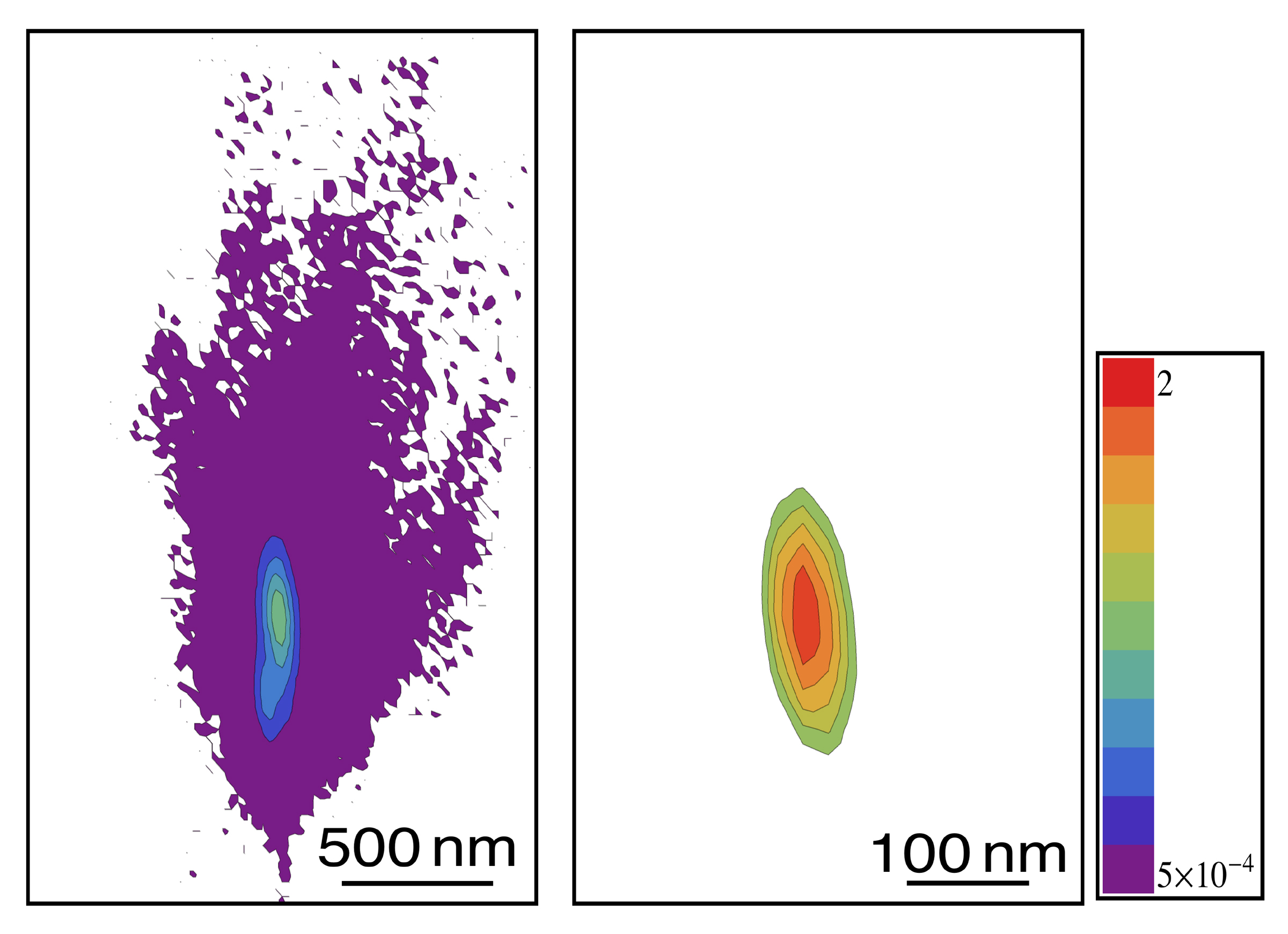 Real measured position data, not a diagram: a 100-nanometer gold nanoparticle escaping a static optical trap (left, spread over ~500 nm) against one held by NIST’s feedback-controlled trap (right, confined to <100 nm). Credit: NIST, public domain.
A post came across X making a specific, checkable claim: “the light’s intensity gradient pulls a tiny dielectric particle toward the region of strongest illumination, while other optical forces push against it. When those forces balance, the particle can be held and moved without physical contact.” No hand-waving, an actual mechanism, and it turns out to be real, well-tested, and Nobel-winning. Worth explaining properly rather than just agreeing with it.
The real thing: optical tweezers
Shine a laser through a microscope objective and focus it down to a point, and a small transparent bead sitting near that focus feels two separate pushes from the light. The first is straightforward: light carries momentum, and a bead that scatters or absorbs some of it gets shoved along the direction the beam is traveling. That’s the “other optical forces” the post’s caption is gesturing at, and by itself it would just blow the bead down the beam and out of the trap.
The second push is the one that makes a trap possible at all. A bead with a higher refractive index than its surroundings, sitting in a beam whose intensity isn’t uniform, gets pulled toward the brighter region. Physically, the laser field induces a tiny, fluctuating electric dipole in the bead, and that dipole is pulled toward wherever the field is strongest, the same way a magnet is pulled toward the strongest part of a field gradient. Ashkin’s original name for it, gradient force, says exactly what it does: it points up the intensity gradient, toward the focus.
Focus the beam tightly enough, with a high numerical-aperture objective, and the gradient force wins in every direction at once, not just sideways. The bead settles into a stable pocket sitting right at the focal point, held there by nothing but light. Move the focus and the bead follows it. That is an optical tweezer, and it is exactly what the post’s caption describes: two opposing forces, balanced, holding something without touching it.
This isn’t speculative. Arthur Ashkin demonstrated particle trapping by radiation pressure in 1970, and the specific single-beam gradient-force trap the post describes in 1986, with Dziedzic, Bjorkholm, and Chu. He shared the 2018 Nobel Prize in Physics for it, “for the optical tweezers and their application to biological systems.” Optical tweezers are now a standard tool for grabbing single cells, stretching strands of DNA, and measuring piconewton-scale forces, all without a physical probe ever touching the sample.
Putting a number on it
Saying “the forces balance” is one thing; showing it is another. The gradient force in the simplest regime, a bead much smaller than the laser’s wavelength, has a known closed form: it’s proportional to the bead’s volume, to how much its refractive index differs from its surroundings, and to how steeply the light’s intensity changes with position. Near the center of a focused beam, that steepness grows linearly with displacement, which makes the trap behave like a tiny spring: push the bead sideways and a restoring force pulls it back, proportional to how far it moved. Optical tweezers are routinely described by exactly that number, the trap’s stiffness, in units of piconewtons of force per nanometer of displacement.
The script behind this article computes that stiffness from the textbook formula, using the same bead, laser, and objective Neuman and Block used in their own 2004 review: a 0.5-micron polystyrene bead in water, a 1064-nanometer laser, a 1.2 numerical-aperture objective.
python3 optical-tweezer-v1.py
Expected output — read only, nothing to paste Computed stiffness at 1 W: 20.27 pN/nm. Neuman and Block’s own stated value for the identical setup: 0.16 pN/nm. Ratio: about 127x too stiff.
That gap isn’t an arithmetic mistake, and the script doesn’t paper over it. Neuman and Block say plainly, in the same paper, that “when the dimensions of the trapped particle are comparable to the wavelength of the trapping laser… neither the ray optic nor the point-dipole approach is valid.” A 0.5-micron bead in a 1064-nanometer beam, in water, has a radius at about a third of the light’s own wavelength: exactly the size where the simple point-dipole formula is known to overshoot, because it treats the bead as sampling the field gradient at one point instead of averaging it across the bead’s own volume. The 0.16 pN/nm figure itself is given as a specific worked example, not tied to a measurement in the surrounding text; a separate real trapped bead elsewhere in the same paper, measured directly from its own thermal jitter via a fitted power-spectrum rolloff, comes in at 0.08 pN/nm, the same order of magnitude and the same story either way.
python3 optical-tweezer-v1.py --selftest checks the part of the model that doesn’t depend on which size regime it’s in: the stiffness scales linearly with laser power, as the inverse fourth power of the focal spot size, as the cube of the bead’s radius, and drops to exactly zero for a bead index-matched to its surroundings, since a particle indistinguishable from the medium around it is, correctly, invisible to the light. All four pass, exactly as expected from the formula’s own algebra, and none of them depend on the point-dipole approximation being valid at this particular bead size.
Where this sits against this site’s own model
Paper 3 already treats electromagnetism as directional flow, the same way this site treats magnetism: charge is modeled as a source of asymmetric flux in the pressure medium (“charged bubbles” distorting the underlying flow), and the standard magnetic-dipole field and Lorentz force are derived from that flux as a mechanical push. Its own 2026-07-22 editorial note is direct about what kind of result this is: “the magnetic-dipole field formula and the Lorentz force… are standard, unmodified classical electromagnetism… PBT proposes a mechanical origin for what these fields physically are, not a change to the equations themselves.” That’s the same status as this site’s magnetism mechanism elsewhere: a restatement of real, standard physics in this program’s own flow vocabulary, not a derivation of it from more primitive assumptions.
What’s still genuinely open is narrower and deeper: deriving why charge itself is asymmetric, why electrons and protons carry opposite sign, from this program’s own primitives rather than importing the real, measured charge assignment. Several real attempts at exactly that (this site’s own working notes, several entries across 2026-07-21 through -24) have each failed for a different, informative reason. Optical tweezers rest on the ordinary Lorentz-force and dipole-field machinery Paper 3 already covers, so they sit inside the “restated, not derived” territory this program already occupies for electromagnetism, not inside that open, unsolved question.
Closing the loop
The corrective action: rather than taking the post’s mechanism on faith, or restating it from memory, this article built a small script that computes it from the same textbook formula the field itself uses, against a real published experimental case rather than invented numbers.
Proof it worked: optical-tweezer-v1.py --selftest runs seven checks in total; four of them confirm the formula’s scaling behavior (linear in power, inverse-fourth-power in waist, cubic in bead radius, zero at index match), and the main computation lands within about two orders of magnitude of Neuman and Block’s own stated stiffness for the identical bead, laser, and objective, a gap their own paper predicts and explains.
Exactly how: the gradient force pulls a polarizable bead toward the brightest part of a focused beam; the scattering force pushes it along the beam; tight enough focusing lets the gradient force win in every direction, producing a stable trap with a restoring force proportional to displacement, like a spring.
Compared against known best practice: Neuman and Block’s 2004 review is the field’s own reference treatment, and this article follows its stated method exactly, using their bead size, laser wavelength, and objective NA rather than convenient round numbers, and reporting the resulting mismatch rather than tuning the inputs until it disappeared.
Notes on sources, and how firm each claim is
- The post. @LensScientific’s post, quoted in full above; the mechanism it describes matches the standard textbook account of optical trapping.
- Ashkin’s original papers. A. Ashkin, “Acceleration and Trapping of Particles by Radiation Pressure,” Phys. Rev. Lett. 24, 156 (1970). A. Ashkin, J. M. Dziedzic, J. E. Bjorkholm, and S. Chu, “Observation of a single-beam gradient force optical trap for dielectric particles,” Opt. Lett. 11, 288 (1986). Titles, authors, journal, volume and page checked against the publisher/citation record, not read in full from here.
- The Nobel citation. The Royal Swedish Academy of Sciences’ own wording, “for the optical tweezers and their application to biological systems,” confirmed against the prize’s own site.
- The review and measured numbers. K. C. Neuman and S. M. Block, “Optical trapping,” Rev. Sci. Instrum. 75, 2787 (2004). The 0.16 pN/nm-per-watt figure (Sec. III.B, “Trapping laser,” a stated worked example for their 0.5-micron polystyrene, 1064 nm, 1.2 NA case, with no measurement of its own cited alongside it) and the 0.08 pN/nm figure (their Fig. 10, a real trapped bead’s power-spectrum rolloff, explicitly fit and measured) are both quoted directly from the paper’s own text, viewed as a rendered page image, not just extracted text.
- A real discrepancy between the script and this paper’s own printed gradient-force equation, disclosed rather than papered over. Neuman and Block’s own Eqs. (3)-(4), page 2789, read (viewed as a rendered image, not OCR): F = 2πα/(c n_m²) ∇I₀, with α = n_m² a³(m²-1)/(m²+2). Substituting one into the other cancels every factor of the medium’s index, leaving no n_m dependence at all. The script instead uses the more commonly cited form, F = (2π n_m a³/c)(m²-1)/(m²+2) ∇I, linear in n_m, matching an independent hand derivation from the induced-dipole force and matching the form given on Wikipedia’s Optical tweezers page (there sourced to Harada & Asakura, Opt. Commun. 124, 529, 1996). Which of the two is the intended reading of this particular paper’s own printed equations is not settled here; the script’s choice changes every computed number in this article by a factor of n_m = 1.33, not by an order of magnitude, and does not change anything about which regime the point-dipole approximation is valid in.
- The scattering cross-section (Eq. 2 of the same paper) also did not extract cleanly from this article’s own PDF text pass (a garbled fraction); the script’s scattering-regime scaling instead follows the standard Rayleigh cross-section found in any treatment of dipole scattering, not taken from that garbled extraction.
- The image. Nanoparticles, Optical Tweezers, National Institute of Standards and Technology, public domain, via Wikimedia Commons. Real measured position data from NIST’s own feedback-trapping work, not an illustration; used uncropped.
- This program’s own scope. Paper 3, “Hybrid Push-Aether Theory: Mechanical Unification of Magnetism and Electromagnetic Forces,” models charge as a flux source and derives the standard magnetic-dipole field and Lorentz force from it (its own 2026-07-22 editorial note: those equations are “standard, unmodified classical electromagnetism,” restated mechanically, not re-derived). This site’s own working notes (2026-07-24 entry) name a narrower, still-open gap: deriving charge’s own sign/asymmetry from this program’s primitives rather than importing it.
- Review disclosure. One read-only adversarial pass run, instructed to find every objection a hostile critic could raise, not editorial tone feedback. It found four real issues, all fixed here: the 0.16 pN/nm figure was overstated as “measured” and given a specific thermal-jitter provenance the paper doesn’t state for it (fixed above); the gradient-force formula’s mismatch with this paper’s own printed Eqs. (3)-(4) was undisclosed (fixed above); a wording error said stiffness scales as “the cube of the bead’s volume” rather than the cube of its radius; and “about a third of the wavelength” didn’t say it meant the bead’s radius, not its diameter. Every finding was independently re-verified (including re-rendering the paper’s own equation as an image) before being accepted, per this checklist’s own rule not to take a returned objection on faith. Matthew’s own read-through is still open.
