Gravity as a pressure: Euler, Arminjon, and what a medium theory has to prove
14 November 2026
 Leonhard Euler, pastel by Jakob Emanuel Handmann, 1753. Euler proposed gravity as the thrust of an ether whose pressure drops near massive bodies. Public domain, via Wikimedia Commons.
Could gravity be a push from a surrounding medium instead of a pull across empty space? This article explains one of the more fully developed published attempts to make that idea work: the scalar ether theory of Mayeul Arminjon, a researcher at the CNRS 3SR laboratory in Grenoble. You will get a plain account of how it works, what his papers claim, what changed when he revised it, where it meets hard observational tests, and the calculations that would settle its fate. At the end we set it beside the question this site’s Pressure-Based Theory (PBT) work starts from: what if gravity is a pressure differential in a medium, and can that be shown to work, provably and repeatably?
Two very different “push” ideas
Push explanations of gravity come in two families. The first is the shielding picture usually credited to Nicolas Fatio de Duillier and Georges-Louis Le Sage. Space is crossed by a flux of tiny particles from all directions, and two bodies shade each other from it, so each is pushed toward the other. Arminjon summarizes it in one line as massive bodies “shielding an ubiquitous flux of ‘ultramondane particles’” and adds that, as far as he knew, an accurate model of gravity based on that concept was still lacking (Arminjon 2004, note 40). Flux models must answer long-standing drag and heating objections (see Disproven Theories).
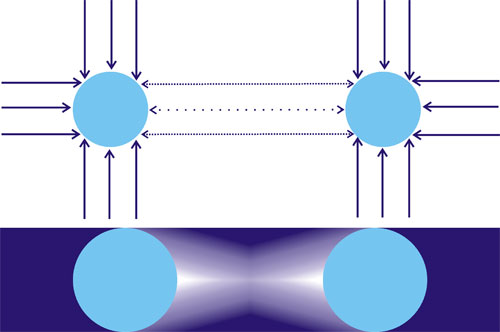 The shielding picture: each body shades the other from a flux arriving from every direction, so the net push drives them together. Diagram: D.H, CC BY-SA 3.0, via Wikimedia Commons.
The second is the buoyancy picture, which goes back to Leonhard Euler. Here a continuous fluid, the ether, has lower pressure near a massive body, so any small piece of matter is pressed harder on its far side and pushed toward the body. That is Archimedes’ thrust, the force that floats a cork, pointing inward because the pressure gradient is reversed.
Arminjon gives Euler’s argument in detail, with translations from two of Euler’s papers (Arminjon 2004, Sect. II). Euler took the ether pressure near a body of the form p = h − A/x, which gives a weight falling off as 1/x², so the inverse square law follows from the pressure profile. To make the force proportional to mass instead of volume, Euler had to assume that the finest parts of all matter share one density, with ordinary bodies mostly made of pores. He also saw that the pressure deficit he needed was very large; Arminjon’s reconstruction from Euler’s own numbers puts it above ten million atmospheres at the Earth’s surface.
Euler admitted he could not say why matter lowers the ether pressure around it, only that a pressure deficit is easier to conceive than bare attraction at a distance. What makes the pressure drop is still the central question for any medium theory.
Arminjon’s mechanism: the medium first, geometry as its effect
By his own account, Arminjon reached a mechanism close to Euler’s without knowing of Euler’s version (Arminjon 2004, introduction). His first papers on it appeared in 1993 as “A theory of gravity as a pressure force,” parts I and II, in Rev. Roum. Sci. Techn. – Méc. Appl. 38. His publication list also states that the first version of a later paper on the theory dates back to the end of 1992 (publication list, items A8, A9, A18).
His starting point was Lucien Romani’s idea, from his 1975 book Théorie Générale de l’Univers Physique, of a perfectly fluid “constitutive” ether, in which elementary particles are not separate objects sitting in the fluid but organized flows of the fluid itself, like vortices. In this premise, only a perfect fluid could fill space without braking moving bodies, and a perfect fluid can only exert pressure. So the gravity acceleration is set by the pressure gradient divided by the ether density, g = −grad p_e / ρ_e (Arminjon 2004, Sect. III). Because the particles are made of ether, Euler’s uniform-density assumption is no longer a separate miracle. (Plain-language introduction.)
Three further steps turn the picture into a theory.
- The ether defines the frame. Arminjon shows that neither Euler’s ether nor his own can obey ordinary fluid mechanics: the equations become overdetermined. He reads this as a feature. The averaged motion of the ether defines the preferred reference frame in which mechanics is written, so the ether cannot also be one more fluid moving inside that frame (Arminjon 2004, Sect. III.B, III.C).
- Compressibility gives waves. An incompressible ether reproduces Newton’s gravity exactly. A compressible one supports pressure waves, which become the theory’s gravitational waves (Arminjon 2004, abstract; Arminjon 2008 review).
- Gravity changes rods and clocks. In the Lorentz-Poincaré reading of special relativity, rods really contract and clocks really slow when they move through the ether. Arminjon extends this: a lower ether density near a mass contracts rods and slows clocks in the same way. The curved spacetime metric is therefore not the cause of gravity. It is a description of how physical measuring standards are distorted by the state of the medium. Motion follows from an extension of Newton’s second law, and in a static field that law reproduces geodesic motion (1996 PIRT conference paper; Arminjon 2006).
This is the medium-first order of explanation: pressure and density are physical, and curved geometry records their effects on instruments. It also brings a preferred frame and an absolute time, which Arminjon treats as a motivation, since a preferred time may ease the link with quantum theory (Arminjon 2008 review, abstract).
Version 1 and version 2: what changed and why
Version 1 (v1) assumed that gravity contracts rods only along the direction of the gravity acceleration, leaving perpendicular lengths unchanged. With its scalar field equation this gives exactly the Schwarzschild exterior metric of general relativity around a static spherical body. In his words, the anisotropic version “predicts exactly the Schwarzschild exterior metric in the static case with spherical symmetry” (arXiv:physics/0404132, Sect. 4). The abstract of his 1996 conference paper says more briefly that the theory “predicts Schwarzschild’s exterior metric” in that case (1996 PIRT paper, proceedings 1998, posted 2011; see also Arminjon 2004, Sect. VII).
The problem came from extended bodies. Working with his own “asymptotic” post-Newtonian scheme, Arminjon found that in v1 the acceleration of a small body depended on its internal structure even in the limit where its size goes to zero. That is a violation of the weak equivalence principle, the rule that all small bodies fall alike. He traced the cause to the direction-dependent spatial metric, and in his own words the size of the violation was “likely to discard the initial version of the theory” (Arminjon 2006, Sect. 1). He suggested a similar effect might appear in general relativity in some gauges (review, Sect. 4.5); that is his remark, and standard general relativity predicts that small neutral bodies fall alike regardless of their make-up.
Version 2 (v2), proposed in 2004 and worked out in a 2006 paper in the Brazilian Journal of Physics, makes the gravitational contraction of rods the same in every direction. The equations of motion are unchanged. To keep an exact energy conservation law, the scalar field equation is changed so that its left side is the flat-spacetime wave operator (arXiv:physics/0404132; Arminjon 2006, abstract). The 2006 paper then shows that the structure-dependent term disappears: at the point-particle limit, a small body falls like a test particle, at least in the static spherical case.
So which version gives Schwarzschild? v1 gives the exact Schwarzschild exterior. v2 gives a different exact exterior that agrees with Schwarzschild only to first post-Newtonian order. In v2 the static spherical field is β = exp(−GM′/c²R), with the time part of the metric equal to β² and the space part scaled by β⁻². Expanded to first post-Newtonian order, that is the standard post-Newtonian metric of general relativity, the same as the spatially isotropic form of Schwarzschild to that order (Arminjon 2006, Eqs. 5 to 6 and 86 to 88). The 2019 paper with Rainer Wolfgang Winkler confirms the same thing for test-particle motion: for a body at rest in the ether, the v2 acceleration is identical to general relativity up to order c⁻² (Arminjon and Winkler 2019, abstract and Sect. 5). Beyond that order the two differ. Writing u = GM/c²R, with M the mass that orbits measure, the time parts still agree at second order (1 − 2u + 2u² in both), but the spatial factor’s second-order term is 2u² in v2 against 1.5u² in isotropic Schwarzschild. So v2 matches the weak-field light tests and test-particle orbits around a source at rest in the ether, but exact Schwarzschild agreement is a v1 result.
What the papers claim, and what has been checked by others
His papers report two kinds of result. Some are checks against general relativity at the order used for the classical tests: the correct Newtonian limit, and light bending and time delay equal to general relativity’s at first post-Newtonian order (Arminjon 2004, Sect. VII; 1996 PIRT paper, abstract). Others are his own derivations with no comparison to modern data that we found: a true local energy conservation law, gravitationally modified Maxwell equations, an accelerating cosmic expansion without a dark-energy term, interiors with no infinite-density singularity, and, in a 2003 analysis of v1, radiation through the quadrupole alone (gr-qc/0310062; Arminjon and Winkler 2019, Sect. 1). Papers on the theory appeared in peer-reviewed journals including Foundations of Physics, Theoretical and Mathematical Physics, the Brazilian Journal of Physics and Zeitschrift für Naturforschung A.
Publication is not independent replication. Our search did not find a published paper by other authors that rederives his key results, and we did not find a published paper that refutes the theory by name. That is a statement about what our search turned up, not proof that no such work exists. For now the theory’s standing rests mainly on its author’s own calculations, which makes them a clear target for anyone who wants to check them.
The preferred frame meets the planets
An ether theory has an “absolute velocity” of the solar system through the ether. In v1, Arminjon derived equations of motion for the planets that included preferred-frame terms and fitted them to the Jet Propulsion Laboratory’s DE403 ephemeris, using heliocentric planet positions from 1956 to 2000 as stand-in data. The best fit wanted an absolute velocity of about 3 km/s, and the result still differed from DE403 by a small but significant amount (Arminjon 2002, IJMPA). A companion paper puts the difference at about 3.8″ for Mercury after a century, compared with the 43″ relativistic perihelion advance (Arminjon 2003, Recent Res. Dev. Astron. Astrophys. 1, 859). DE403 is itself fitted with general relativity, so this is a gap against a GR-based ephemeris, not against raw observations, as Arminjon himself points out. In his 2004 overview he wrote that it seems the ephemeris “cannot be reproduced within 10″ per century” (Arminjon 2004, Sect. VII).
The 2019 Arminjon and Winkler paper redid the planetary test for v2 in its Section 6 (DOI 10.1515/zna-2018-0470; free PDF). The fit assumptions shape the result:
- The Sun and eight major planets were fitted to DE403 over one century. The target was an ephemeris, not raw observations.
- The mass centres were treated as test particles, so self-field and internal-structure effects were neglected. Post-Newtonian terms came from the Sun alone, as a spherical body; the planets contributed Newtonian attractions only.
- The solved-for parameters were the initial positions and velocities, the masses, and the absolute velocity vector V of the barycentre.
The fit drove V to about 40 km/h, which is roughly the speed of the barycentre relative to the Sun. In effect it set the Sun nearly at rest in the ether, where the v2 equations coincide with those behind the VSOP2000 ephemeris. The authors note that a solar system at rest in the ether is “difficult to accept given what we know about galactic motion,” and give two reasons this does not yet decide the question: the ephemeris was itself built from observations reduced with general relativity, and real planets are likely to show structure effects that test particles do not. They conclude that a real test needs self-fields and direct observations reduced with the scalar theory itself, which they call hard, specialized work.
As fitted so far, then, v2 matches the planets best when its preferred-frame effect is switched off, and the fit treats the planets as test particles, so it is not yet the extended-body test the theory’s own history shows is needed. Planets are also not the only check on a preferred frame. Lunar laser ranging and pulsar timing bound the standard preferred-frame parameters to α₁ below about 4×10⁻⁵ and α₂ below about 2×10⁻⁹ (Will 2014, Table 4). We did not find v2 expressed in those parameters.
Pressure waves and the gravitational-wave era
In Arminjon’s theory a gravitational wave is a pressure wave in the ether, a disturbance of one scalar field. His 2003 radiation paper, written for v1, uses a post-Minkowskian scheme to show that an isolated system loses energy only through quadrupole terms, with no monopole or dipole radiation. Applied to a binary in the Newtonian approximation, it gives energy-loss coefficients of k₁ = 2 and k₂ = 3/4, compared with 12 and 11 for general relativity in harmonic coordinates. The paper’s acknowledgment records the referee’s calculation that, for the binary pulsar PSR 1913+16 with its orbital parameters taken from the standard fit, the theory’s energy loss “would be some six times less than in GR.” Arminjon’s answer is that those parameters were themselves fitted with general relativity, and that a binary pulsar timing model built entirely on his theory might fit the pulse data (arXiv:gr-qc/0310062). No such timing fit appears in the sources reviewed here, so the comparison on record is a factor-of-six shortfall.
Two points need care.
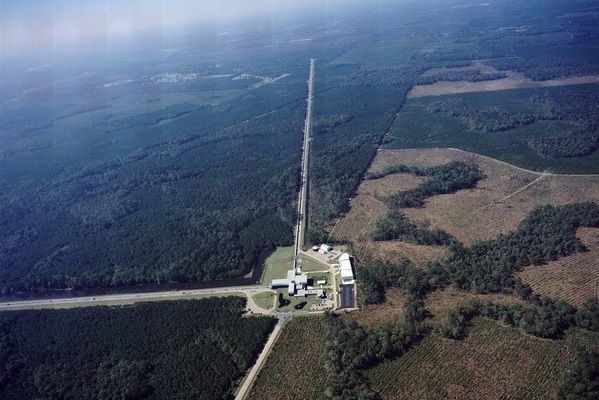 LIGO Livingston, Louisiana, one of the detectors behind the GW170814 and GW170817 results. Credit: Caltech/MIT/LIGO Laboratory, public domain, via Wikimedia Commons.
Quadrupole energy loss is not tensor polarization. The amount of energy a binary radiates and the pattern in which a passing wave stretches a detector are different properties. General relativity predicts two tensor polarizations. A theory whose only gravitational field is one scalar would be expected to produce a scalar pattern, a breathing or longitudinal stretch, though in this theory the metric is an effect of the medium on rods and clocks, and the Arminjon papers reviewed here do not derive the detector response. The LIGO-Virgo network measured GW170814 with three detectors and, comparing the simplest pure models, found Bayes factors above 200 and 1000 in favour of pure tensor polarization over pure vector and pure scalar (LIGO-Virgo 2017, PRL 119, 141101). Under the standard reading of a single scalar field, that is already in strong tension with the data; a calculation of the strain this theory actually produces is what would confirm or lift it.
Speed and delay are already constrained. For GW170817, gamma rays arrived 1.7 seconds after the gravitational signal, which limits any difference between the speed of gravity and the speed of light to between −3×10⁻¹⁵ and +7×10⁻¹⁶ of c, and also constrains the Shapiro delay of gravitational versus electromagnetic waves (LIGO-Virgo, Fermi and INTEGRAL 2017). In v2 the scalar field obeys a flat wave equation in the preferred frame, while light follows the physical, curved metric. Two signals following different rules through the Galaxy’s potential would generically pick up different delays, unless the theory shows why they cancel. Whether that difference fits inside the bound is a calculation we did not find in his papers, and we did not find any paper that confronts Arminjon’s waves with either event.
On gravitational waves, then, the theory faces two published constraints it has not been shown to meet: strong tension on polarization, and an unshown fit to the GW170817 timing.
What would settle it
The theory is not in mainstream use, and the open problems are on the record above: a scalar wave sector in tension with tensor polarization, a propagation split not yet checked against GW170817, a planetary fit that works best with its preferred frame switched off, and a v1 pulsar energy-loss comparison about six times short of general relativity, with v2 radiation and a theory-consistent timing fit not yet published. Reviving it would take these calculations, each of which could also end it.
- Strong-field static test for v2. Compare the exact v2 exterior, with β = exp(−GM′/c²R), against general relativity beyond first post-Newtonian order, for example in second-order light deflection.
- Gravitational-wave speed and Shapiro delay. Compute the v2 travel time of a pressure wave and of light from a source like GW170817 through the Galaxy’s potential, and compare with the measured 1.7 second gap and its bounds.
- Polarization and detector response. Derive the strain pattern a v2 pressure wave produces in an interferometer and test it against the GW170814 network analysis and later events.
- Radiation in v2. Redo the quadrupole energy-loss calculation in v2, then build a full binary pulsar timing model in the theory and fit actual pulse data.
- Planets with self-fields. Carry out the extended-body post-Newtonian equations for v2 and fit them to direct observations reduced in the theory itself, with the absolute velocity left free, and see whether a realistic galactic velocity survives.
- Independent rederivation. Other authors rederiving the v2 equivalence-principle result and post-Newtonian metric would add weight either way.
Where this meets the PBT question
PBT starts from a what-if: what if gravity is a pressure differential in a medium, with curved space and slowed clocks as effects rather than causes? What we are after is a working solution, one that is provable and physically repeatable, and ultimately a unified account of gravity with the rest of physics. My own working picture is what I call subatomic pressure dynamics: regions of higher and lower pressure in the medium mechanically balance out the positions of the clumps of mass inside a system. That is a guiding picture for the work, not an established result, and general relativity, with its long record of passed tests, remains the benchmark its predictions have to meet. The shared starting point makes Arminjon’s scalar ether a close conceptual predecessor. It is not the same theory, it is not a proven ancestor, and it does not establish anything about PBT by association. Its record matters here for a plainer reason: it shows where any medium solution gets tested. Four tests stand out.
- Matching static general relativity is necessary, and it is not enough. v1 matched exact Schwarzschild and was still set aside because of a subtle equivalence-principle failure in extended bodies. A medium theory has to check bodies with structure, not only test particles.
- Geometric choices have physical consequences. One assumption, whether rods contract in one direction or in all, decided between a theory that broke the weak equivalence principle and one that, by its author’s analysis (not yet checked by others), does not. PBT should state its rod and clock rules explicitly and follow each one through to the equations of motion.
- A preferred frame has to be paid for in the planets. If the medium has a rest frame, the solar system moves through it, and the effect must be measured against data.
- Energy loss and polarization are separate checks. A correct pulsar decay rate does not fix what a detector sees.
PBT’s own derivations for clock rates, light propagation, the Shapiro delay and gravitational waves are not finished. Those are the next stage of the work, and Arminjon’s record shows why they are the stage that counts. A pressure solution earns its place by passing those tests in the open, measured and repeatable by anyone, and his work shows clearly what passing looks like. Passing them is also the necessary step toward the larger aim, a unified account.
Text licensed under CC BY 4.0. Quotations from cited works remain the property of their authors and are used for commentary. Images carry their own licences, as credited.