What Holds Atoms Together: An Equilibrium-Pressure Answer, Checked Against the Real Physics
20 July 2026

Generated via Grok.
A 2002 notebook page (original notes14.pdf, part of the recovered original PBT notes) sketches an “electron equilibrium envelope” — electron stability as a balance against the nucleus, with attraction explicitly rejected as a category, consistent with the push-only picture already used for gravity. It didn’t say what drives that balance. Twenty-four years later, working back through the same notebook alongside entanglements.pdf and electron mesh.pdf’s bonding brainstorms, a specific driver falls out — and it happens to speak to two other questions at the same time: why gravity’s “strength” depends on context, and what containment has to do with a neutron decaying into a proton.
The idea: protons and neutrons sustain continuous internal activity that produces an outward pressure from the nucleus. That pressure meets the ambient, inward-pushing subatomic medium. Where the two balance is a shell — an equilibrium “bubble” — and that’s where electrons sit. Bring two atoms close enough and their bubbles touch and join; that joined structure is the bond. A growing structure casts a bigger pressure-shadow, so it draws in more atoms, following the same pressure-shadow logic already published for gravity — a notebook-level extension of that mechanism to molecular scale, not yet a formal claim in any live paper.
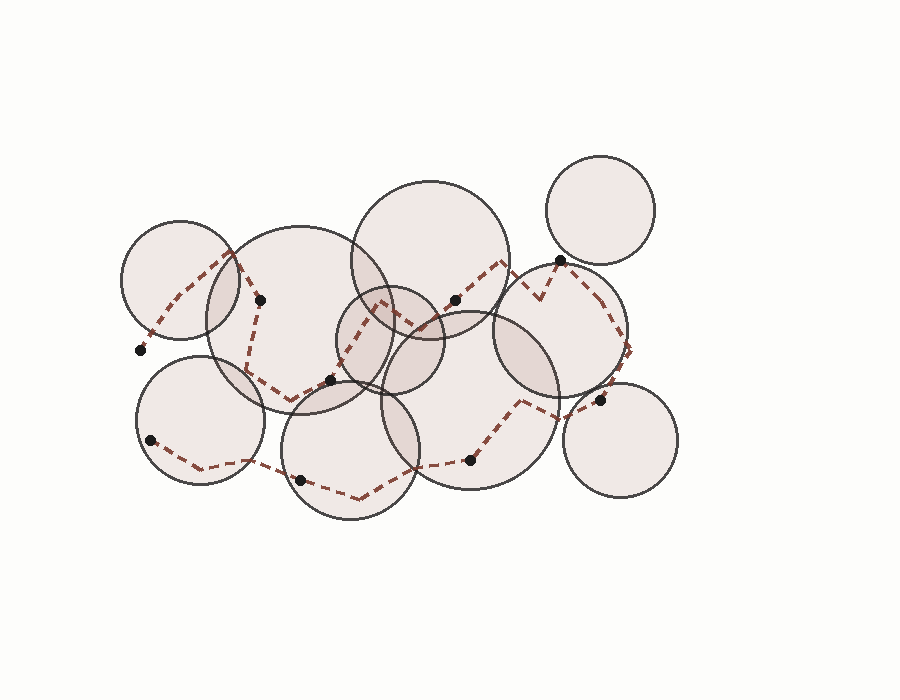
The original working sketch — not AI-generated, not a finished figure, kept here because it’s how the idea actually got worked out.
Where this agrees with established physics. Mainstream nuclear physics already treats the nucleus with volume, surface, Coulomb, asymmetry, and pairing terms — pressure- and surface-tension-like language, going back to the semi-empirical mass formula (the liquid-drop model). This model isn’t inventing “nuclear pressure” from nothing; it’s asking whether the ambient subatomic medium supplies the outer half of a balance whose inner half nuclear physics already treats this way. Real solid-state physics also describes electron conduction the way this model describes electron flow through joined bubbles: scattering through a lattice via a mean free path, not a straight path — the delocalized “electron sea” picture (Drude 1900, corrected quantum-mechanically by Sommerfeld in 1927, extended to real crystal lattices by Bloch in 1928). The parallel here is the path picture — scattering through a lattice — not a claim that bubble-packing geometry predicts which metals conduct best; that’s a separate, and much weaker, test. And it’s compatible with a feature nuclear physics already requires: the strong force runs on continuous virtual particle exchange between nucleons, an always-on process, not something unique to unstable isotopes.
Containment and beta decay. In this picture, a free neutron’s outward pressure isn’t balanced by a joined multi-nucleon structure the way a nuclear interior’s is — the equilibrium condition that holds a neutron stable inside a nucleus is simply missing, and the neutron decays. A bound proton/neutron system can sit inside a shared pressure balance that a free neutron can’t. That’s a containment sketch, not a derived decay rate: the actual lifetime numbers would have to come from the same equilibrium-pressure parameter already tasked with the binding curve above. If they don’t, the sketch fails — a derived free-neutron lifetime (measured at about 880 seconds) from that same parameter would be a further, stricter test, not something claimed here yet.
Where it’s a genuine departure — including a real burden it takes on. Mainstream quantum mechanics gets the same “electron sits at an equilibrium shell” result from a completely different balance: electrostatic attraction against the quantum kinetic-energy cost of confining a wave into a small space. No outward-nuclear-pressure term appears in that picture at all. Worth being direct about the scale problem this creates: the residual strong force operates at roughly 1–2 femtometers, while electron shells sit some four to five orders of magnitude farther out. For this model to work, the nuclear-sourced pressure has to couple into the ambient medium and still matter at that much larger distance — a real requirement the model takes on, not a detail to skip past.
A testable target, not just a story. The boundary between stable and radioactive nuclei is already precisely mapped — the valley of stability, governed by binding energy per nucleon, which peaks at iron-56 and nickel-62 (around 8.8 MeV per nucleon) and falls off for both lighter and heavier elements. If a single equilibrium-pressure parameter, calibrated against that real curve, can reproduce why light nuclei need proportionally fewer neutrons and heavy nuclei need disproportionately more, that’s real support. The deuteron — the simplest bound nucleus, binding energy 2.22 MeV — is the smallest test case available. A second, independent check, reaching across the same scale gap named above: the identical parameter, unmodified, should also roughly track measured covalent (or atomic) radii across the periodic table. A nuclear-scale fit that also holds up at atomic scale is real, non-trivial support; systematic failure there is a real problem, not something to paper over.
On gravity’s “strength.” An older note in the same archive claims flatly that gravity “is not a feeble force.” Held up against the real, precisely measured hierarchy problem — gravity is roughly 10³⁶ to 10⁴⁰ times weaker than electromagnetism at the particle scale — that blanket claim doesn’t hold. The better statement, and the same scale-jump this model already leans on: pressure, like gravity, is relative to context, the way a pressure vessel can hold intense stored energy or almost none. What reads as weak gravity at planetary distance and strong binding inside an atom may be the same kind of mechanism in two different pressure zones, not two different strengths.
Bottom line: one calibrated equilibrium-pressure parameter has to do two jobs at once — match the nuclear binding curve and roughly track atomic radii. Failure at either scale undercuts both the shell picture and the binding-curve claim, because they’re the same number. That coupling is what makes this a real test rather than a flexible story. Not yet checked against the papers’ math; not yet a finished model.
Correction, 2026-09-24. The second job named above, the same nuclear parameter roughly tracking atomic radii, is not yet a well-posed test. The parameter is an energy and a radius is a length, no derived mapping between them exists in this framework, and the two scales rest on entirely different mechanisms. This project’s Paper 13, still unpublished as of this note, examined the claim and records it as an unresolved prerequisite rather than a prediction. With the atomic half withdrawn, the “two jobs at once” coupling this paragraph relied on no longer holds; what remains is the nuclear test on its own. Paper 13 ran that test: a single equilibrium-pressure parameter did not suffice, a proton-repulsion term of the standard Coulomb form had to be added and is reframed rather than derived, and the resulting four-term fit holds for medium and heavy nuclei with a known weakness at the light end. A separate benchmark the atomic side has to meet on its own, the periodic table’s period lengths, is set out in Two, Eight, Eight, Eighteen.