Einstein Called Relativity a Principle Theory — And Named What It Left Out
30 September 2026
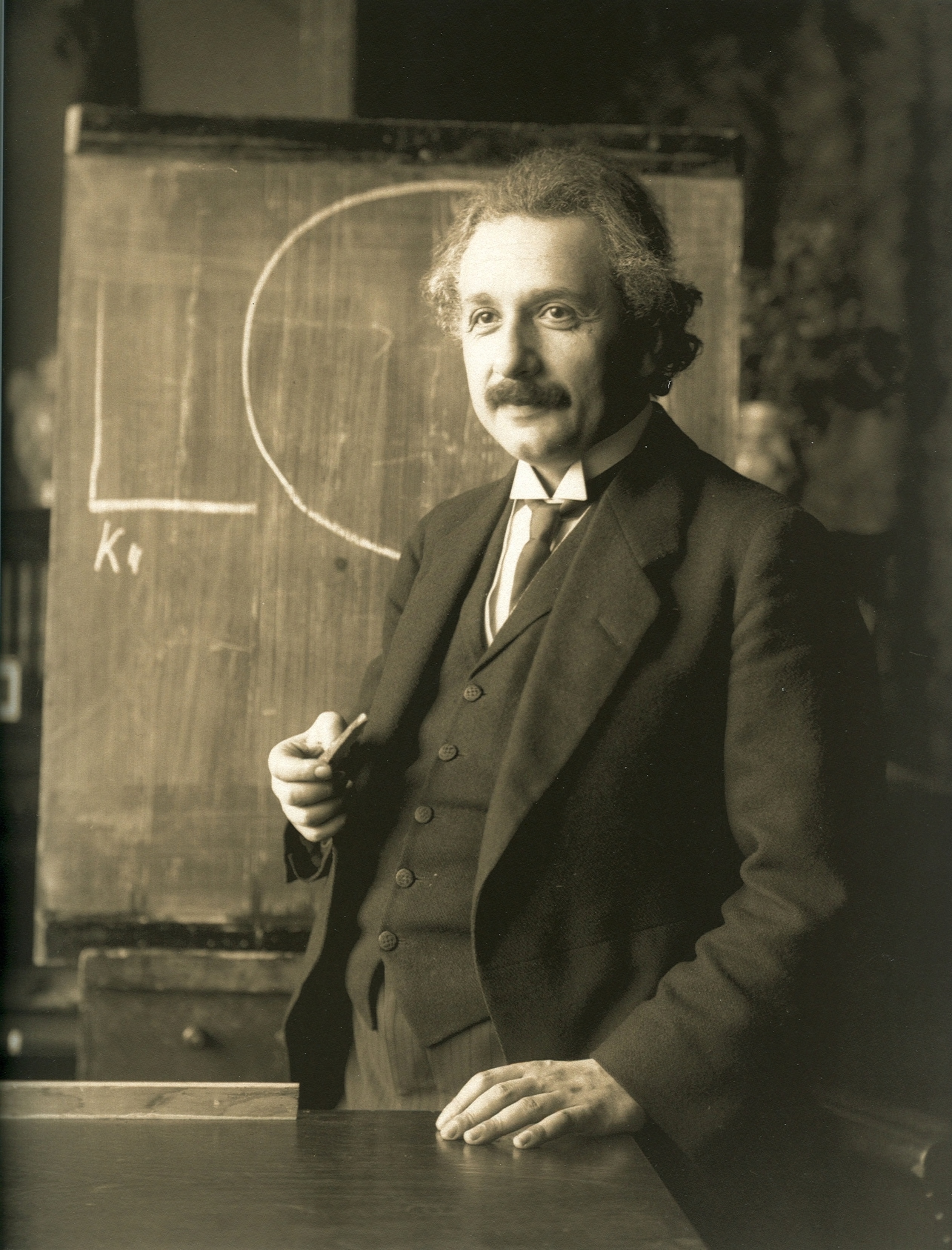 Albert Einstein lecturing in Vienna, 1921 — a year after he told an audience in Leiden that general relativity required something he was willing to call “ether” again. Photo: Ferdinand Schmutzer, 1921, Austrian National Library, public domain, via Wikimedia Commons.
Why Universal Time and How It Could Work make this project’s case for a real medium and one universal time. This piece is upstream of both: why chase a medium at all, when the reigning theory works. The short answer is that Einstein told you why, in his own words, at the time he published it.
What a “principle theory” is, in Einstein’s own terms
In 1919, writing for the Times of London, Einstein sorted physical theories into two kinds. A constructive theory builds a phenomenon up from an underlying model — his example was the kinetic theory of gases, which explains pressure and temperature as molecules colliding. A principle theory does the opposite: it starts from an empirically found constraint and works out what must follow, without describing what is physically happening underneath. His example there was thermodynamics — you don’t need to know what heat is to use the rule that perpetual motion is impossible.
He placed relativity in the second category, on purpose. Special relativity starts from two postulates — the laws of physics look the same in every inertial frame, and light moves at the same speed for every observer — and derives time dilation, length contraction, and the rest as necessary consequences. Nothing in that derivation says what a clock or a rod is doing that makes it behave that way. The theory tells you the effects must occur. It was never built to tell you the mechanism.
That is not a criticism invented for this piece. It is Einstein’s own filing of his own theory, published the same year the 1919 eclipse expedition made him famous.
The aether he dropped, and the one he brought back
Einstein didn’t need a mechanism in 1905 because he’d removed the thing a mechanism would have acted on. Nineteenth-century physics carried a luminiferous aether — a medium light was supposed to move through, the way sound moves through air. Special relativity’s postulates made that aether unnecessary for the mathematics to work, and Einstein said so directly, calling it überflüssig — superfluous.
He did not stay away from the idea. In an address at the University of Leiden, titled “Ether and the Theory of Relativity” — delivered 27 October 1920, five months after its planned date, following a bureaucratic mix-up in which Dutch authorities briefly confused him with the unrelated German writer Carl Einstein — he argued that general relativity actually requires something he was willing to call ether again: the gravitational field itself, varying from point to point, conditioning how matter and light behave. But he was explicit about the one property he was not bringing back. That field, he said, has no state of motion — no observer can be said to be at rest or moving relative to it. A rest frame was exactly what he’d spent 1905 arguing away, and in 1920 he still wasn’t willing to reinstate it.
So the historical arc isn’t “Einstein believed in an aether, then stopped.” It’s closer to: he removed a detectable one in 1905, and revived a non-detectable one in 1920, without ever supplying the thing a constructive theory would need — a mechanism that makes the postulates true rather than assumes them.
“Nothing” was never a satisfying answer, and modern physics agrees
The instinct that empty space can’t be truly empty isn’t a fringe position. Quantum field theory already rejects it. The vacuum carries zero-point energy; the Higgs field has a nonzero value everywhere in space, which is what gives particles mass at all; the Casimir effect is measured directly — two uncharged plates in “empty” space pull toward each other because the vacuum between them is a real, structured thing, not nothing. Even physics’s most famous unsolved number, the cosmological constant problem — the predicted vacuum energy density and the observed one disagree by something like 120 orders of magnitude — is an admission that whatever is out there is real, present, and not yet understood, not that it doesn’t exist.
Where this project’s claim goes further than the mainstream is specific and worth stating plainly: the standard quantum vacuum has no preferred rest frame. It’s Lorentz-invariant by construction — every inertial observer sees the same vacuum. This project’s claim is that the medium does have a rest frame, one you could in principle be moving relative to. That’s the actual extra step, and it’s the one this project owes real evidence for.
Does “dynamic” rule out a rest frame? No — and the mainstream’s own preferred-frame tests already assume it doesn’t
A fair objection: if the medium is active and dynamic rather than static, can it even have a rest frame to speak of? It can, and the reasoning is ordinary fluid mechanics, not a special pleading for this project. A rest frame requires a well-defined local velocity, not stillness. Any medium with that — however turbulent, flowing, or evolving — has a local rest frame at every point, the frame comoving with the medium right there. A hurricane is about as dynamic as a fluid gets and still has a definite wind velocity everywhere inside it.
The precedent is already load-bearing physics: the frame actually used to test for preferred-frame effects against real data is the rest frame of the cosmic microwave background — the frame in which the CMB looks the same in every direction. That background is expanding and cooling, and it still defines a clean, well-used local rest frame. The modern theory closest to what this project needs, Einstein-aether theory (Jacobson and Mattingly, 2001 — a genuinely modern theory, not Einstein’s own work; the name is borrowed because it builds on general relativity), uses a dynamical field for its preferred frame, with its own kinetic term and its own perturbations, not a rigid, static substance.
What actually threatens a preferred frame isn’t motion. It’s leakage — does the medium’s local rest state show up in how matter moves, beyond what the metric alone predicts? Three parameters measure exactly that: α₁, α₂, and α₃, the preferred-frame terms in the parametrized post-Newtonian (PPN) formalism used to test gravity theories against solar-system and pulsar data. Current bounds are tight: |α₁| ≲ 10⁻⁴ from lunar laser ranging and binary-pulsar orbital polarization, |α₂| ≲ 4×10⁻⁷ from the alignment of the Sun’s spin with the ecliptic, |α₃| ≲ 10⁻²⁰ from pulsar spin-down — the tightest of the three by a wide margin. Any real theory with a preferred frame has to come in under all three. Foster and Jacobson showed in 2006 that Einstein-aether theory manages it: α₃ already matches general relativity for any choice of the theory’s four coupling constants, and α₁ and α₂ — the two that actually depend on those constants — can be set to exactly zero by two conditions on them. Not approximately, not by weakening the frame, but by tuning the aether field’s own internal dynamics.
Where this leaves it
What this piece resolves. Two things that came up in a real working session and were worth settling in writing rather than leaving loose. First, a naming conflation: “Einstein-aether theory,” the closest published analogue to this project’s own preferred-frame ambitions, is not something Einstein worked on — it’s a 2001 theory that borrows his name for building on general relativity. Second, an objection worth taking seriously rather than waving off: an actively dynamic medium is not disqualified from having a rest frame, because a rest frame only ever required a well-defined local velocity, which a dynamic medium has everywhere it flows.
Proof, not assurance. The historical claims are checked against primary sources, not memory: Einstein’s 1919 Times of London piece for the principle/constructive distinction, his 1920 Leiden address (published by Methuen, 1922) for the no-state-of-motion ether, and his 1905 paper for “superfluous,” already verified for this site in Why Universal Time. The physics claims are checked against the papers that made them: Foster and Jacobson (2006) for the exact-zero result, and the current PPN bounds from lunar laser ranging, solar-alignment, and pulsar spin-down measurements — cited below, not summarized from a search result.
The mechanism, stated exactly. A preferred-frame medium survives current bounds by tuning its own internal dynamics, not by making the frame small or making the medium static. Einstein-aether theory’s escape is structural: α₃ comes out GR-valued for free from the field’s own construction, and α₁, α₂ are zeroed by two conditions on how the field’s dynamics work, not by anything about how matter couples to it. That’s the target this project’s own gravity-engine work is now aimed at — not another fit to a number general relativity already gets right, but a medium whose own dynamics make the number come out that way.
Compared against the documented standard. Einstein named the gap himself in 1919: a principle theory constrains, a constructive theory explains. General relativity, on Einstein’s own classification, is closer to the constrained end for gravity’s dynamics — a geometric account, not a mechanical one. This project takes his own distinction at face value and tries to build the constructive theory his principle theory was never meant to be. Judged against that standard, this project conforms to what Einstein asked for and has not yet delivered it: no coupling has been derived and checked against α₁, α₂, α₃ for this project’s own medium. That is the next, specific, falsifiable piece of work, not a claim already made.
Notes on sources, and how firm each claim is
- Einstein’s 1919 principle theory/constructive theory distinction. From his article for the Times of London, later collected in his essays; the kinetic-theory-of-gases and thermodynamics examples are his own. Well-documented in the history-of-physics literature on Einstein’s methodology.
- The 1920 Leiden address, “Ether and the Theory of Relativity.” Originally scheduled for 5 May 1920; delivered 27 October 1920 after a five-month delay caused by Dutch authorities mistaking Einstein for the unrelated German writer Carl Einstein — documented in Leiden University’s own history of the appointment and in the historical literature on the episode. Published in English by Methuen & Co., London, 1922. The “no state of motion” language is Einstein’s own characterization of the revived field concept, distinguishing it explicitly from a classical, detectable aether — checked against a direct quote from the lecture text, not a paraphrase.
- “Superfluous” (überflüssig), 1905. Verified against Einstein’s own paper for this site’s companion piece, Why Universal Time — not re-verified independently here, cited from that prior verification.
- Quantum vacuum, zero-point energy, the Higgs field, the Casimir effect. Standard quantum field theory; the Casimir effect has been directly measured in laboratory experiments since the 1990s to good precision.
- The cosmological constant problem. The ~120-order-of-magnitude discrepancy between naive QFT vacuum-energy predictions and the observed value is a standard, widely cited figure in cosmology, not a number specific to this project.
- Einstein-aether theory and the Foster-Jacobson (2006) result. Jacobson and Mattingly introduced the theory in 2001; Foster and Jacobson, “Post-Newtonian parameters and constraints on Einstein-aether theory,” Physical Review D (2006, arXiv:gr-qc/0509083), fetched and checked directly rather than taken from a summary. α₃ and the theory’s other PPN parameters already match general relativity for any choice of the four coupling constants (c₁–c₄); only α₁ and α₂ depend on those constants, and two conditions on them set both to exactly zero.
- PPN preferred-frame bounds. |α₁| ≲ 10⁻⁴, |α₂| ≲ 4×10⁻⁷, and |α₃| ≲ 10⁻²⁰ (the last from binary and single-pulsar spin-down measurements) are compiled in Will’s 2014 Living Reviews article, “The Confrontation between General Relativity and Experiment,” and in Shao and Wex (2012) for the pulsar-based figures. The α₂ bound’s original derivation traces to Nordtvedt (1987); cited here from the compiling review rather than re-derived. A looser solar-system-only bound on α₁, α₂ from combined planetary perihelion precession is also in the literature and is looser than the figures used above.
- The CMB rest frame as the reference frame for preferred-frame tests. Standard cosmological practice; the frame in which the cosmic microwave background is isotropic is the conventional reference for testing motion relative to a preferred frame.
- Review disclosure. Drafted from a same-day working discussion, logged in this project’s internal working notes. Historical and physics claims were checked against named primary/secondary sources before writing, not carried from memory. One independent read-only adversarial pass has run: it corrected the Leiden lecture’s delivery date (this piece originally had it five months early) and corrected how the Foster-Jacobson result was described — the original draft said the two coupling-constant conditions “reduce every other PPN parameter” to its GR value, when in fact α₃ and the rest already sit at their GR values regardless of those constants; only α₁ and α₂ depend on them. Both corrections are folded into the body above, not left as a patch. Matthew’s own read-through happened and approved publish, 2026-09-30, with no changes requested.