DC to AC Across the Spectrum: Power Inverters, Ham Radio, Sound, and Light
July 2026
Download the full 5-page guide (PDF) — built by Matthew (AE4JC) with Grok, mapping DC-to-AC conversion terminology, output characteristics, and interference relationships from sub-Hertz oscillations up through visible light.
Why this guide exists
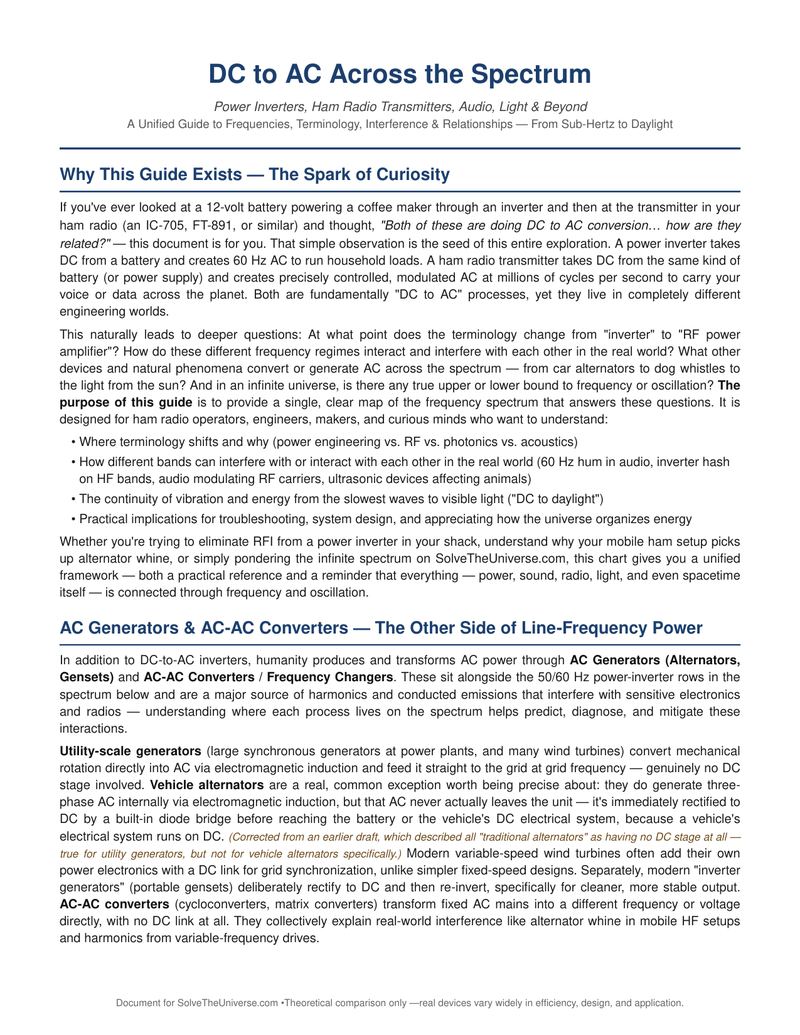
The spark for this was a simple, direct observation: a 12-volt battery running a coffee maker through a power inverter, and a 12-volt battery running a ham radio transmitter, are both doing DC-to-AC conversion — but they feel like they belong to completely different engineering worlds. One makes 60 Hz household power; the other makes a precisely modulated radio-frequency carrier. Same starting point, same basic operation, wildly different outcome. That question — how are these actually related? — is what this guide answers, by mapping the full continuum from the lowest oscillations physics recognizes up through visible light, and naming exactly where and why the terminology changes along the way.
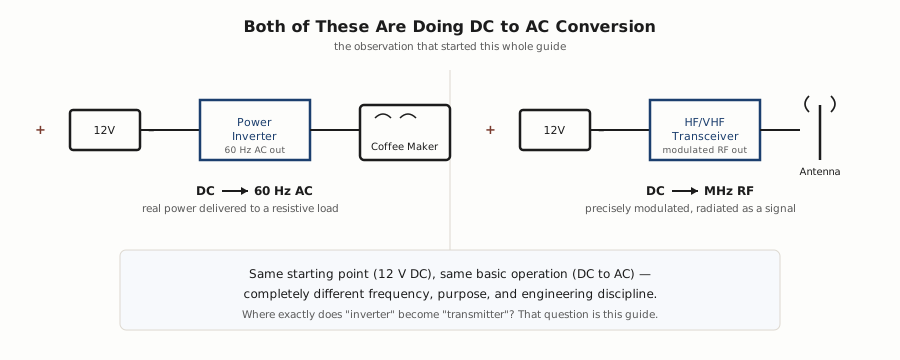
The spectrum, from infrasound to daylight
The guide’s core table sorts by frequency and covers, in order:
- Infrasound (< 20 Hz) — natural mechanical pressure waves: earthquakes, volcanoes, whale and elephant calls, sonic booms, large explosions.
- Schumann-resonance signal generators (0.01 Hz – ~10 Hz) — lab/consumer devices producing Earth’s own natural electromagnetic resonance (~7.83 Hz fundamental).
- Variable Frequency Drives (0–400 Hz, variable) — industrial motor speed control, AC output tailored down to near-DC.
- Human voice and brain waves (~80 Hz – 8 kHz) — genuinely two different physical phenomena sharing a frequency range: voice is an acoustic pressure wave from the vocal cords; brain waves (delta, theta, alpha, beta, gamma) are electrical oscillations in neural tissue. When you speak into a ham radio mic, the acoustic voice signal modulates a much higher RF carrier — the point where these two completely different physical processes actually interact.
- Audio power amplifiers and loudspeakers (20 Hz – 20 kHz) — true electrical AC in the audible band, converted to acoustic sound pressure waves at the speaker. (The classic wine-glass-shattering demonstration lives here too: driving a glass at its natural resonant frequency, usually 500–2000 Hz, with enough sustained amplitude.)
- Power inverters (50/60 Hz) — the familiar case: household and vehicle inverters, optimized for efficiency and clean sine output to real loads.
- Aerospace/aircraft inverters (400 Hz) — higher frequency deliberately chosen because it shrinks and lightens the magnetic components, which matters enormously when every gram counts.
- High-frequency inverters and resonant converters (~1 kHz – 100 kHz) — specialized power conversion and induction heating, where internal switching frequency (not output frequency) is the relevant number.
- Ultrasonics (20 kHz – several MHz) — mechanical pressure waves above human hearing: dog whistles (~23–54 kHz), ultrasonic pest deterrents, medical imaging, industrial cleaning.
- RF power amplifiers and ham radio transceivers (≥ 1 MHz, including HF/VHF) — true radio-frequency electromagnetic waves; this is where “inverter” language stops applying entirely and “transmitter”/“power amplifier” takes over.
- Microwave, mmWave, and 5G (1 GHz – 100+ GHz) — waveguides, phased arrays, beamforming.
- Arbitrary waveform generators (mHz – GHz) — precision instrumentation, not power delivery; these don’t convert the guide’s baseline power figure at all, they’re built for waveform accuracy instead.
- Infrared (~300 GHz – 400 THz) — felt as heat; still fundamentally oscillating electromagnetic fields, generated by LEDs, lasers, or blackbody radiation.
- Visible light (400–790 THz) — the guide’s own “DC to daylight” endpoint: LEDs converting DC directly to optical-frequency EM waves via electroluminescence.
AC generators and AC-AC converters — the other half of the picture
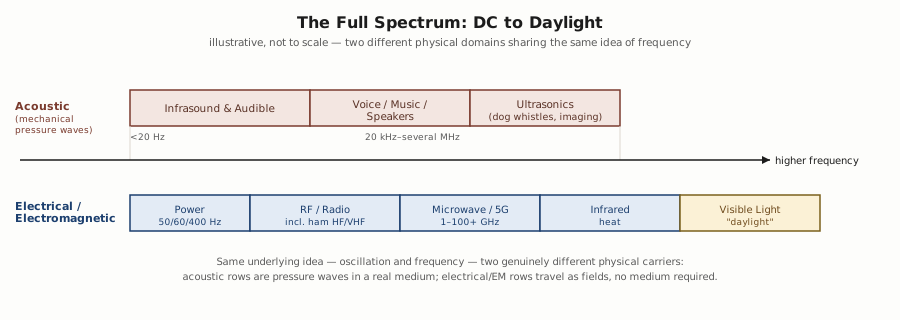
Alongside DC-to-AC inverters, the guide adds a section on how AC power gets made and transformed the other ways. Utility-scale generators (large synchronous generators at power plants, and many wind turbines) genuinely do convert mechanical rotation directly into AC via electromagnetic induction with no DC stage, feeding straight to the grid. Vehicle alternators are a real exception worth being precise about, corrected in this guide’s most recent revision: a car alternator does generate three-phase AC internally, but that AC never actually leaves the unit — it’s immediately rectified to DC by a built-in diode bridge before reaching the battery, because the vehicle’s own electrical system runs on DC. Modern “inverter generators” (portable gensets) separately rectify to DC and re-invert, deliberately, for cleaner output. AC-AC converters (cycloconverters, matrix converters) transform AC directly from one frequency or voltage to another with no DC link at all. Practically, this matters to a ham operator specifically because alternator whine in a mobile HF setup is a real, common interference signature traceable directly to the vehicle alternator’s own switching/rectification behavior.
Interference and relationships — why the full map matters
Mapping the whole spectrum in one place makes it possible to actually predict and diagnose real-world interference: 60 Hz power-line hum showing up in audio equipment, inverter hash/RFI from switch-mode supplies appearing as broadband noise across HF ham bands (a genuine, common problem for portable/POTA operation), alternator whine in mobile radio setups, a voice signal (80 Hz–8 kHz) modulating a much higher RF carrier, and ultrasonic pest deterrents affecting pets while staying silent to humans. Each of these is two different rows of the same table interacting — which is exactly why having the whole map matters more than any single row alone.
Negative frequencies and the infinite spectrum
The guide also covers two more abstract points worth naming directly. Negative frequencies are a real, standard mathematical feature of Fourier analysis (the complex-conjugate counterpart to positive frequencies) — not a physical wave running “backward,” but the correct framework behind real phenomena like noise-cancelling headphones, where two waves of identical frequency and opposite phase genuinely cancel via destructive interference. And the guide closes on an open question rather than a settled claim: if the universe is infinite, is there any true upper or lower bound to frequency at all? That’s a real, unresolved question in physics generally — worth noting here as philosophical framing, not a proven result, and not unique to Pressure-Based Theory specifically, though it resonates with Embracing Infinity’s broader treatment of the same theme on this site.
Catalog status: Proven Systems
The spectrum terminology, the physics of each frequency range, and the real interference mechanisms described here are all standard, well-established electrical engineering, radio, and acoustic physics — not PBT-specific claims. The one genuinely open item is the closing “does frequency have a true bound” question, which is unresolved physics generally, not a settled result either way.
Where this touches PBT and this site
Two direct connections worth naming. First, the acoustic rows of this spectrum (infrasound, human voice, ultrasonics) are the same literal-pressure-wave phenomena discussed in Why Pressure and covered in more mathematical depth in the new Sound section. Second, Why Pressure also raises the real, standard “hydraulic analogy” already used to teach electricity (voltage-as-pressure, current-as-flow) — the power-inverter and AC-generator rows of this guide are the literal electrical-engineering side of that same comparison, described here on its own terms rather than through PBT’s lens.