Atmospheric & Vacuum Pressure Measurement: A Practical Conversion Guide
July 2026
Download the full conversion table (PDF) — built and maintained as a real working reference, reconciling every common unit system used to describe atmospheric pressure and vacuum across different industries and equipment.
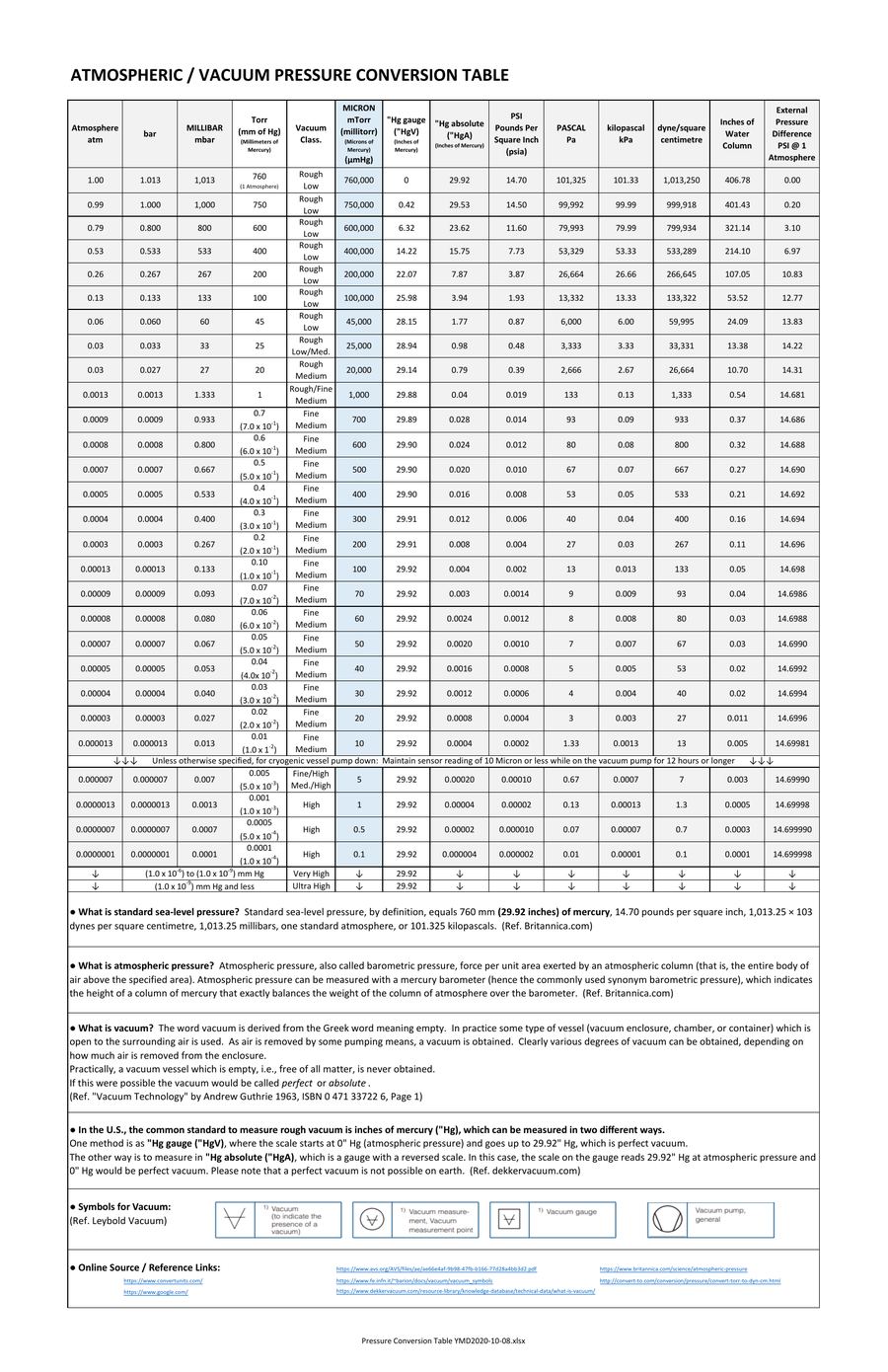
Why this table exists
Different fields settled on different units for the same physical quantity — pressure — and vacuum measurement is where that shows up most. A semiconductor fab talks in Torr and microns. An HVAC technician talks in inches of mercury or inches of water column. A pressure gauge on industrial equipment reads PSI. A scientific instrument reads pascals. None of these are wrong — they’re just different conventions for the same underlying physics, and reconciling between them by hand, under time pressure, is a real, recurring practical problem. This table exists to make that reconciliation instant instead of error-prone.
What “vacuum” actually means
“The word vacuum is derived from the Greek word meaning empty. In practice some type of vessel (vacuum enclosure, chamber, or container) which is open to the surrounding air is used. As air is removed by some pumping means, a vacuum is obtained. Clearly various degrees of vacuum can be obtained, depending on how much air is removed from the enclosure. Practically, a vacuum vessel which is empty, i.e., free of all matter, is never obtained. If this were possible the vacuum would be called perfect or absolute.”
— Andrew Guthrie, Vacuum Technology (1963)
A perfect vacuum is not achievable on Earth — every real vacuum is a matter of degree, and that degree is exactly what all these unit systems are trying to describe.
Gauge vs. absolute — the part that actually causes confusion
In the U.S., rough vacuum is commonly measured in inches of mercury (“Hg), and it’s measured two different, easily-confused ways:
- “Hg gauge (“HgV) — the scale starts at 0” Hg at atmospheric pressure and rises toward 29.92” Hg (perfect vacuum). This reads how much vacuum has been pulled.
- “Hg absolute (“HgA) — the scale is reversed: it reads 29.92” Hg at atmospheric pressure and falls toward 0” Hg (perfect vacuum). This reads how much pressure is actually left.
Same physical vacuum, same instrument family, two conventions that run in opposite directions — worth checking explicitly before trusting a number on an unfamiliar gauge, not assumed from habit.
The unit systems, at a glance
| Column | What it measures |
|---|---|
| Atmosphere (atm) | Multiples of standard sea-level pressure — the most intuitive reference point. |
| Bar / Millibar (mbar) | SI-adjacent metric pressure unit; millibar is the standard meteorological unit. |
| Torr (mm Hg) | Named for Torricelli; defined so 760 Torr = 1 atm exactly. The traditional vacuum-technology unit. |
| Micron / mTorr (µmHg) | 1 micron of mercury = 1 millitorr = 0.001 Torr — the standard fine-vacuum unit, used once Torr itself gets inconveniently small. |
| “Hg gauge / “Hg absolute | Inches of mercury, in the two conventions explained above. |
| PSI (psia) | Pounds per square inch, absolute — the standard U.S. engineering pressure unit. |
| Pascal (Pa) / kilopascal (kPa) | The SI pressure unit, named for Blaise Pascal; 1 Pa = 1 N/m². |
| Dyne/cm² | The CGS pressure unit — 1 Pa = 10 dyne/cm² exactly. |
| Inches of Water Column | Common in low-pressure HVAC and gas-system work, where inches of mercury would be an inconveniently large unit. |
| External Pressure Difference (PSI @ 1 atm) | The actual force differential a vacuum vessel’s walls have to withstand — the number that matters for structural design, not just measurement. |
Vacuum classification
The table also classifies each pressure level by real, standard vacuum-technology terminology — Rough, Medium, Fine, High, Very High, and Ultra High vacuum — spanning from atmospheric pressure down through $10^{-9}$ mm Hg and below. These bands aren’t arbitrary; they correspond to genuinely different pumping technologies and physical regimes (rough vacuum is dominated by viscous gas flow; high vacuum and beyond is dominated by molecular flow, where gas molecules collide with chamber walls far more often than with each other).
A real practical application: cryogenic vessel pump-down
The table’s own working guidance for cryogenic vessel pump-down: maintain a sensor reading of 10 microns or less while on the vacuum pump for 12 hours or longer, unless a specific process calls for something different. This is exactly the kind of number that only means something once you can place it on the full scale above — 10 microns is deep into fine/medium vacuum, well past the point where residual air acts as meaningful thermal insulation, which is the whole point of pulling vacuum on a cryogenic vessel in the first place.
Standard reference facts
Standard sea-level pressure, by definition, equals 760 mm (29.92 inches) of mercury, 14.70 pounds per square inch, $1{,}013.25\times10^3$ dynes per square centimetre, 1,013.25 millibars, one standard atmosphere, or 101.325 kilopascals. (Britannica)
Atmospheric pressure, also called barometric pressure, is the force per unit area exerted by an atmospheric column — the entire body of air above the specified area. It’s classically measured with a mercury barometer, which reads the height of a column of mercury that exactly balances the weight of the atmosphere above it. (Britannica)
Not the same “vacuum”
Physics also uses the word “vacuum” for something entirely different: the quantum vacuum, or “vacuum energy” — the idea that even empty space has real field structure at a fundamental level (the Casimir effect, discussed in Casimir Vacuum Energy and PBT, is real, measured evidence of this). The post above touches a real, published (if non-mainstream) idea in that space — H.E. Puthoff’s “Polarizable Vacuum” reformulation of General Relativity — but the specific geometric construction shown (golden-ratio polygon nesting, “positive/negative mass,” a “Dyadic universe”) goes well beyond anything independently verified here, and hasn’t been checked against the original published PV literature for accuracy. Worth being direct about: this has nothing to do with the atmospheric/engineering vacuum covered above. Same English word, two unrelated physical concepts — one is about how much air is in a chamber, the other is a proposed fundamental property of spacetime itself. Confusing the two is an easy, understandable mistake, not a small one.
References
- Guthrie, A. (1963). Vacuum Technology. Wiley. ISBN 0-471-33722-6, p.1.
- “Atmospheric pressure.” Encyclopaedia Britannica.
- American Vacuum Society (AVS) — reference PDF.
- Dekker Vacuum Technologies — “What is Vacuum?”.
- Vacuum symbols per Leybold Vacuum convention.
- Original table: Pressure Conversion Table, compiled 2020-10-08.