Sunday, April 19, 2026

Voltage and Current in Pressure-Based Theory (PBT): Electricity as Subatomic Pressure Flows in an Infinite Pressurized Medium

Voltage and Current in Pressure-Based Theory (PBT): Electricity as Subatomic Pressure Flows in an Infinite Pressurized Medium

By Matthew Foutch
SolveTheUniverse.com
April 2026

Pressure-Based Theory (PBT) models our observable universe as an infinite pressurized bubble filled with ultra-high-speed, infinitely small, infinitely numerous subatomic particles. These particles behave like an ultra-dense, incompressible “gas” or fluid in constant motion, exerting pressure everywhere. There is no true vacuum — only local pressure imbalances within this infinite medium. All fundamental forces, including gravity (as a push system), magnetism, light, radiation, and now electricity, arise mechanically from the flows, bounces, and pressure gradients of these particles.

This article extends PBT to electricity by treating voltage as a measure of relatively low subatomic pressure and current as the pipeline-like movement of high-pressure subatomic gas from regions of higher pressure to lower pressure. It directly builds on the site’s existing framework (see the core PBT page and the PBT Ref Guide) and provides an intuitive mechanical picture that unifies with the theory’s other components: PBT Pressure, PBT Infinity, PBT Subatomic Particles, PBT Magnetism, and PBT Electricity.

The Mechanical Picture: Voltage as Low Pressure, Current as Pipeline Flow

In PBT, a voltage source (battery, generator, power supply) does not “create charge” or “pump electrons” in the conventional sense. Instead, it maintains a local pressure deficit at one terminal relative to the surrounding medium or the opposite terminal.

  • Voltage (V) = the pressure difference (ΔP) between two points in the subatomic particle medium.
    It represents potential — the possibility of flow created by a low-pressure region. The greater the pressure imbalance, the higher the voltage.

  • Current (I) = the organized pipeline flow of subatomic particles (the “high-pressure gas”) through a conductor (wire).
    Particles stream from the high-pressure region to the low-pressure region exactly as gas or liquid flows through a pipe driven by a pressure gradient. The visible drift of electrons is simply the macroscopic signature of this underlying subatomic flux.

Because the medium is infinite in all dimensions, the high-pressure reservoir is inexhaustible and the low-pressure “sink” can be sustained indefinitely. The system never runs out of particles, and global equilibrium is never reached — only local redistributions occur. This infinite supply is what allows steady DC currents or sustained AC oscillations without the entire universe equalizing.

This framing is fully consistent with PBT’s core postulate: everything observable is driven by pressure imbalances and particle flows in the infinite pressurized bubble.

Why Inductors and Capacitors Behave Oppositely: The “Eli the Iceman” Mnemonic in PBT Terms

The classic mnemonic “ELI the Iceman” (voltage E leads current I in an L inductor; current I leads voltage E in a C capacitor) now has a direct mechanical explanation in the pressure-gas model:

  • Inductor (Voltage leads current — E leads I):
    Apply voltage first → you instantly create a pressure gradient (low-pressure region). But the subatomic particles must accelerate against the background motion and organized “inertia” of the infinite medium. The growing magnetic field is the visible effect of this organized particle flow pushing through the medium.
    Result: The pressure difference (voltage) appears immediately, but the actual pipeline flow (current) builds up more slowly. Exactly like opening a valve on a long pipe filled with heavy fluid — pressure is there, but flow lags.

  • Capacitor (Current leads voltage — I leads E):
    Particles rush into the plates immediately to equalize the pressure difference. Current spikes right away as the “gas” flows to one plate and is depleted from the other. Voltage (pressure difference across the plates) only builds afterward as accumulation/depletion occurs.
    Exactly like filling one side of a tank while emptying the other — flow happens first, pressure difference appears second.

In both cases the 90° phase shift is not mysterious; it is the natural consequence of what gets established first in the pressure medium: the gradient (voltage) or the organized flow (current).

Advantages of the Infinite Model

  • No depletion: Batteries and generators can maintain gradients indefinitely because the particle reservoir is infinite.
  • No singularities or runaway effects: Local imbalances are sustainable without violating conservation at the universal scale.
  • Unification: The same pressure-flow mechanics that explain gravity (push from particle imbalances) and magnetism (organized toroidal flows) now explain electricity without extra postulates.

Testable Calculation Strategies: How to Prove (or Falsify) the PBT Electricity Model

PBT is designed to be falsifiable. Here are concrete, calculable strategies to test the voltage-as-low-pressure / current-as-pipeline-flow picture. These can be performed with standard lab equipment, fluid analogs, or simulation tools and compared against conventional Maxwell/Ohm predictions.

  1. Fluid-Dynamic Analogy Derivations (Analytical)
    Treat the wire as a pipe and the subatomic medium as an incompressible fluid. Use the pressure-flow equivalent of Poiseuille’s law:
    I=πr4ΔP8ηL I = \frac{\pi r^4 \Delta P}{8 \eta L}
    where ΔP is the pressure difference (voltage scaled by a PBT conversion factor), r = effective “pipe” radius, η = medium viscosity (derived from particle density/speed in PBT Ref Guide), L = length.
    Test: Derive DC resistance R from known wire geometry and measured particle properties (or fitted constants). Compare predicted I vs. measured current. Deviation at extreme currents/temperatures would support or refute the particle-flow model.

  2. Inductance from Particle Inertia (L Calculation)
    Inductance L arises from the time required for particle flow to overcome medium inertia. Approximate:
    Lμ0N2Al×kPBT L \approx \frac{\mu_0 N^2 A}{l} \times k_{\text{PBT}}
    where k_PBT is a factor incorporating infinite-medium background pressure and particle speed (calculable from PBT infinity assumptions).
    Testable: Build simple solenoids, measure inductive reactance X_L = 2πfL at various frequencies, and back-solve for k_PBT. Predict how L changes in different background media (e.g., vacuum chamber vs. pressurized gas cell) and compare.

  3. Capacitance from Pressure Accumulation (C Calculation)
    Capacitance C is the rate at which particle accumulation changes the pressure difference across plates:
    C=QΔP C = \frac{Q}{\Delta P}
    with Q proportional to particle flux integrated over time.
    Testable: Charge a capacitor at constant current and plot voltage rise. Fit the curve to PBT accumulation equations. Predict frequency-dependent behavior in AC circuits and verify phase lead.

  4. AC Phase-Shift Verification with Eli the Iceman
    In an RL or RC circuit, measure exact 90° phase relationships using an oscilloscope.
    PBT prediction: The phase lead/lag must match the pressure-build vs. flow-build times derived from particle density and speed constants in the PBT model. Any deviation outside measurement error falsifies the analogy.
    Extend to RLC resonance: calculate resonant frequency from pressure-flow time constants instead of standard LC formulas and test empirically.

  5. Simulation Strategies (Numerical)
    Use Python/SymPy or COMSOL Multiphysics to model a 2D/3D “particle gas” under pressure gradients with infinite-boundary conditions (constant far-field pressure). Simulate wire, inductor, and capacitor geometries.
    Output: predicted V-I curves, phase plots, and power dissipation. Compare directly with bench measurements. Code example skeleton available on request for site visitors.

  6. Extreme-Condition Tests (Falsifiability)

    • High-vacuum or cryogenic environments: If PBT is correct, reduced background particle density should measurably alter inductance/capacitance values beyond standard predictions.
    • High-current superconductors: Predict whether “perfect” flow occurs only when particle drag drops below a PBT threshold.
    • Compare with the August 2025 PBT paper’s gravitational-drag predictions (< 10⁻¹⁹ m/s²); electrical analogs should show correspondingly negligible “particle drag” in steady state.

These calculations are fully mechanical and rely only on pressure, particle properties, and infinity — no probabilistic wave functions or action-at-a-distance fields required. Results that match standard electrical laws while providing deeper mechanical insight would support PBT; measurable discrepancies (especially in phase or extreme regimes) would falsify it.

Next Steps and Invitation

This pressure-flow model for electricity slots cleanly into the existing PBT framework and brings us one step closer to a complete mechanical unification of all forces. The site’s PBT Ref Guide already supplies the necessary constants and infinity-handling methods; the strategies above give experimenters and theorists concrete ways to test the ideas today.

Comments, derivations, simulation code, or lab data are welcome below or via the contact form. If you have extensions (e.g., how batteries maintain the pressure gradient, or PBT explanations of semiconductors), submit them — collaboration is the point of SolveTheUniverse.com.

References

Wednesday, August 6, 2025

Strange Ideas - Alternative Aether Particle Options

 Ideas to investigate if conventional PBT simulations fail ...

  1. Self-Permeable Particles
  2. Toggle Particles - Particles that turn off and on - behave one way towards other substances and a different way towards others and themselves - i.e., shape shifters
  3. Variable Permeability
  4. Infinitely variable permeability
  5. particles that dissipate upon impact - turn into subatomic vapor upon impact - no return bounce - one-way trip infinite from outside in
  6. particles that fizzle out upon touching others and yet balance out because they are always striking from opposite sides

There are likely infinite ideas to explore, including and not limited to infinite variability of particles.

But these options may not be (are likely not) needed if conventional PBT models work with conventional scalable calculations i.e. a sphere is to a bubble as a bubble is to a planet as a solar system is to an atom - presence of sphere indicates pressure - orbits indicate pressure - flows indicitat "something" some kind of particles flowing or being pushed along in the flow of others i.e. sediment in a stream of water ... where you can't see the actual water molecules but you can see the water and you can see the sediment.

Tuesday, August 5, 2025

PBT Article 03: Push-Pressure Theory: A Mechanical Approach to Unifying Fundamental Forces

Push-Pressure Theory or Pressure-Based Theory (PBT) offers a mechanical framework for understanding the universe, treating forces as push effects from particle fluxes in an infinite pressure vessel. This series of papers develops the theory from basic push mechanics to relativistic and electromagnetic extensions, resolving issues like dark matter, singularities, and force unification. The work integrates hierarchical scaling to bridge scales from cosmic to quantum, providing calculations and simulations that align with observations.

Infinite Push-Pressure Theory

The foundational paper introduces the universe as an infinite pressure vessel filled with infinitely small particles moving at infinite speeds, creating push forces through shadowing. Bodies are modeled as low-density bubbles balanced against external pressures, with forces emerging from flux imbalances. Hierarchical levels allow energy density to scale with size, unifying gravity with nuclear and atomic interactions.

Key calculations include the gravitational constant G derived as ε σ² / (4π M_n²), matching the observed value of 6.6743 × 10^{-11} m³ kg⁻¹ s⁻². Nuclear bindings are estimated at ~8 MeV/nucleon, and tidal heights at ~0.7 m for the Moon. Simulations show flat galactic rotation curves without dark matter, and black hole collapse stabilizes without singularities.

Classical objections, such as heating and drag, are addressed by infinite-speed jumps and elastic bounces. The theory is falsifiable through astronomical data, like galaxy dynamics.

Depiction of ultramundane corpuscles explaining gravity through particle impacts.

Figure 1: Le Sage's Illustration of particle shadowing in push gravity theory.

Hybrid Push-Aether Theory for Relativistic Unification

The second paper extends PBT by incorporating a dynamical Einstein-aether field to achieve Lorentz invariance, eliminating preferred frames. The aether u^μ evolves with the metric, representing average flux, while pushes distort it for emergent forces. Light propagation is treated as waves in the medium, with bending from refractive index gradients.

The action includes aether couplings with c1–c4 < 10^{-15} to match GR closely. Drag is negligible at ~10^{-19} m/s², below detection thresholds. Light deflection is calculated as θ ≈ 4 G M / (c² b) ≈ 1.75" for the Sun, aligning with observations. Simulations confirm flat rotation curves at ~220 km/s for the Milky Way and singularity avoidance in collapse.

This model unifies forces mechanically in a relativistic context, with predictions for subtle frame effects in gravitational waves, testable by LIGO or LHC.

Illustration of the Michelson-Morley experiment setup, related to aether theories.

Figure 2: Michelson-Morley Experiment Diagram, testing for luminiferous aether.

Hybrid Push-Aether Theory for Electromagnetic Forces

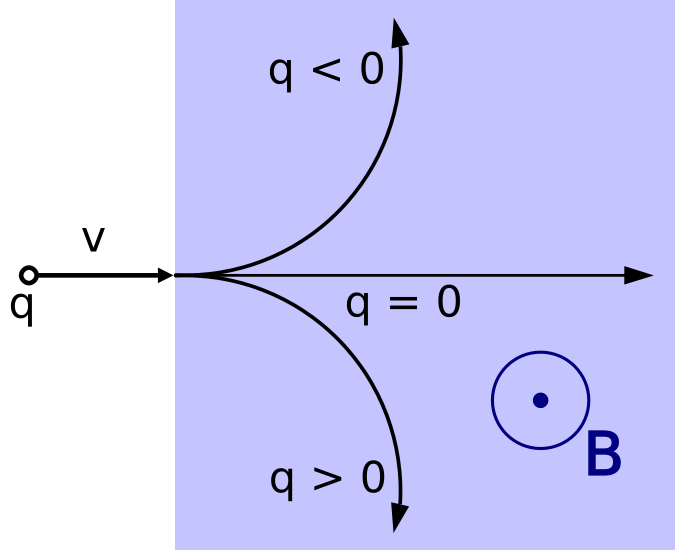
The third paper incorporates magnetism and electromagnetism, describing magnetic fields as subatomic particle flows from charge-induced aether flux gradients. The Lorentz force F = q (v × B) is derived mechanically from push interactions. Simulations model dipoles with curvature κ ≈ 10^2 m^{-1}, unifying EM with gravity via hierarchies.

The theory predicts anisotropies in superconductors and resolves EM without photons, falsifiable in high magnetic fields. It extends the mechanical unification to all forces, addressing quantum effects through finer scales.

Diagram illustrating the Lorentz force on a charged particle.

Figure 3: Lorentz Force Diagram showing force vectors.

Significance of the Work

PBT provides a mechanical alternative to standard models, eliminating the need for dark matter by explaining rotation curves by hierarchical pushes. It resolves singularities by stabilizing collapse and unifies forces without quantum gravity conflicts, offering a testable framework for anomalies in cosmology and particle physics. The theory's falsifiability via surveys like Euclid or experiments at LHC positions it as a potential paradigm shift, encouraging empirical validation to advance our understanding of the universe.

This article was edited with assistance from Grok, an AI built by xAI, to refine structure, clarity, and flow while preserving the original voice and ideas.

Image Credits

  • Figure 1: From Wikimedia Commons, public domain.
  • Figure 2: From Wikimedia Commons, public domain.
  • Figure 3: From Wikimedia Commons, public domain.

References

  1. Foutch, M. (2025). "PBT Papers." Solve the Universe. https://www.solvetheuniverse.com/p/papers.html

  2. Foutch, M., & Grok. (2025). "Infinite Push-Pressure Theory: A Hierarchical Mechanical Framework for Unifying Forces and Resolving Gravitational Anomalies." Solve the Universe. https://www.solvetheuniverse.com/p/pbt-paper-01.html

  3. Foutch, M., & Grok. (2025). "Hybrid Push-Aether Theory: Mechanical Unification of Forces in a Relativistic Framework." Solve the Universe. https://www.solvetheuniverse.com/p/pbt-paper-2.html

  4. Foutch, M., & Grok. (2025). "Hybrid Push-Aether Theory: Mechanical Unification of Magnetism and Electromagnetic Forces." Solve the Universe. https://www.solvetheuniverse.com/p/pbt-paper-3.html

Monday, August 4, 2025

Article 0: Why Solve The Universe?

Abstract

This site serves as a platform to challenge the misconception that everything in science is solved, highlighting persistent unknowns in physics and the necessity for theoretical unification. By exploring key unsolved problems and the importance of a unified theory, the site fosters collaborative inquiry to advance our comprehension of the cosmos.

Some believe that everything in science is solved—for example, that gravity is fully understood, the brain's functions are known, and physics has no major gaps left. When in fact there are many gaps (such as quantum gravity, dark matter and dark energy, matter-antimatter asymmetry, the arrow of time, and the black hole information paradox). While remarkable progress has been made, fundamental questions remain unanswered, revealing the incompleteness of our knowledge. For example, gravity, as described by general relativity, conflicts with quantum mechanics, and the brain's consciousness defies full explanation. These misconceptions underscore the need for resources like www.solvetheuniverse.com, which promotes awareness of unknowns and the pursuit of unification to resolve them. The site is important for educating the public and scientists, useful for sparking discussions and research, and necessary to drive innovation toward a complete theory of the universe.

Misconceptions in Science

Many assume that core phenomena like gravity and brain function are fully known. Gravity is often seen as "solved" by Einstein's general relativity, but it fails at quantum scales, leading to singularities in black holes and the Big Bang where physics breaks down. Similarly, brain function is mapped to neural activity, yet consciousness—the subjective experience—remains unexplained, with no consensus on how physical processes produce awareness. These examples illustrate that science is far from complete, making platforms like www.solvetheuniverse.com essential to dispel illusions and encourage deeper investigation.

Key Unknowns in Physics

Physics harbors numerous unsolved problems, revealing gaps in our understanding. Here are some key examples:

  1. Quantum gravity: How to reconcile general relativity with quantum mechanics? Current theories diverge at extreme conditions, like inside black holes.

  2. Dark matter and dark energy: These make up 95% of the universe's energy density, but their nature is unknown, affecting cosmic expansion and structure formation.

  3. Matter-antimatter asymmetry: Why is the universe dominated by matter when equal amounts should have been produced in the Big Bang?

  4. The arrow of time: Why does time flow in one direction, linked to increasing entropy, despite time-symmetric laws?

  5. Black hole information paradox: Does information falling into a black hole disappear, violating quantum principles?

These unknowns highlight the limitations of current models and the need for new frameworks.

Diagram of the Standard Model of particle physics, showing elementary particles and forces.

Caption: The Standard Model, while successful, does not include gravity and leaves many questions unanswered.

The Path to Unification

Unification of theories is crucial to resolve these unknowns, providing a consistent description of all forces—gravity, electromagnetism, strong, and weak nuclear. It would explain high-energy events like the Big Bang, enable technologies such as quantum computing or fusion energy, and reveal the universe's fundamental nature. Efforts like string theory or loop quantum gravity aim for this, but challenges persist. Solvetheuniverse.com intends to facilitate collaboration to accelerate progress through shared ideas and diverse perspectives.

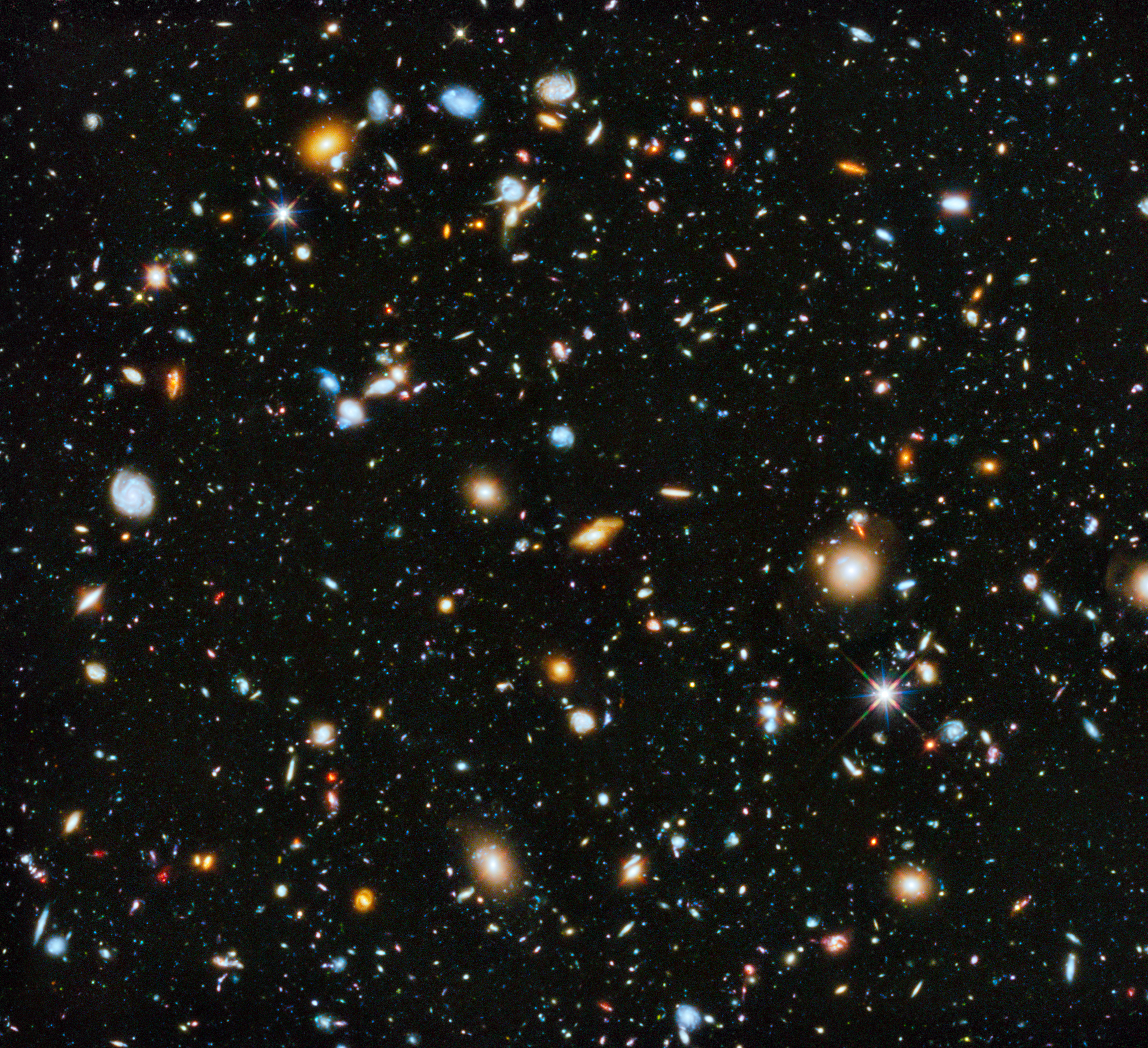
The Hubble Ultra Deep Field image, capturing thousands of galaxies.

Caption: Cosmic observations reveal unknowns like dark energy, emphasizing the need for unification.

Challenges and Implications

Achieving unification requires overcoming theoretical inconsistencies and experimental limitations, but the implications are profound: a complete theory could transform energy, materials, and our worldview. Solvetheuniverse.com plays a role in this by promoting and facilitating collaboration, dialogue, and exploration, while leveraging newly available resources (such as AI and mathematical models) to overcome legacy challenges. With the straightforward goal being to really, actually Solve The Universe!

This article was edited with assistance from Grok, an AI built by xAI, to refine structure, clarity, and flow while preserving the original voice and ideas.

Image Credits

  • Standard Model Diagram: From Wikimedia Commons, public domain.
  • Hubble Ultra Deep Field: Courtesy of NASA/ESA, public domain.

References

  1. Wikipedia. "List of unsolved problems in physics." https://en.wikipedia.org/wiki/List_of_unsolved_problems_in_physics

  2. Quora. "What are three key unsolved questions in physics at this time?" https://www.quora.com/What-are-three-key-unsolved-questions-in-physics-at-this-time-Why-do-you-think-they-re-so-important-to-solve-and-why-havent-they-been-solved-already

  3. Big Think. "25-year update on the 'Millennium problems' in physics." https://bigthink.com/starts-with-a-bang/update-millennium-problems-physics/

  4. Wikipedia. "Theory of everything." https://en.wikipedia.org/wiki/Theory_of_everything

  5. NBC News. "The 7 Biggest Unanswered Questions in Physics." https://www.nbcnews.com/mach/science/7-biggest-unanswered-questions-physics-ncna789666

  6. Live Science. "The 18 biggest unsolved mysteries in physics." https://www.livescience.com/34052-unsolved-mysteries-physics.html

  7. ThoughtCo. "These Are the 5 Great Unsolved Problems in Physics." https://www.thoughtco.com/five-great-problems-in-theoretical-physics-2699065

PBT Article 02: Embracing Infinity: Key to Understanding the Universe

Abstract

This article delves into the concept of infinity, exploring its mathematical foundations through proven facts and its manifestations in the physical world. By addressing cognitive challenges and implications, it highlights how embracing infinity advances our understanding of the universe's mysteries, from quantum scales to cosmic expanses.

Infinity exists on the mathematical number line and serves as a crucial tool for modeling phenomena in mathematics and the physical world. The presence of infinity in mathematics is a clue that infinity is a reality in nature. To ground this exploration, consider three provable mathematical facts about infinity:

  1. There are infinitely many prime numbers. Euclid's proof by contradiction assumes a finite list of primes, multiplies them and adds 1 to form a new number that must have a prime factor not in the list, leading to an endless sequence of primes. This demonstrates how infinity emerges naturally in number theory, showing that primes extend without bound, much like the universe's expansive structures.

  2. The cardinality of the continuum (real numbers) is greater than that of the natural numbers. Cantor's diagonal argument demonstrates that no bijection exists between naturals and reals, as any assumed listing allows construction of a real number differing from each in the list. This reveals hierarchies of infinities, where some infinite sets are "larger" than others, challenging intuitive notions of size and quantity.

  3. An infinite set can have the same cardinality as one of its proper subsets. Dedekind's definition shows, for example, that the real line maps one-to-one with its left half, illustrating that infinite sets behave differently from finite ones. This property, often exemplified by Hilbert's infinite hotel paradox, highlights the counterintuitive aspects of infinity, where removal of elements does not diminish the set's "size."

Now apply that understanding to what we know in the physical, as both tiny and mega. Within the nonconfines of infinity these concepts both exist and exist only as a portion of the whole. To illustrate infinity in physics, consider three examples grounded in established models:

  1. The potential infinite spatial extent of the universe. In cosmology, observations indicate a flat geometry consistent with an infinite universe, where space extends without bound in all directions. This boundless large-scale structure implies endless repetition of patterns, such as galaxies, over infinite distances.

  2. Infinite divisibility of space on small scales. In classical physics and continuum models, space can be divided indefinitely without a fundamental limit, allowing for infinite subdivisions. Though quantum effects introduce a Planck length, the mathematical framework treats space as infinitely divisible, mirroring the tiny, mega interplay within infinity.

  3. The infinite extent of time in certain cosmological models. Eternal inflation or cyclic universe theories posit time without beginning or end, where universes emerge perpetually. The existence of time implies something must precede and follow any interval, suggesting an eternal continuum that defies finite boundaries.

Infinity can be both the easiest thing to understand and the most difficult concept to comprehend. Understand that infinity is a real, tangible thing, and we are living in the midst of infinity. Embracing this boundless nature is essential to unraveling cosmic mysteries. Infinity on all scales is key to understanding the mysteries of the universe. This article integrates these insights to explore infinity's profound implications, advancing our collective understanding through collaboration.

Infinity in Mathematics

Infinity extends the number line indefinitely, supporting concepts like limits, infinite series, and calculus. It enables precise modeling of continuous phenomena and underpins theorems essential to mathematical progress. For instance, the proofs above illustrate how infinity resolves paradoxes in counting and continuity, allowing for rigorous descriptions of irrational numbers and unending processes. Without embracing infinity, foundational tools like integration and differentiation would falter, limiting our ability to quantify change and accumulation.

Historical sketch of the infinity symbol as introduced by John Wallis.

Caption: Translation of the Latin text: "I suppose at the outset (following Bonaventura Cavalieri's Geometry of Indivisibles) that any plane is as it were made up of infinitely many parallel lines: Or rather (which I would prefer) of infinitely many parallelograms of equal height; of which indeed the height of each single one is of the total height 1/∞, or a part infinitely small; (for let ∞ be the symbol of an infinite number;) and thus the altitude of all together equal to the altitude of the figure."

Infinity in the Physical World

Infinity permeates physics, from the boundless cosmos to infinitesimal quantum scales. It challenges finite approximations in theories, revealing exact structures in nature, such as self-similar patterns that repeat without end. Applying the tangible reality of infinity to the physical realm means recognizing that microscopic quantum fluctuations and macroscopic galactic clusters are both manifestations of the same boundless continuum—tiny and mega coexisting as mere portions within the nonconfines of an infinite whole. This perspective resolves apparent contradictions, like the universe's potential endless expansion, where every observable part is but a fraction of an ungraspable totality.

High-resolution sketch-like representation of the Mandelbrot fractal boundary.

Caption: The Mandelbrot set, a fractal that exhibits infinite complexity upon zooming, illustrating self-similarity at all scales.

These patterns, evident in fractals, mirror natural formations and cosmic distributions, emphasizing infinity's tangible presence.

Image revealing infinite cosmic depths from the Hubble Ultra Deep Field.

Caption: The Hubble Ultra Deep Field image, capturing thousands of galaxies in a small patch of sky, hinting at the infinite vastness of the universe.

Challenges and Implications

It is difficult for the human mind to stop imagining that infinity isn't infinite. Humans tend to compartmentalize things. Humans tend to like to gather stuff into boxes. But infinity, by its nature, cannot be contained. Comprehending infinity requires overcoming mental barriers that impose limits on the limitless. By embracing its reality across scales—from the infinitesimal to the cosmic—we unlock deeper insights into the universe's mysteries, fostering collaborative advancements in science and philosophy. This shift allows us to view quantum approximations not as ultimate truths but as finite windows into an exactly infinite reality, encouraging innovative approaches to longstanding puzzles like the nature of space-time or the origins of the universe.

This article was edited with assistance from Grok, an AI built by xAI, to refine structure, clarity, and flow while preserving the original voice and ideas.

Image Credits

  • Infinity Symbol: From Wikimedia Commons, public domain.
  • Mandelbrot Set: From Wikimedia Commons, public domain.
  • Hubble Ultra Deep Field: Courtesy of NASA/ESA, public domain.

References

  1. Oppy, Graham. (2021). "Infinity." Stanford Encyclopedia of Philosophy. This entry provides a comprehensive overview of infinity in philosophy, mathematics, and cosmology. https://plato.stanford.edu/entries/infinity/

  2. Rucker, Rudy. (1982). Infinity and the Mind: The Science and Philosophy of the Infinite. Birkhäuser. A popular introduction to various notions of infinity in mathematics and beyond. https://math.stackexchange.com/questions/816497/are-there-any-good-books-on-infinity

  3. Stewart, Ian. (2017). Infinity: A Very Short Introduction. Oxford University Press. Explores infinity in mathematics and its physical implications, including whether space is infinite. https://academic.oup.com/book/972/chapter/137835875

  4. MacTutor History of Mathematics. "Infinity." University of St Andrews. Historical perspective on infinity, blending mathematical, philosophical, and religious aspects. https://mathshistory.st-andrews.ac.uk/HistTopics/Infinity/

Thursday, July 31, 2025

Article 02: Recognizing Similarities in Nature 01

Article 02: Recognizing Similarities in the Universe

The universe reveals itself through patterns that echo across vastly different scales, from the microscopic to the cosmic. Recognizing these similarities offers insights into fundamental principles governing natural systems. This article is one of many that help us explore the parallels between hurricanes and galaxies, bubbles and planets, atoms and solar systems, and many more, supported by visual examples to illustrate these connections.

Similar forces likely form these natural phenomena. Knowing how one works on a measurable scale can help us understand what is expected to happen on a scale outside our existing measurement capabilities. In other words, knowing how one is formed helps us to understand how the other may be formed.

Hurricanes and Galaxies

Hurricanes and galaxies exhibit striking similarities in their spiral structures. Both feature a central core— a hurricane’s eye or galaxy’s nucleus—surrounded by rotating arms driven by dynamic forces. Hurricanes form from atmospheric pressure gradients and Coriolis effects, while galaxies arise from gravitational collapse and angular momentum. Their spiral patterns, observed in satellite imagery and astronomical data, suggest a universal tendency for rotating systems to organize into similar shapes.

Image: Satellite view of Hurricane Ike

Satellite view of Hurricane Ike
Caption: The spiral structure of Hurricane Ike mirrors galactic arms.

Image: The Pinwheel Galaxy, NGC 5457

Pinwheel Galaxy NGC 5457
Caption: The Pinwheel Galaxy, NGC 5457, showcases spiral arms akin to hurricane patterns.

Bubbles and Planets

Bubbles and planets share a spherical geometry shaped by surface tension and gravitational forces, respectively. A bubble forms as air pressure balances with the liquid’s surface tension, creating a near-perfect sphere. Planets coalesce from dust and gas under gravity, also tending toward sphericity as mass increases. This similarity highlights how minimizing energy states—tension for bubbles, gravitational potential for planets—drives similar outcomes across scales.

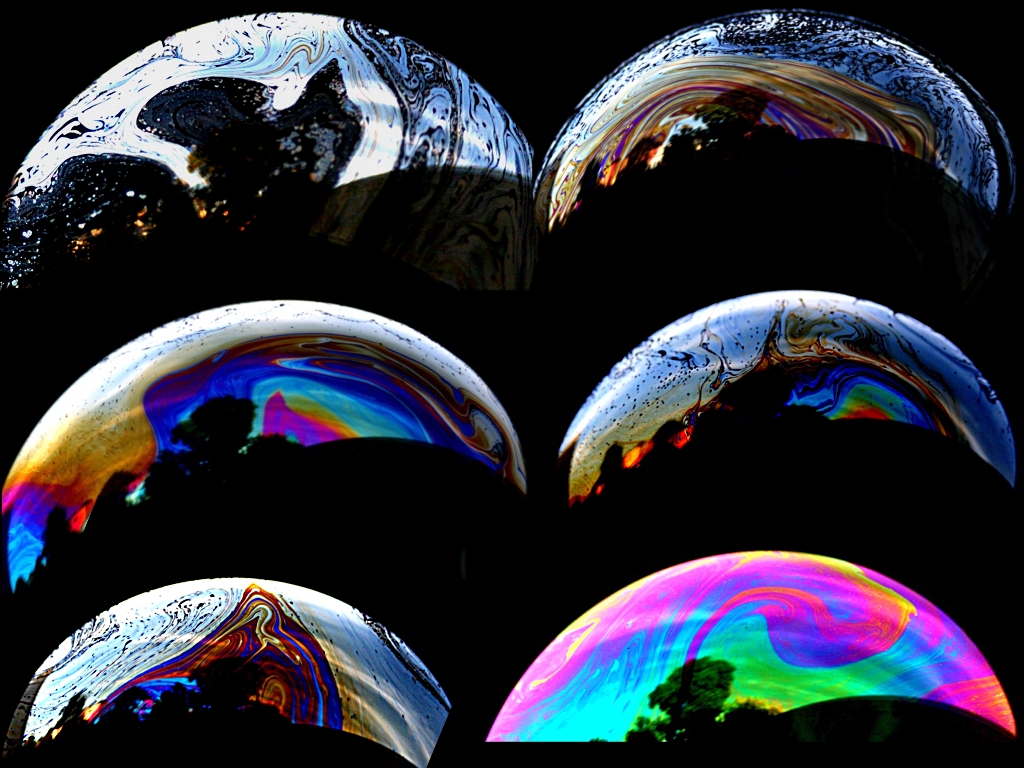
  • Image: Soap bubble in sunlight.
    Caption: A soap bubble’s spherical shape reflects planetary formation principles.
    Soap bubble in sunlight
    Link
  • Image: Earth from space.
    Caption: Earth’s near-spherical form parallels bubble geometry under gravity.
    Earth from space
    Link

Atoms and Solar Systems

Atoms and solar systems display analogous structures with a central mass orbited by smaller bodies. In an atom, electrons orbit a nucleus of protons and neutrons, bound by electromagnetic forces. In a solar system, planets orbit a star, held by gravity. The Bohr model of the atom even draws on solar system imagery, though quantum mechanics refines this picture. This resemblance suggests a recursive pattern where central forces organize orbiting entities.

  • Image: Diagram of the Bohr model of an atom.
    Caption: The Bohr model illustrates electron orbits, echoing planetary motion.
    Diagram of the Bohr model of an atom
    Link
  • Image: Solar system diagram.
    Caption: Planetary orbits around the Sun mirror atomic electron paths.
    Solar system diagram
    Link

Conclusion

These comparisons—hurricanes and galaxies, bubbles and planets, atoms and solar systems—reveal a universe governed by recurring principles. Spiral dynamics, spherical equilibrium, and orbital mechanics appear across scales, from weather patterns to cosmic structures. Such insights encourage further exploration, potentially inspiring research into unified models of natural phenomena.

More to come ...

Written by Matthew Foutch and Grok, built by xAI.

Wednesday, July 30, 2025

PBT Article 01: Realizing the Absurdity of Pull Gravity

One day, I was cutting the grass and pondering the nature of the universe.

I watched the grass clippings as they were ejected from the mower, each falling perfectly to the earth.

Grass Clippings From Mower Image created with Google AI

I wondered how gravity was accomplishing its job on the clippings. By what mechanism was each pull accomplished so precisely?

I thought of all the ways in nature that I could think of in which things are pulled. To pull, something must be latched onto or captured by something. In all those natural cases, an arm, a hand, a rope, a string, a cable, a net, a hook, or something—anything is connected to an anchor point, latches on, and pulls.

That's when I wondered ...

How is it that something is always latching on, hooking up, and towing each and every one of these grass clippings towards the center of the earth? And, if so, what is used to latch on? Where's the anchor point? What cables are being used? How is each and every one always connected? Why do none ever escape? Where are these pulling devices hidden when they aren't pulling?

Thinking about it this way, the concept of gravity pulling in nature doesn't work. In fact, it's absurd.

This realization led me to look at things from the entirely opposite direction—truly 180 degrees.

I thought, if these clippings aren't being pulled, then what's happening to them?

What if they are being pushed?

That's when I realized that nature pushes things into place—almost everywhere you look.

Examples: Air pressure forms bubbles, pushing everything to the center of a sphere. Water pressure forms bubbles, pushing everything to the center of a sphere.

Therefore, why isn't gravity the same? Why, like in air and water, aren't these grass clippings being pushed by outward pressure towards the center of the sphere of the Earth?

This is the line of thinking that began the journey for me.

And was thrilled to find that others have travelled this path ...

Upon research into push gravity, the first I found was Walter Wright, author of the 1979 book Gravity Is a Push, where he proposed gravity as a pushing force based on years of research.

Later, I found that Einstein had considered mechanical explanations for gravity, though his theory of general relativity ultimately described it as the curvature of spacetime.

And most recently, I've learned of Le Sage, whose 18th-century theory explained gravity through streams of tiny particles pushing matter together.

These concepts are not new, but their application to unification may be or apparently is.

I'm grateful to join these others and more on this wonderful journey.

References

  1. Wright, Walter C. (1979). Gravity Is a Push. Carlton Press, New York. 176 pages. This book presents an alternative theory where gravity is explained as a pushing force rather than a pull, drawing from the author's decade-long research and experiments. Available for free viewing and download at the Internet Archive: https://archive.org/details/GravityIsAPushbyWalterCWright.
  2. Einstein, Albert. (1915). General Theory of Relativity. Einstein's groundbreaking work revolutionized our understanding of gravity, describing it not as a mechanical force but as the curvature of spacetime caused by mass and energy. While he explored mechanical explanations earlier in his career, his final theory emphasized geometric properties over traditional attraction. For more details, see: Wikipedia - General Relativity.
  3. Le Sage, Georges-Louis. (1748). Le Sage's Theory of Gravitation. This 18th-century mechanical theory posits that gravity results from streams of tiny, unseen particles (ultra-mundane corpuscles) bombarding matter from all directions, with bodies creating "shadows" that produce a net pushing force toward each other. It was one of the most developed push-gravity models of its time. Further information available at: Wikipedia - Le Sage's Theory of Gravitation.

Credits

This article was edited with assistance from Grok, an AI built by xAI, to refine structure, clarity, and flow while preserving the original voice and ideas.  Images created with Google AI.